
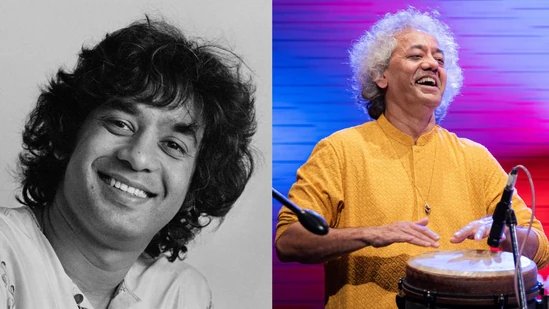
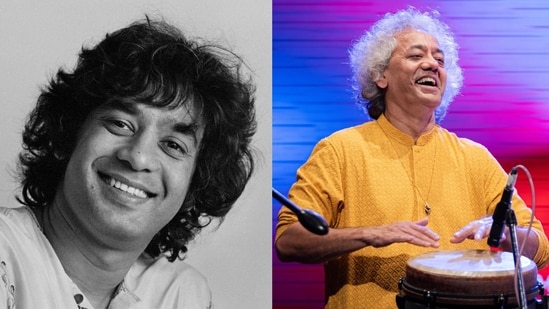
It’s the late hour when Taufiq Qureshi is back home, but when a conversation about his late brother, tabla maestro Ustad Zakir Hussain comes up, there’s a freshness to his voice. He recalls the road to their childhood, legendary father Ustad Alla Rakha and their music, as a path paved with love and learning. To the world, Zakir Hussain may whip up the image of fingers flying over the tabla, almost as if in trance, playing to a packed audience and thundering applause. For Qureshi, the earliest memory of his famous brother is a singular, simple one: “I remember seeing him just sit on the drum kit and playing just for fun, and also playing the congas,” he says. And in a special evening on March 7 at the Grand Theatre, Nita Mukesh Ambani Cultural Centre (NMACC), friends, luminaries, and music lovers will also celebrate the depth, range, and impact of Ustad Zakir Hussain on his 75th birth anniversary.
The indisputable ambassador of Indian classical music took the tabla across the world, earning him multiple awards including four Grammys. He brought India into the world stage at a time when Indian classical musicians were still seeking a global platform. Qureshi goes down memory lane to recount that journey: “I think when he went to America in the late 1969, with first Pandit Ravi Shankar and then with Ustad Aashish Khan Saab, Zakir Bhai realised it’s a different world there. He heard jazz music and he started liking it. He also realised how African, Middle Eastern, Cuban, Indian, tribal music and more all fell under one umbrella – world music. When he came back, he would speak about his experimentations that he was doing with the Tiga Rhythm Band and with Mickey Hart and co-founding the fusion band Shakti with John McLaughlin in 1973. He would tell us how he thought of John McLaughlin as a fabulous musician. When McLaughlin came to India, he came home and I remember having lunch with him and then going with Zakir Bhai to drop him at the President Hotel where he was staying,” he informs.
Life’s greatest lessons are often imparted sans words and for Qureshi and his brother too, that made for the magic of their jugalbandi. He reveals: “When Zakir Bhai would go on stage with our father, there was never a conversation. It was like, ‘Okay, I’m going to throw something at you; you’d better be able to catch it and play it. Whenever I would be on stage with him, too, there was never a conversation. It was all in the eyes. We spoke through our eyes and through our expressions on the face. I would read his eyes and I would know what he wants me to do. And every time I was on stage with him, for me, it was a masterclass. I wasn’t performing with him, but I was learning and taking his blessings.”
Not many know that Hussain had his sporty side and he loved playing cricket with his siblings, even teaching them how to skate.” While he composed soundtracks, his formidable acting talent was on display in the Merchant-Ivory production ‘Heat and Dust’ and Qureshi shares an earlier anecdote of when K Asif (film director) had once approached his father to cast him as the young Salim in Mughal-e-Azam. “My sisters and I would always say, ‘You are a fabulous actor, Zakir Bhai. Why don’t you try your hand at more films? But after Saaz, he said, ‘I’m satiated. After acting with the great Shabana Azmi, I have nothing more to say. This is it. This is my world; the tabla and the music’. He definitely broke boundaries,” he says.
It’s just over a year into his passing, but Ustad Zakir Hussain lives on through concerts like the upcoming one in Mumbai, curated by Qureshi. The latter admits: “I’ve seen 10 avatars of my brother Zakir in this life – my brother, my father, my guru, my mentor, my inspiration, my friend and more. I am so fortunate to have been born in the family where there was Ustad Alla Rakha and Ustad Zakir Hussain. For me, they are still here and through their music, they will always be with us,” he says.
‘Zakir Bhai… Kuch Alag Ho Jaaye’ will be held at The Grand Theatre, NMACC, Mumbai, on March 7, 2026, 7.30PM.
Book tickets: LINK