
Washington
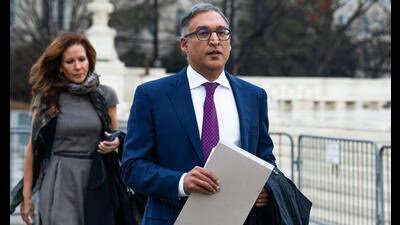
Neal Katyal, the Indian-American lead attorney who successfully argued in the Supreme Court against US President Donald Trump’s powers to impose tariffs under the International Emergency Economic Powers Act, has termed the verdict a victory for constitutional government. In an interview with HT, Katyal said that President Trump’s new 15% global tariffs, imposed under different provisions, stand on shaky legal ground and are likely to see additional legal challenges.
Q. What are your first reactions to the Supreme Court’s verdict striking down President Trump’s tariffs? Why was this an important case for you?
A. I think this was a victory for the rule of law and for our constitutional government. I think India and the United States both share this, which is that we are the largest democracies under constitutions. What happened in this case on Friday, is that the President said that I can disregard the Constitution. I can go beyond it. I can do what I want in the name of foreign policy, in the name of national security, in the name of the economy. And what the Supreme Court said is, no, you can’t do that in a constitutional government. You have to colour within the line. You have to comply with the law. And the Supreme Court said the President hasn’t complied with the law.
Q. Many said the US Supreme Court would not want to challenge the President on what had been his signature initiative of his administration. What do you think swayed the court your way in this argument?
A. I think your question is really smart, because if you go back over the course of our 200 years of American history, you’ll see the Supreme Court almost never, maybe never, has really struck down the President’s core signature initiative. They always defer to the president because they don’t want to second guess the president on something so important. So that’s why those analysts you’re referring to said we weren’t going to win. Now I view the Constitution a little differently. I think it is a set of rules that our founders gave us over 200 years ago, and that do apply in hard times and good times and to presidents and paupers alike. I always thought the case was winnable, but I knew it would be tough. I brought the challenge to President Trump’s Muslim ban back in 2017 and even though I won in the lower courts and he had to modify it by the time it ultimately came to the Supreme Court, the Supreme Court voted 5-4 in favor of President Trump and deferred there. So we always knew it was a risk. But at the same time, we felt the case against President Trump’s tariffs was so strong, that the tariffs were so unconstitutional and that we could bring a broad coalition of people to the Supreme Court to show them just how wrong and awful these tariffs were. Now we thought we could win. Six of the nine justices, fortunately, said we were right.
Q. The administration has now placed a 15% global tariff under Section 122 of the Trade Act of 1974. You’ve pointed out in public as well that this new tariff also rests on some pretty dubious legal grounds.
A. Yes, it’s not just me who pointed it out. The Trump Justice Department in my case, said Section 122 didn’t apply and they couldn’t use it for redressing the US trade deficit. So it’s very hard for them now to turn around and say, oh, yeah, that’s the thing we want to use. So we’ve always said, look, the President has been given certain powers by Congress to enact tariff increases, but they’re always temporary or circumscribed in all sorts of ways. And if the President wants more than that, if he keeps saying the country is going to be destroyed and things like that, then the only thing he can do is go to Congress and get authorization. That is the American way. That’s what our constitution says. And you know, notably, President Trump, the first time he was president, he did go to Congress to try and get authority for his tariff increases. And you know what Congress did? They said, no way. And so I think he’s afraid to go to Congress. And because he’s afraid, he’s playing all these games with tariffs and other places,
Q. Are we going to continue to see legal challenges and difficulties? Countries like India have seen their tariff rate fluctuate quite sharply over the last few weeks
A. Yeah, I’m so sympathetic to that question. I myself was in India earlier this year and bought a bunch of things and wasn’t sure what the tariffs would be if I shipped them to the United States. But for businesses who depend on their livelihood, you need consistent rules, and the rules by President Trump are anything but consistent. And so yes, I do expect legal challenges to Section 122, and those 15% tariffs to be struck down and maybe redone, and so on. And that is just a terrible place for us all to be, and I’d rather President Trump do the right thing, which is, follow the Constitution, follow the law, follow the United States Supreme Court. Look, if you want tariffs, there’s a way to do it, go to Congress and get them approved.
Q. The administration believes that using more targeted tariffs – like the Section 301 tariffs – will be more effective going forward and will stand legal scrutiny. What do you think of the administration’s reasoning?
A. It’s incoherent. I mean, these are the same people who said they needed to have President Trump’s big, huge reciprocal tariffs because nothing else would work. And they also said that the Trump administration was going to win the Supreme Court case. But it wasn’t shaky legal ground. It was solid. They said it was a slam dunk. Well, all of that’s been proven wrong, so I’m not too confident in any of their legal predictions at this point.
Q. On the day the Supreme Court struck down the tariffs, you said you were remembering your father who immigrated to America from India. Talk to us a little bit about the symbolism of your victory as a son of immigrants
A. It’s incredibly meaningful to me, and I’m glad you asked the question. My parents are Punjabi. They came to America the year before I was born, and they came here for one simple reason, which is they thought their children could be treated fairly and well by the country. That has always been my experience going to the schools I have, holding the positions in the government that I have. We are truly a country with the rule of law at its backbone, and I’m so grateful to it. And I saw President Trump’s tariffs as a real threat to what our rule of law and our constitutional democracy is about, and it is just the most humbling, wonderful privilege to be able to stand up in our highest court of the land and bring the case in the name of the Constitution and the name of our businesses in the name of our citizens, and to say what the President is doing is a betrayal of our fundamental principles. And you know, my parents are so patriotic, and they love America as they love India too. The thing they love about America is its commitment to the rule of law, and so to be part of that and to share that, and to remind the court in the country of our deepest principles; I don’t have words to describe exactly what that feels like right now. But I am remembering my parents, and I’m remembering my family, and I’m remembering all the people around the world who are just fighting for equal rules and treatment by everyone.