
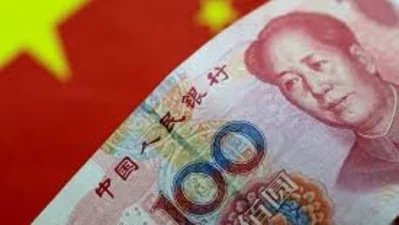
THE YUAN is China’s currency but the world’s problem. It is troublesome not just because it is difficult to pronounce (you-en is closer to the mark than you-an, but if you say you-en, no one will know what you-re talking about). Nor is it because Xi Jinping, China’s leader, wants the yuan to become a “powerful” currency that could eventually offer an alternative to the dollar. The problem is more immediate: the exchange rate that would stabilise China’s economy is out of whack with the rate that would balance the world economy.
That is the verdict of the IMF’s annual health check for China’s economy, released on February 18th. In currency disputes, the fund is the closest thing the world has to a referee. Its new report concludes that the yuan is undervalued by about 16%. That is the biggest misalignment since 2011, when a similar calculation suggested an undervaluation of 23%.
The root of the problem lies in China’s property bust over four years ago. The economy’s weak recovery since has left its firms scrambling. Industrial prices paid to producers have declined for 40 months in a row. Wage growth is weak and inflation is “uncomfortably low”, points out Sonali Jain-Chandra of the IMF. Falling prices at home have made Chinese goods fiercely competitive abroad. This edge is reflected in China’s “real” exchange rate, which is adjusted for international differences in inflation. On this measure, the yuan was 15% cheaper at the end of last year than it was four years before (see chart).
The cheap yuan has contributed to China’s export boom, cushioning its economy. But it has also unbalanced global commerce and alarmed China’s trading partners. China is monitored by America’s Treasury Department for evidence of currency manipulation. The European Union also complains of “unfair competition”. In July it will impose a levy of €3 ($3.54) on parcels worth less than €150, many of which originate from Chinese e-commerce sites. This trade tension poses a threat to China’s future growth.
One obvious sign that the yuan is too cheap is the size of China’s current-account surplus, which includes its trade balance as well as the income it earns on its foreign assets. A country like China with a middle-aged population would be expected to run a modest surplus of 0.9% of GDP, according to the IMF’s models. But China’s surplus last year was 3.7% of GDP. Part of the gap reflects the cyclical weakness of the economy. But the rest is evidence of a misaligned currency. The country’s surplus was also bigger than the fund expected when it finalised its report. Had it known the true figure, it would probably have judged the currency to be undervalued by about 19% not 16%.
Some economists think China’s true surplus is even bigger than official figures suggest. The income China earns on its vast holdings of foreign assets, including government bonds, loans and foreign-direct investments, has stagnated since 2021, despite the rise in global interest rates since then. That looks odd. The implied yield on China’s foreign assets has fallen, even as it has risen for every other big economy. China is either understating its earnings or revealing itself to be a hapless overseas investor, according to Brad Setser of the Council on Foreign Relations, an American think-tank. China’s government says it will soon report the income from direct investments (such as large ownership stakes in foreign companies) separately. That “will help us verify or not some of the hypotheses we had about what could be driving this apparent inconsistency”, says Ms Jain-Chandra.
As things stand, China’s exchange rate, adjusted for inflation, would have to move a lot to correct its undervaluation. But if the yuan were to rise too much too soon on the currency markets, the loss of competitiveness would jeopardise China’s economic recovery and deepen deflationary trends. The IMF proposes an alternative way out. It argues that China’s government should spend less on industrial subsidies and more on rural pensions, health care, poverty alleviation and shoring up the property market. This extra spending would help stimulate the economy directly. And by improving confidence in China’s social-safety net, it might also help indirectly, by unlocking some of its high household savings. “We are calling for an urgent and significant fiscal package,” says Ms Jain-Chandra, “because we are worried about deflation getting entrenched.”
China’s government may not share that urgency. It has talked a lot about boosting consumption, and introduced a variety of helpful schemes, but it has not put enough money where its mouth is. It seems willing to tolerate deflation as long as growth remains on target.
The stimulus the IMF proposes would strengthen China’s economy. Coupled with a delay in the retirement age, it would add half a percentage point to the annual growth rate on average over the next five years. The policy package would also reverse deflation and put upward pressure on prices. That would make Chinese goods a little less competitive abroad, narrowing the country’s trade surplus by over 1% of GDP. The world economy would be better balanced and trading partners would gain some relief. In its policy proposals, the IMF is that rare thing: a referee whose prescriptions could make both sides happy.
Subscribers can sign up toDrum Tower, our new weekly newsletter, to understand what the world makes of China—and what China makes of the world.