
When the US and Israel struck Iran, and then Tehran retaliated with ballistic missiles and drones that tore through Gulf skies, explosions were not heard loudest in government war rooms. They were heard also in homes in Kerala, Maharashtra and other Indian states whose economies see contributions from the 4.3 million Indians living and working in the United Arab Emirates.
Also read | ‘I could see missiles zooming past’: Kerala CM urges Centre to help workers in Gulf
The Indian community in the UAE stands at nearly 4.4 million (or 44 lakh), more than double of what was recorded a decade ago, as per information by the embassy there. This means Indians constitute approximately 38% of the UAE’s total population. They are concentrated in construction, retail, hospitality and logistics. These happen to be sectors that a war shuts down first.
With the start of “special flights” to evacuate those stranded in the UAE, there was some relief on Monday. But impact remains palpable, for now and in the medium and long run too.
Overall, around 10 million Indians live and work in West Asian countries. Iran is home to around 10,000 Indians, while more than 40,000 Indians live in Israel.
What Iran hit
Iran has hit back after the US and Israel launched a joint military operation targeting Iran’s Islamic Revolutionary Guard Corps facilities, missile sites and nuclear infrastructure. Supreme Leader Ayatollah Ali Khamenei was killed, as was a large part of the Iranian regime’s leadership. But it continues to fight back.
Iran has retaliated with ballistic missiles and drones fired into Gulf states including the UAE, where the US and its allies have military bases.
UAE air defences intercepted 167 missiles and 541 drones, but 35 hit Emirati soil, killing at least three people and injuring 58. The injured included an Indian.
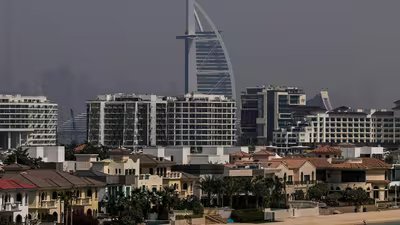
Fires erupted at the Burj Al Arab and Palm Jumeirah. Strikes also hit Jebel Ali port and Abu Dhabi port infrastructure.
“Tehran chose Dubai coldly and rationally, understanding that threatening the nexus of global capital would instantly send markets into a panic and coerce the UAE to pressure Washington for immediate restraint,” Clemens Chay, Senior Fellow for Geopolitics at the Observer Research Foundation’s Middle East desk, has written.
Another ORF researcher, Samriddhi Vij, said, “Despite the UAE ranking as one of Iran’s largest trading partners, interdependence did not restrain Tehran. When survival becomes paramount, economic interdependence ceases to function as a deterrent, and instead becomes a pressure point open to exploitation.”
What Indian govt has said
Prime Minister Narendra Modi has already called UAE President Sheikh Mohamed bin Zayed Al Nahyan. Modi posted on X that he “strongly condemned the attacks on the UAE”, expressed solidarity, and specifically thanked the UAE President for “taking care of the Indian community living in the UAE”.
External affairs minister S Jaishankar reached out to the foreign ministers of Saudi Arabia, Kuwait, Bahrain, Qatar and the UAE’s Deputy PM Sheikh Abdullah bin Zayed, while also speaking with Iran’s Seyed Abbas Araghchi and Israel’s Gideon Sa’ar. The MEA issued a formal statement saying India was “deeply concerned at the recent developments in Iran and the Gulf region”, urging “all sides to exercise restraint, avoid escalation and prioritise the safety of civilians.”
India separately issued advisories for its nationals in Iran, Israel, Jordan, Qatar, the UAE and Palestinian territories to exercise utmost caution. The Ministry of External Affairs said embassies are in active contact with stranded nationals across the region.
India’s opposition parties, while urging for evacuation efforts, have been critical of Modi’s policies. Congress general secretary Jairam Ramesh said Modi visited Israel on February 25–26 “at a time when the entire world was aware that a US–Israel military attack on Iran for regime change was imminent,” calling the government’s response a “betrayal of India’s values, principles and interests”.
Remittance lifeline
The economic stakes are high, as the Reserve Bank of India says the UAE accounts for about a fifth of all inward remittances, as per latest data from 2024. This makes it the second-largest source globally after the United States. The GCC as a whole accounted for 38% of India’s total inflows. India’s total remittance receipts hit $119 billion in 2023-24, and the UAE’s share to about $23 billion.
More than half of all remittance funds received by Indian households are used to maintain the family, covering essential items such as food, education and healthcare, experts say. At the state level, Maharashtra received just over a fifth of total remittances, followed by Kerala at just under 20%, then Tamil Nadu, Telangana, and Karnataka.
Biswajit Dhar, Distinguished Professor at the Council for Social Development, told news agency PTI that oil prices may rise to $120–130 per barrel, inflating the import bill and stoking inflation, while remittances could get hit if the conflict continues, squeezing Indian households from both ends simultaneously.