
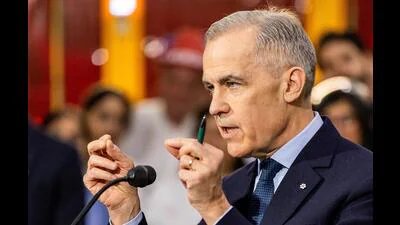
Toronto: Inking a deal to supply uranium to India is expected to be among the principal deliverables as Canadian Prime Minister Mark Carney arrives in the country later this week.
Tim Gitzel, CEO of one of the world’s largest uranium suppliers, Cameco will be part of the business delegation accompanying Carney during the visit, Business Council of Canada CEO and president Goldy Hyder confirmed to the Hindustan Times. While Hyder could not confirm whether the uranium supply deal will be clinched during the visit, officials on both sides have indicated as much.
Cameco is headquartered in Saskatoon in the province of Saskatchewan and its premier Scott Moe will be part of the delegation joining Carney. On Tuesday, Moe was quoted by the agency Canadian Press as saying, “I would say there’s been an ongoing conversation and relationship with India about the potential for uranium sales, for example, and that’s that has been part of virtually every conversation we’ve had with India.”
The deal, people familiar with discussions said, will be worth about CA$ 2.8 billion and span a decade.
Cameco earlier had a supply agreement with the Department of Atomic Energy, which expired in 2020. That agreement came in effect after Prime Minister Narendra Modi travelled to Canada in the spring of 2015 and held a bilateral with his Canadian counterpart Stephen Harper.
Export of Canadian uranium to India for the generation of electricity was authorised by the Canada-India Nuclear Co-operation Agreement which came into force in September 2013.
A broader nuclear cooperation agreement could be in the works, with India also interested in small modular reactors, a senior official had indicated earlier. That’s also part of the energy dialogue launched when Canada’s Minister of Energy and Natural Resources Tim Hodgson visited India last month and held several bilateral meetings with his Indian counterparts spanning multiple ministries.
Business leaders are expecting several positive outcomes from the trip, including the potential formal launch of the comprehensive economic partnership agreement (CEPA).
The BCC group, constituting ten corporate leaders from Canada, will form half the delegation for the CEOs Forum on March 2 in New Delhi to be addressed by both PMs. The other half will comprise members of the Confederation of Indian Industry (CII).
“It will be an opportunity to hear from business leaders from both sides,” Hyder said. He also said the Council was “cautiously optimistic” about the prospects for CEPA since there appeared to be “a strong will and tailwinds on moving quickly.”
He pointed out that trade agreements provided a framework for businesses to deploy capital with confidence. CEPA will go a “long ways in accelerating bilateral economic relationship to new heights”, he added.
India has been far more receptive of Canadian business over the past 18 months than during the period between September 2023 and early 2024, when Justin Trudeau was still PM and rancour existed after ties cratered over the killing of pro-Khalistan figure Hardeep Singh Nijjar in Surrey, British Columbia, on June 18, 2026.
Kushagr Sharma, president of the Canadian Hindu Chamber of Commerce (CHCC), experienced the change first-hand when he led a trade mission to India in January. “It was very positive this time, definitely a level up,” he said, referring to CHCC’s previous India mission in 2024.
“They’re taking us more seriously. It does feel like it’s a step up from last time as it’s easier to talk about the India-Canada relations,” he added. The CHCC delegation met several Indian officials including the Chief Ministers of Uttar Pradesh and Haryana, Yogi Adityanath and Nayab Singh Saini.