
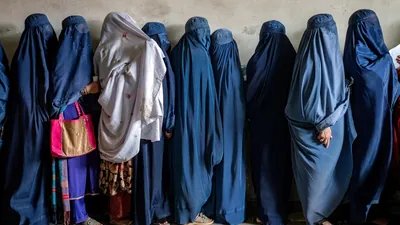
A country has now legally allowed men to beat their wives, seemingly being considered at par with being “slaves”. No, this is not a script of a dystopian television show showing the plight of women in a regressive society (read The Handmaid’s Tale), this is now the reality of the women in Afghanistan under the Taliban rule.
According to a new 90-page criminal code signed by Taliban’s supreme leader Hibatullah Akhundzada, the Afghan society would effectively be divided into upper and lower members, with their religious leaders, also called mullahs, placed above the law and shielded from any kind of criminal prosecution in the country and ‘slaves’, who would be at the mercy of the upper members, reported Independent.
As per the new criminal code, which was accessed by Independent, women of Afghanistan are set to bear the brunt of the new laws which seemingly equates their position in the society to that of ‘slaves’ and hence subject them to beatings by their husbands which would be backed by the law. The same fate would befall on “slaves” as well, who could be punished by their “slave masters”.
Also read: Neighbour kills woman in front of wheelchair-bound husband in Bengaluru, flees with gold, arrested
The criminal code is reportedly called De Mahakumu Jazaai Osulnama and was distributed across courts in Afghanistan.
Society divided into four categories
According to Rawadari, an Afghan-based human rights group, the new criminal procedure code was issued earlier this year on January 4, 2026, and it consists of three sections, 10 chapters, and 119 articles.
The code, through its Article 9, effectively divides the Afghan society into four categories which would decide how they will face law instead of the nature of the crime. The four categories are — “scholars” (ulama), “the elite” (ashraf), “the middle class”, and “the lower class”.
Also read: ‘What kind of culture are we developing?’: Supreme Court slams freebies given by states
In case of a crime, it would be a person’s social standing that would decide how they would be treated before the law and not the crime or its seriousness instead. Emphasising on this, Rawadari said that if a crime is committed by a religious scholar, which sits at the top of this new food chain, would be merely let go after advice while someone from the elite class may face summons to a court along with advice. However, it would be this easy for those from the remaining two classes. For the “middle class”, if they commit the same crime, they may face imprisonment and for the people from the “lower class” it could be a step further and lead to corporal punishment along with jail time.
The code also seeks to render a section of the society as “slaves” as it uses the word multiple times, not just providing legitimacy to slavery but also effectively putting women in the same position as it mentions in paragraph 5 of Article 4 states that the execution of the “hadd” punishment can be carried out by the “Imam” and the execution of “tazir punishment” can be carried out by the “husband” and the “master” [badaar], according to the rights group.
Also read: ₹70,000 crore tax evasion scam across India”>How a Hyderabadi biryani restaurant probe uncovered a ₹70,000 crore tax evasion scam across India
Legal relief for women, but first show your wounds
In another major burden for women, the code attempts to provide them some relief but only if they prove the extent of the beating. A husband won’t face any punishment unless the beating was done with a stick and it led to severe injury such as “a wound or bodily bruising”. Additionally, the burden of proving the same also falls on the woman and even if she manages to do so, the husband would face imprisonment for a mere 15 days.
The woman, on the other hand, could face imprisonment of up to 3 months in case she goes to her father’s or relative’s place without her husband’s permission and does not return upon his request, according to the code’s Article 34. Apart from the woman, her relatives would also be considered to have committed a crime, leaving women with no choice but to stay with her husband and with no refuge in case of repeated domestic violence.
The new code does not shield children as well from certain types of physical violence, particularly by teachers, and only bars beatings which could lead to severe injuries such as “bone fracture”, “torn skin”, or “bodily bruising”, as per Article 30.