
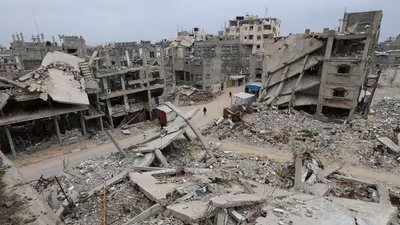
The U.S. is hosting an inaugural meeting of President Trump’s Board of Peace on Thursday, debuting the president’s vision for a new international organization to cement Middle East peace and rebuild a war-ravaged Gaza.
Countries involved in the board plan to pledge billions of dollars to rebuild the enclave, with funding allocated for reconstruction, humanitarian assistance, and standing up an international security force to oversee a lasting peace deal.
Trump will announce Thursday that Board of Peace members have contributed $5 billion for Gaza’s humanitarian reconstruction efforts, White House press secretary Karoline Leavitt told reporters Wednesday. She also said members pledged thousands of personnel to serve as local police in Gaza and in the International Stabilization Force, a military coalition to keep peace in the enclave, but declined to give specifics.
Yet the plan still faces significant questions over whether the Hamas terrorist group will fully disarm, as it committed to do in the cease-fire that Trump first brokered late last year. U.S. and Middle Eastern officials say no peace plan will last as long as Hamas remains a military threat.
“The message is clear to Hamas,” Mike Waltz, Trump’s ambassador to the United Nations, said in a brief interview. “You’re either going to disarm the easy way or the hard way. And we expect they will live up to their end of the agreement.”
The Trump administration has yet to publicly outline a plan for Hamas to disarm, but officials say talks are continuing with Egypt, Qatar and Turkey, which are communicating with Hamas negotiators. Israel has said it wouldn’t allow any major reconstruction to take place in Gaza before Hamas and other Palestinian groups in the territory agree to disarm.
Trump is slated to speak at the meeting, along with Secretary of State Marco Rubio, Waltz, U.S. Special Envoy Steve Witkoff, and Trump’s son-in-law Jared Kushner, who is involved in Gaza peace plans.
The Trump administration first unveiled the Board of Peace at a signing ceremony at the World Economic Forum in Davos, Switzerland, last month. Over 20 nations have signed on, including multiple Middle Eastern countries, El Salvador, Hungary and Uzbekistan. Other countries including Brazil, China, Japan, India, South Korea and Japan were issued invitations but haven’t accepted them.
The board faces skepticism from some of America’s closest allies, including France, the United Kingdom and Germany. Some U.S. allies refused to join after Trump extended an invite to Moscow to join the Board of Peace while it wages a war in Ukraine. Others raised concerns that the Board of Peace is a U.S. effort to supplant the U.N.—a charge that administration officials deny. Pope Leo XIV, a prominent advocate of Middle East peace, declined an invitation to join the board, as the Vatican argued that the U.N. should lead any peacemaking efforts.
The Board of Peace meeting on Thursday, which will include delegations from at least two dozen countries, is also set to discuss plans for an International Stabilization Force, or ISF, to oversee long-term peace in Gaza. Major questions remain unanswered about what role, if any, the ISF would have in overseeing the disarmament of Hamas.
The Board of Peace meeting will take place in Washington in the U.S. Institute of Peace. The Trump administration slashed staffing and funding for the government-funded organization last year, then added Trump’s name to the building.
Indonesia has pledged around 8,000 troops to the ISF. Albania, Morocco and Greece are also set to join Gaza stabilization forces in the coming weeks, according to officials familiar with the plans. Those troops will possibly address border-related issues, but it remains unclear if those countries will allow their forces to be involved in monitoring or policing Hamas disarmament.
The U.S. plans to pledge up to $1.25 billion in funding for the Middle East peace plan at the first board meeting, of which $1 billion will go to humanitarian assistance and the rest to law-enforcement and peacekeeping efforts, according to two U.S. officials briefed on the plans.
The State Department didn’t respond to a request for comment.
The Board of Peace is also expected to outline plans for major reconstruction projects in Gaza, including a proposal to rebuild the city of Rafah with 100,000 permanent housing units, 200 education centers and 75 medical facilities.
The United Arab Emirates, one of the largest donors of humanitarian aid to Gaza since the start of the war, is also set to pledge over $1 billion to the Board of Peace for the enclave, said Arab officials familiar with the matter.
The Gulf state is already planning to help fund Gaza’s first planned community in Rafah, set to house up to 25,000 Palestinians, according to a presentation given at the Civil-Military Coordination Center and reviewed by The Wall Street Journal.
The planned community is the U.A.E.’s first investment in a postwar reconstruction project located in the part of Gaza currently held by the Israeli military, known as the Green Zone.
The Emirati-backed endeavor is set to be the first of several residential camps that will serve as safe communities free from Hamas and subject to security checks to prevent the introduction of weapons and militants.
Write to Robbie Gramer at robbie.gramer@wsj.com and Summer Said at summer.said@wsj.com