
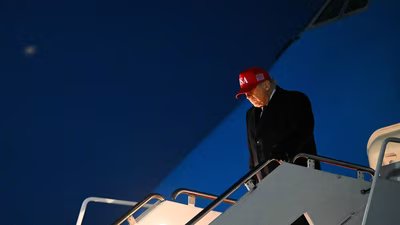
US President Donald Trump on Monday said he would not rule out sending ground troops into Iran if necessary. “Like every president says, ‘There will be no boots on the ground.’ I don’t say it,” Trump told the New York Post in one of several brief interviews on Monday.
“I say ‘probably don’t need them’, ‘if they were necessary’,” he further said, news agency AFP reported.
Live: Updates on the US-Iran conflict
He mentioned a “big wave” as he also spoke to CNN. “We haven’t even started hitting them hard. The big wave hasn’t even happened. The big one is coming soon,” Trump said, adding that Washington did not know who the country’s new leader would be following the killing of Ayatollah Ali Khamenei.
“We don’t know who the leadership is. We don’t know who they’ll pick,” he said.
Many senior US officials remain doubtful if the military operation against the Islamic Republic could lead to a regime change in the near term, Reuters has reported. Iran is not like Venezuela, from where President Nicolas Maduro was taken away by US military and an interim leader took over from within the regime with apparent US backing, they have reportedly said.
Trump’s words about not ruling out a ground operation came just hours after US defence secretary Pete Hegseth on Monday addressed concerns that the US-Israeli strikes in Iran could spiral into a stretched regional conflict.
“This is not Iraq. This is not endless,” Hegseth said, referring to the 2003 invasion of Saddam Hussein-led Iraq by the US.
Hegseth, along with US Air Force General Dan Caine, chairman of the Joint Chiefs of Staff, held the Trump administration’s first news briefing since Saturday’s strikes.
President Donald Trump, while he’s conducted a few phone interviews with individual reporters, has not taken questions on camera and only released two videos since the operation began.
Hegseth said the operation had a “clear, devastating, decisive mission” to “destroy the missile threat” from Iran, destroy its navy and “no nukes”.
“No stupid rules of engagement, no nation-building quagmire, no democracy-building exercise, no politically correct wars. We fight to win, and we don’t waste time or lives,” Hegseth said.
Asked if there are currently boots on the ground in Iran, Hegseth said, “No, but we’re not going to go into the exercise of what we will or will not do.”
He said it was “foolishness” to expect US officials to say publicly how far they’ll go.
He also suggested the US was not seeking to change the Iranian regime with the killing of Iranian Supreme Leader Ayatollah Ali Khamenei. “This is not a so-called regime change war, but the regime sure did change and the world is better off for it,” Hegseth said.
The briefing comes as the conflict has intensified into a wider war in the region. Iran and its allied armed groups have launched missiles at Israel, Arab states and US military targets in the Middle East.
Four American troops have been killed in action, while ther have been over 500 death in Iran, Red Crescant says.
Trump on Sunday predicted there would be more US casualties.
Meanwhile, US ally Kuwait “mistakenly shot down” three American fighter jets during a combat mission as Iranian aircraft, ballistic missiles and drones were attacking on Monday. US Central Command said all six pilots ejected safely from the American F-15E Strike Eagles and were in stable condition.
US officials have not offered any exit plan or offered signs that the conflict would end anytime soon, and Khamenei’s death cast doubt on the future of the Islamic Republic and hurtled the region into broader instability.
Hegseth did not point to any threat of an imminent nuclear threat from Iran, and he said again that last June’s strikes by the US and Israel “obliterated their nuclear program to rubble”.
Instead, Hegseth pointed to threats from other weaponry. “Iran was building powerful missiles and drones to create a conventional shield for their nuclear blackmail ambitions,” Hegseth said.
He said that during negotiations with US officials leading up to the attack, Iranian officials were “stalling”.
Hegseth dismissed questions about a timeframe and said, “President Trump has all the latitude in the world to talk about how long it may or may not take. Four weeks, two weeks, six weeks. It could move up. It could move back.”
(with inputs from AP)