
The US-Israeli war on Iran entered a sixth day with no sign of easing, as the Islamic Republic said its retaliation against American strikes would escalate.
Arab states across the Persian Gulf reported interceptions of Iranian missiles and drones overnight and into Thursday. Israel is carrying out waves of airstrikes on Tehran, hitting military and intelligence assets, following attacks on Hezbollah militia in Lebanon.
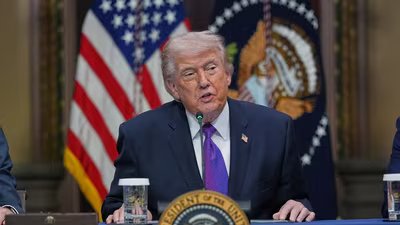
President Donald Trump said on Wednesday that the US was “doing very well on the war front.” The White House said American forces had struck more than 2,000 targets and were moving toward “complete and total control of Iranian airspace,” while the Islamic Republic’s regime had been “absolutely crushed.”
Iran’s Islamic Revolutionary Guards Corps said retaliatory attacks will intensify in coming days, according to the Nour news agency. Tehran will target Israel’s Dimona nuclear facility if the US seeks regime change, Iran’s semi-official ISNA said.
ALSO READ | Trump’s niece Mary L Trump reacts to Iran schoolgirls photo: ‘I defy anybody to justify this’
In all, about a dozen nations have become embroiled, with Tehran striking US bases and embassies across the Middle East, and Israel launching an air and ground offensive against Iran-backed Hezbollah in Lebanon.
Turkey also came under fire on Wednesday, a first for a member of the North Atlantic Treaty Organization since the conflict began. At least 1,100 people have died in Iran so far, and dozens elsewhere in the region.
The possibility of a protracted war is roiling markets with Brent oil rising past $84 a barrel, bringing its advance since the beginning of the conflict to 16%. Gold and silver extended gains amid concerns the conflict could be drawn out. Treasuries were a touch weaker as of 9:40 a.m. in Dubai.
Saudi Arabia continued to thwart attacks on Thursday, saying it intercepted multiple missiles and drones overnight. Strikes have mostly been directed at Al Kharj near Riyadh, where the US has a facility, or the east where Saudi Aramco operates its headquarters.
ALSO READ | Trump shares important message for US citizens in Middle East amid Operation Epic Fury, ‘If you want to come home…’
The US on Wednesday sank an Iranian warship in international waters, marking the first time since World War II that an American submarine has attacked a surface vessel. Some 32 sailors were rescued and more than 100 were missing or dead.
Iran warned the US will regret the action on the warship, which it said was struck in international waters without warning.
NATO said its air defenses downed a ballistic missile headed for Turkey, and Ankara warned Tehran against acts that could further widen the war. Iran’s armed forces denied targeting “neighboring and friendly country Turkey,” according to a statement carried by the Nour news agency.
Sirens sounded three times in the Tel Aviv area overnight, warning of incoming missiles. That would be an unusually high rate of fire for Iran at this point of the war. Israeli media reported no casualties – suggesting successful interceptions of what may have been lone missile launches.
In Washington, the Republican-controlled Senate rejected a Democratic attempt to halt the US strikes on Iran. The House, also controlled by Trump’s party, is expected to vote on a similar measure Thursday.
Trump has offered shifting explanations for the strikes, reiterating claims that Iran posed an imminent threat and saying the US acted before Tehran could attack Israel or American interests.
“Their missiles are being wiped out rapidly. Their launchers are being wiped out. They’re attacking their neighbors. They’re attacking their — in some cases — allies, or not-so-long-ago allies,” Trump said. “It’s really a nation that was out of control, and they would have used it on us if we let them.”
ALSO READ | ‘Regime of fear’ to ‘bomb-first’ warnings: How global media framed the tensions in Middle East
The duration of military operations remains uncertain, with Defense Secretary Pete Hegseth telling reporters “it could be six, it could be eight, it could be three” weeks before they are wrapped up.
Iran has shown no sign of abandoning its nuclear or missile programs despite US and Israeli claims of heavy damage. Israel’s UN ambassador, Danny Danon, told Army Radio Iran still has “significant capabilities” and that “there’s still a long way to go.”
Traffic through the Strait of Hormuz, a maritime chokepoint vital for energy flows and container shipping, has slumped, prompting Trump to announce the US would provide insurance guarantees and naval escorts if needed to ensure safe passage for oil tankers and other vessels.
The White House provided few details about the insurance program, or when US naval escorts would begin. Traders and analysts still expect it will take weeks before flows can resume meaningfully.
Tehran dismissed an earlier report that its Ministry of Intelligence had reached out to the US to negotiate an end to the conflict as “pure falsehood.”
“We have no trust in the Americans and no intention of negotiating with the US,” Mohammad Mokhber, an adviser to the late Supreme Leader Ayatollah Ali Khamenei who was slain in the first salvo of strikes, told Iran’s state-run television.
There are signs Iran is increasingly switching to drones, which tend to be less destructive because they carry smaller payloads.
A British air base in Cyprus was hit by a drone strike on the weekend — so far the only attack on European territory. Greece, the UK and France are now bolstering the Mediterranean island’s defenses.
Israel confirmed attacking a building in Iran’s Qom used by the Assembly of Experts — a conclave that will select Khamenei’s successor. A military spokesperson also appeared to acknowledge that, as widely reported, the site was empty at the time and the clerics survived. Iran’s Nour agency said three people were killed in the attack.
The leadership selection process is close to complete, with options having been identified, Iran’s semi-official Mehr news agency reported, citing Ahmad Khatami, a member of the assembly.
Preparations were under way for Khamenei’s funeral to begin in Tehran on Wednesday, but the ceremony has been postponed to a later date, Iran’s semi-official Tasnim news agency reported.