
JOHANNESBURG—The corporate exodus from what was supposed to be Africa’s breakout economy is accelerating, propelled by a toxic cocktail of corruption, lawlessness and poor infrastructure.
Foreign investors from Shell to British American Tobacco are downsizing in South Africa. Those decisions could mark a watershed moment for a country where the government’s ability to deliver basic services has become so limited that private firms have taken over many basic civic functions.
Africa’s biggest and most-developed economy has long been plagued by logistical problems, including failing infrastructure and rising electricity costs. Firms have put up with those drawbacks for access to South Africa’s deep seam of mineral wealth and its growing consumer market.
But a catalog of recent high-profile corruption scandals, often linked to laws intended to right the racial wrongs of apartheid, has eroded South Africa’s reputation among investors and exacerbated the country’s fundamental problems, including regular dayslong water and power outages.
Legislation designed to improve the lot of South Africa’s Black majority has also deterred investment. Elon Musk’s SpaceX was in talks with South African officials about launching its Starlink internet service in the country—which could have boosted the fortunes of the country’s economic backwaters—but the billionaire, the world’s richest, is demanding an exemption from a rule that requires foreign companies to give up 30% of their local operations to Black South Africans.
The World Bank estimates that crime costs South Africa’s economy at least 10% of gross domestic product annually, including stolen property, the extra costs of security and insurance, and missed economic opportunities.
Rolex closed its South African affiliate office in 2024, citing what a spokeswoman called the evolution of local markets. Criminals, collectively dubbed the ‘Rolex gang,’ terrorize wealthy Johannesburg residents by robbing them of their luxury watches at gunpoint, often shooting first and grabbing the watch after.
The Rolex spokeswoman declined to say whether such groups influenced the company’s decision to leave the country. Rolex is maintaining an after-sales service center there, she said.
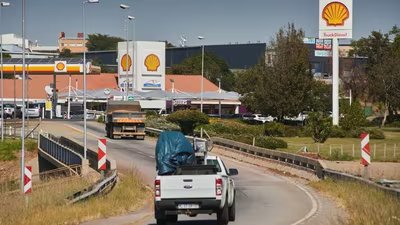
Shell, along with BP, sold the refinery they jointly owned to South Africa’s state-owned Central Energy Fund in 2024 for one South African rand, or about six U.S. cents. That same year, Shell said it would sell its gas stations in the country, but the company has yet to find a buyer. The oil major didn’t respond to a request for comment.
“It’s less about the proceeds. It’s more about taking things that don’t fit our strategy off the books,” Shell Chief Financial Officer Sinead Gorman said on the company’s second-quarter earnings call in July.
British American Tobacco has announced that it is closing its last cigarette-manufacturing facility in South Africa by the end of this year, due to the illicit trade in cigarettes that has wiped out around 75% of the local legal market for tobacco. The company intends to shift to an import model.
The cigarette maker says its facility, first opened in 1975, currently operates at just 35% capacity, due to the exponential growth of the illicit tobacco trade in South Africa, triggered by a ban on cigarette sales during the coronavirus pandemic.
“We’ve held on for as long as we could, in the hope that all the pronouncements that the government is making would come to fruition,” Johnny Moloto, head of corporate and regulatory affairs at the company’s sub-Saharan Africa unit, told The Wall Street Journal. “We’ve now reached that tipping point.”
He added that the company would reinvest in local production should the government bring the illicit trade in cigarettes under control.
During the Covid pandemic, South Africa banned tobacco sales in an effort to relieve the healthcare system. The ban resulted in a flood of illicit cigarettes. The courts later declared the ban unconstitutional, but the legitimate cigarette market has never recovered.
In 2024, BNP Paribas closed its corporate and investment bank in South Africa amid a broader pullback from the continent by European banks. Later that year, HSBC said it would transfer its South African business to local banks and exit the country.
Some multinationals operating here have themselves become embroiled in South Africa’s endemic corruption.
Bain shut down its South African consulting business last year after a state corruption inquiry into Jacob Zuma found the company had colluded with the former president to weaken South Africa’s tax agency.
The Boston-based firm was banned from doing business with the South African government in 2022, after the National Treasury accused Bain of “corrupt and fraudulent practices.”
Bain’s actions curbed the tax agency’s ability to tackle financial crime, according to the inquiry, which heard testimony over almost three years that Zuma and members of his government allegedly allowed well-connected businessmen and foreign companies to score lucrative government contracts in return for payments and other favors. There have been no convictions related to the corruption allegations, which analysts say is evidence of further government failure.
Zuma didn’t respond to a request for comment via his lawyer. He has repeatedly denied the allegations. Bain didn’t respond to requests for comment.
Mining giant Anglo American, a stalwart among South Africa’s foreign investors, is currently working to divest its majority stake in diamond behemoth De Beers for either an initial public offering or sale. Last year it spun off and then sold its remaining stake in the world’s No. 1 platinum mining company, South Africa-based Anglo American Platinum, now called Valterra Platinum.
Still, Anglo, which has operated in South Africa for over 100 years, isn’t giving up on the country entirely. It has retained its majority shareholding in South African miner Kumba Iron Ore, as well as an interest in a local manganese business and its sprawling wine farm, Vergelegen, outside of Cape Town.
“We continue to see South Africa as our hub for investment into the entire region, whether in exploration or more developed opportunities,” said James Wyatt-Tilby, a spokesman for Anglo American. “We are incredibly proud of the broader contributions that we make in the country towards addressing a number of national priorities, whether relating to energy, logistics, crime and corruption, or education, to name a few.”
Write to Alexandra Wexler at alexandra.wexler@wsj.com