
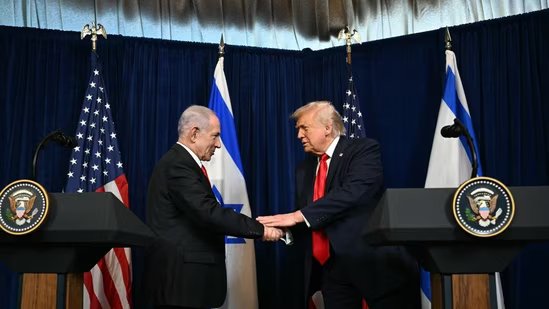
Much of the media seems to want a “split” between President Trump and Israeli Prime Minister Benjamin Netanyahu. This was all the talk until they joined to strike Iran’s nuclear program in June, and lately we hear it again. But as the two met Monday at Mar-a-Lago, their sixth meeting of 2025, no such split was in evidence.
Asked about the relationship, Mr. Trump answered with common sense. “I don’t think it can be better. We just won a big war together,” he said. Israel’s Mr. Netanyahu was effusive in turn, but more important was their convergence on key policy questions, beginning with Iran.
The Iranian regime has been racing to rebuild its ballistic-missile capacity, which Israel named an existential threat at the outset of the 12-day war in June. If Iran accumulates enough missiles, it could overwhelm the air defenses of Israel and other U.S. allies even without a nuclear weapon.
Mr. Trump, focused on the nuclear program, was presumed to be less gung-ho about addressing the conventional missile threat. Yet when asked whether he’d support another Israeli attack on Iran, Mr. Trump was clear: “If they continue with the missiles? Yes. The nuclear? Fast. One will be ‘yes, absolutely’; the other will be ‘we’ll do it immediately.’”
A united front on Iran is the best way to pressure the regime to come to a deal limiting its nuclear and missile programs, so Israel doesn’t have to strike again. But if Ayatollah Ali Khamenei “is trying to build up again,” Mr. Trump said, “we’re going to have to knock ’em down. We’ll knock the hell out of them.”
As the President pointed out, Iran is weak. “They have tremendous inflation. Their economy is bust,” he said. Iran’s currency fell to another all-time low Monday, trading at more than 1.4 million rials to the dollar. In 1979, before the Islamic Revolution, a dollar traded at about 70 rials. Press reports say public protests have broken out in cities over the currency plunge and inflation.
On Gaza, Mr. Trump did well to signal his priorities. Asked when his peace plan would advance to its second stage—with new governance, security and reconstruction—he replied, “As quickly as we can, but there has to be a disarmament. We have to disarm Hamas.”
He later added, “They’re going to be given a very short period of time to disarm.” A deadline at last? Let us hope. When a reporter suggested Israel was holding up the peace plan, Mr. Trump said no. “They’ve lived up to the plan,” unlike Hamas.
Mr. Trump is right to put disarmament first. There will be no peace as long as Hamas hangs onto its weapons, which are the key to its rule over Gaza. Even the world’s greatest economic development plan from U.S. envoys Jared Kushner and Steve Witkoff won’t change that.
The upshot isn’t to junk the peace plan but to pressure Hamas to adhere to it. That means Israeli freedom of action short of war, of the kind it practices from time to time in the West Bank, to prevent Hamas from comfortably reconstituting its forces.
An international stabilization force may help, but Mr. Trump was mistaken to say that 59 countries “want to go in and wipe out Hamas.” Contributing states have made clear they won’t confront Hamas. Turkish forces, about which Mr. Trump was asked, would be least likely to do so. Turkey’s President Recep Tayyip Erdogan praises Hamas as “holy warriors.”
It’s clear from media leaks that some of Mr. Trump’s advisers would like him to restrain Israel across all fronts. But the Israeli public (and not merely Mr. Netanyahu’s government) has taken from the war of Oct. 7, 2023, one lesson above all: It can never again allow jihadists to reign and build up military power with impunity on its borders. That’s a policy worthy of U.S. support.