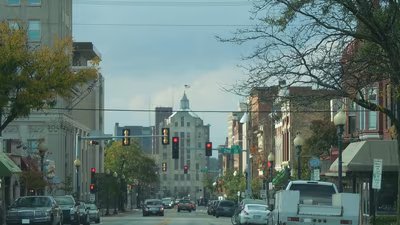
Of all the buildings in Rockford, Illinois, a city of roughly 150,000 people, City Hall is among the prettiest. Originally a bank that went bust in the Depression, it rises eight stories above the city’s main commercial strip. On the ground floor there is a grand arched atrium. The view from the mayor’s office is, sadly, not so handsome. There are rather too many parking lots, and more than one abandoned factory. Looking out, it would be easy to think that Rockford is just another fading midwestern industrial town, struggling to maintain its past glory.
Of all the buildings in Rockford, Illinois, a city of roughly 150,000 people, City Hall is among the prettiest
And yet, go a little closer and Rockford is doing surprisingly well. There is a free art museum, with a Roy Lichtenstein painting. A long-derelict factory recently reopened as a smart hotel. The city has an ornate Japanese garden. And businesses are growing, not closing. Some 8,700 people work at the airport, several thousand more than a decade ago. Clusters of manufacturing sit around it. There is “not a plane that’s going over the United States right now that does not have pieces that come from Rockford”, boasts Tom McNamara, the mayor.
But the biggest change is that fewer people are leaving the city. In 2024, according to Census Bureau data based on tax returns, 141 more people left Rockford for other parts of America than moved in. For most of the decade up to 2020 the annual loss was between 2,000 and 3,000. In 2025, though the full figures are not yet available, the city may well have gained more people than it lost for the first time since before the global financial crisis of 2007-09. Although the city’s amenities help, Rockford also reflects a broader trend. Last year the Midwest census region, which stretches from the Dakotas to Ohio, gained more domestic migrants than it lost. In 2022, 180,000 people moved out. Last year 16,000 moved in.
That, says Hamilton Lombard, a demographer at the University of Virginia, is a remarkable turnaround—especially since it is occurring at a time when America’s overall population is growing as slowly as it ever has. The data do not go back far enough to be sure, but Mr Lombard guesses that the last time more people moved to the Midwest than left was in the 1950s, when black Americans headed north to factory jobs and away from Jim Crow. By the 1970s, if not before, deindustrialisation had reversed the flow, creating a sort of reverse Great Migration.
Illinois is perhaps where the turnaround is most obvious. In 2022 the Land of Lincoln lost nearly 150,000 people to other states. Some smaller counties downstate have been losing population practically since Lincoln himself was alive. This creates enormous fiscal pressure, as spending on pensions grows while tax revenues do not. Indeed, roughly 40% of Chicago’s budget goes on pensions and debt. Such pressures may soon become less intense, however. Last year just 40,000 people left Illinois, some 73% fewer than three years before.
Across the rest of the region, the turnaround is less pronounced and more uneven, but still apparent. Many older, once-industrial cities are doing much better. Last year the Census Bureau estimated that Detroit gained residents for the first time in nearly 70 years. The metro area of Cleveland, Ohio, another rust-belt city, is also losing fewer people. By contrast, Columbus, a city in the same state with the feel of the sunbelt minus the sun, has seen enormous inward migration turn into a modest outflow.
What could explain the overall shift? Talk to any state or local official and they, of course, take credit. People are discovering that “Michigan is a remarkably global and cosmopolitan place,” says Quentin Messner, who runs the state economic-development agency.
Mr Lombard has a more convincing explanation. It is about the cost of living. He contrasts Phoenix, a fast-growing city, with Chicago. The Arizonan metropolis “used to be relatively affordable. It’s just not at all anymore,” he says. Rents in Chicago are around $150 a month cheaper. On top of this, it is possible to live without a car and see a decent show at the theatre. “You can buy an incredibly nice house with a yard and a garage for $200,000,” says Mr McNamara, the mayor of Rockford.
In recent decades the biggest outflow from Chicago has been of working-class, often black families. In the decade to 2020, Cook County, which contains the city, lost 100,000 black residents, or 8% of the total—some to neighbouring states, many to places such as Atlanta and Houston. Now the South is no longer as cheap and its pay is no longer much higher. In the Midwest the decades-long decline in manufacturing jobs seems to have bottomed out.
It is too early to say if the great-migration flip will be sustained. The winters are still bleak, and southern sun will remain a lure. The bigger problem, though, is that even if fewer people leave the Midwest, President Donald Trump has cut off the largest supply of new workers: international migration. In January the Congressional Budget Office reduced its forecast of how much the American population will grow over the next decade from 15m people to 8m, owing to lower migration and birth rates. The immigrant population is probably shrinking, making competition for people more intense. Any midwestern gain will be somewhere else’s loss.