“WE DIDN’T START this war, but under President Trump, we are finishing it,” Pete Hegseth, America’s secretary of war, told Americans on March 2nd. To observers of Russia, the phrase sounded familiar. “We did not start this so-called war. On the contrary, we are trying to finish it,” Vladimir Putin had told Russians a few years earlier, after invading Ukraine. Mr Putin’s recognition of his own words in English may help to explain Russia’s muted response to the assault on Iran by America and Israel. There is, in fact, little Russia can do to help Iran, a country with which it has been tentatively allied for years. But even if it could, it remains unclear how much it would want to do so: for Mr Putin, friendly relations with Donald Trump may take precedence.
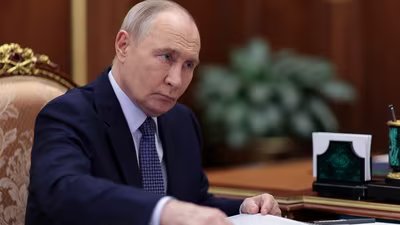
We did not start this so-called war. On the contrary, we are trying to finish it,” Vladimir Putin had told Russians a few years earlier (AP)
Despite losing two allies in two months to American military interventions—first Nicolás Maduro, Venezuela’s president, in January, and now Iran’s Ayatollah Khamenei—Russia’s leader has trodden carefully. Mr Putin’s first response to Khamenei’s killing was limited to a condolence telegram published on the Kremlin website, calling it “a cynical violation of all norms of human morality and international law”. It made no mention of who was responsible. Russia’s foreign ministry issued a predictably bellicose statement, but the Kremlin publicly distanced itself. “This is not our war,” Dmitry Peskov, Mr Putin’s spokesman said. “We must do what corresponds to our interests…cynical as that may sound.”
Iran’s military relationship with Russia has been of limited help to it since the war started. The most significant aspect so far seems to involve intelligence: reports have emerged that Russia had provided targeting data for Iranian drone and missile strikes. American officials suggested that Russia had given the locations of some American warships and aircraft, among other military assets, to counterparts in Iran. When asked about the extent of Russia’s ongoing support for Iran, including communication between the governments, Mr Hegseth pronounced himself unconcerned.
The military kit Russia supplied in the past seems to have been of little use. In the mid-2010s it sent Iran S-300 air-defence missile systems. Later it sold the country training jets, attack helicopters, armoured vehicles and small arms. Most recently it agreed to sell Iran Verba shoulder-fired missiles, capable of shooting down missiles, drones or low-flying aircraft. Reportedly a deal was struck in December under which Iran would pay €500m ($580m) for 500 Verba units, and 2,500 missiles, to be delivered over three years. It is unclear whether any of these arrived. For its part, Iran supported Russia in its war in Ukraine and supplied it with drones, artillery shells and ammunition. Under a strategic partnership agreement signed in January 2025, the two countries agreed to share intelligence, but did not oblige themselves to defend each other. They also exchanged technology and experience in surveillance and suppression of protests.
Much of Iran’s air defences, including Russian-built ones, have been destroyed—first by Israeli and American strikes during the 12-day war in June, and subsequently by the attacks this month. What remains has done nothing to stop American and Israeli jets from ruling the skies: Iran has failed to shoot down a single enemy aircraft. On March 4th a Russian-made Yak-130 jet, built as a trainer but pressed into service as a fighter, provided an easy target for an Israeli F-35. Russia has no desire to provoke America by attempting to resupply Iran with missiles or munitions. If it did there is little it can spare, given its own needs in Ukraine.
For Russia, the war’s effects are mixed. It stands to benefit economically as energy prices rise. The price of a barrel of Russian oil, which normally trades at a discount to the global benchmark due to Western sanctions, rose from less than $50 in December to $72 this week. That reflected both the cessation of tanker traffic through the Strait of Hormuz, and market expectations of a prolonged war. It is well above the $59 assumed in Russia’s government budget for 2026. In an effort to calm global markets, on March 5th America gave India a 30-day waiver to purchase Russian crude.
The rally will provide temporary relief from a sharp decline in Russia’s oil and gas revenues, which in January were 50% lower year-on-year, and ease the pressure on the Russian budget, which is running a deficit. Mr Putin also stands to benefit from Iran’s strike on the liquefied natural gas infrastructure of Qatar, which supplies around a tenth of Europe’s LNG. But this will not address the structural problems of Russia’s economy.
In military terms, the war in Iran helps Russia by depleting America’s supplies of anti-ballistic and air-defence missiles, leaving fewer for it to sell to Ukraine. But on balance, it is a strategic loss: a further demonstration that Russia is unwilling or unable to protect its allies. If anything, Russia seems to be restraining Iran rather than encouraging it. On March 6th Mr Putin spoke to Masoud Pezeshkian, Iran’s president (the pair are pictured above), and called for an end to hostilities. A few hours later Mr Pezeshkian apologised to Iran’s neighbours and pledged to stop striking them with missiles and drones, though he said Iran would never accede to Mr Trump’s demand to “surrender”.
This does not mean that Mr Putin wants the war to stop. He would benefit from having America bogged down in the conflict. But for Russia, Iran is not a strong ally—the two countries have a long history of antagonistic relations—but a partner of convenience, a bargaining chip in its strategic contest with the West. Mr Putin is likely to navigate between keeping Iran on side and leveraging the relationship to gain greater advantage in Ukraine and in broader confrontation with the West.
Russia’s recent policies towards Iran are best understood as part of its relationship with America and its war in Ukraine, as a recent report by Re:Russia, a Vienna-based think-tank, explains. When Mr Putin signed the strategic partnership with Mr Pezeshkian in January 2025, he declined to sell Iran the advanced S-400 air defence system, which Russia had sold to Turkey and had offered to sell to Saudi Arabia. That appears to have been a gesture to Mr Trump: America and Israel feared the systems might make a future strike on Iranian nuclear facilities more difficult.
Following the 12-day war, when Russian-American tension rose again, Russia announced it would help Iran build a nuclear power plant and dropped hints about selling it Su-35 fighter jets. A week later Mr Trump threatened to supply Ukraine with Tomahawk missiles. After a conversation between Mr Trump and Mr Putin on October 16th, both threats were dropped. Russia hopes its restraint now, too, will win American goodwill in Ukraine. On March 5th Mr Trump linked the two conflicts, telling Volodymyr Zelensky, Ukraine’s president, that after America’s assault in Iran, he had “even less cards” and should “get a deal done” with Russia.
Yet for Russia to preserve its Iranian bargaining chip, it must hope the regime in Tehran does not collapse. That gives Mr Putin reason to worry. For years Russian officials have hailed Iran as a role model of “sovereignty”: a besieged nation, isolated by sanctions and dependent on selling oil, that has survived by repressing dissent. Russia’s tightening control over the internet and disconnection from the West followed an Iranian model. The Kremlin’s ideology, and the rising militarism of the Russian Orthodox church, have gravitated towards Iran’s theocratic fundamentalism.
Now, the Kremlin’s state-sponsored propaganda channels have begun to project Iran’s experience onto Russia. On one recent television show a member of the Duma, Russia’s puppet legislature, argued that the president should no longer travel abroad for fear of suffering Khamenei’s fate: “We need to put in place collective leadership.” That is not a thought Mr Putin likes to entertain.