
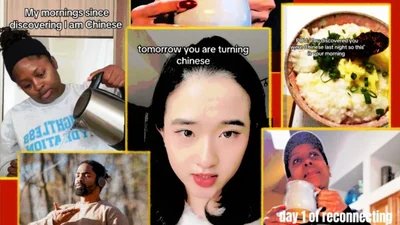
Noë Bryant spent 41 years identifying as African American. This year, she became Chinese.
Inspired by viral videos on social media, Bryant dragged her husband and two children to their local Asian grocery store in Austin, Texas. She asked ChatGPT which Chinese pantry staples she should buy and spent around $200 stocking up on soy sauce, goji berries and other ingredients.
“I told ChatGPT, ‘I want to become a Chinese baddie,’” said Bryant, a stay-at-home mom.
These days, she starts her mornings with warm herbal tea. Congee is her go-to meal. She wears slippers around the house, and wants to try acupuncture next.
Across the U.S. and Western world, non-Chinese people are embracing Chinese lifestyles. In Gen Z parlance, they’re “Chinamaxxing”—becoming the most Chinese they can be.
Drink hot water, never cold beverages. Don’t walk around the house barefoot. Do longevity exercises. The newly converted Chinamaxxers are obsessing over daily habits that are as second-nature to many Chinese people as brushing their teeth.
For decades, China lacked cultural cachet on the world stage, even as it became an economic superpower. Now, the country is enjoying a soft-power boost, just as the U.S. is losing some of its global appeal.
The seeds were planted a year ago, when an impending TikTok ban in the U.S. pushed a flood of Americans onto the Chinese social-media platform Xiaohongshu, also known as RedNote. There, Chinese users and the self-declared TikTok refugees taught each other Mandarin and English, exchanged recipes and swapped notes on daily life in their respective countries.
Popular American streamers Darren Watkins Jr., known as IShowSpeed, and Hasan Piker both toured China last year, bringing visions of the country’s futuristic skylines to millions of viewers. Labubu dolls made by Chinese toy maker Pop Mart became a global craze.
Chinamaxxing memes began peppering the internet. “You met me at a very Chinese time in my life,” social-media users would say, riffing on a line from “Fight Club.”
Wellness influencers and regular people alike started adopting traditional Chinese medicinal practices.
Sherry Zhu, 23, helped popularize habits like drinking hot water, eating boiled apples and wearing slippers around the house. She wanted to share parts of her personal life growing up Chinese American in New Jersey. In TikTok videos that have racked up millions of views, Zhu tells people they are turning Chinese.
“I thought that it would just be funny,” said Zhu. “Now people are more exposed to Chinese culture, and they want to learn more.”
Crissa Jewel says Zhu’s videos got her back on track to becoming Chinese.
The 31-year-old therapist in North Carolina was among the TikTok refugees on RedNote last year, but eventually stopped checking the app or learning Mandarin on Duolingo. Now, she’s drinking hot beverages—and even has her dogs lapping up warm water, which she said has cured her dog Coco’s stomach issues. Drinking tea with goji berries and red dates has helped ease her period symptoms.
Friends and family are surprised by the sudden shift to hot drinks. “They think that I’m strange,” said Jewel.
For many, the interest has more to do with wellness than politics. The videos blew up around the new year, when people were looking for ways to improve their health.
Alexia Torres, 24, started drinking hot water and eating boiled apples at the start of the year. Inspired by qigong, a Chinese movement practice, she has been hopping up and down every morning, which she says helps drain her lymphatic system. She’s considering taking up tai chi. Living in Los Angeles, she often sees elderly people who look fit for their age practicing the slow movements in the park.
“They may be onto something,” she said.
China’s state media is thrilled, amplifying Chinamaxxing as a sign of the country’s growing global influence.
Many Chinese Americans, on the other hand, are confused. Those who were bullied as kids for being different, or faced anti-Chinese harassment during Covid, have mixed feelings about people now wanting to become Chinese.
At first, Karen Lin was excited to see people embracing Chinese culture. “All of a sudden, being Chinese is cool,” said Lin, 32, who was born and raised in New York’s Chinatown.
Then things started getting weird. It felt like people were turning her culture into a costume.
“If I eat Mexican food, I’m not going to say I’m Mexican now,” she said.
Chinamaxxing has been a hot topic in Armond Dai’s group chats with Asian American friends. “Everyone was like, ‘What is happening?’” said the 28-year-old in California.
He grew up drinking hot water and boiling fruit for soups to combat colds. To see these practices now going viral feels surreal.
Dai’s hope is that people embracing Chinese lifestyle habits will also respect Chinese people.
“You are at a Chinese time in your life,” said Dai. “I will be Chinese forever.”
Write to Hannah Miao at hannah.miao@wsj.com