
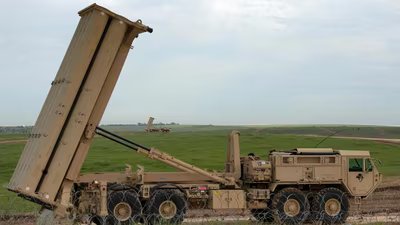
Iran has destroyed a key, $300-million radar system used to direct US THAAD missile defence batteries in the Gulf, putting Washington and its allies at risk of future attacks, reports said on Saturday.
Satellite photos showed an RTX Corp AN/TPY-2 radar and support equipment, used by US THAAD missile defence systems, was destroyed at Muwaffaq Salti Air Base in Jordan in the opening days of the war, CNN reported citing commercial satellite imagery. According to a Bloomberg report, the destruction of the equipment was later confirmed by a US official.
There were two reported Iranian strikes in Jordan: one on February 28 and one on March 3. Both were reported to have been intercepted.
“If successful, an Iranian strike on a THAAD radar would mark one of Iran’s most successful attacks so far,” Ryan Brobst, deputy director of the Centre on Military and Political Power at the Foundation for the Defence of Democracies, was quoted by Bloomberg as saying.
However, he added that “the US military and its partners have other radars that can continue to provide air and missile defence coverage, mitigating the loss of any single radar.”
What is the US THAAD system?
US Terminal High Altitude Area Defence(THAAD) units are designed to destroy ballistic missiles at the edge of the atmosphere, enabling them to engage more difficult threats than shorter-range Patriot batteries.
With the AN/TPY-2 radar out of commission, missile interception duties will fall onto the Patriot systems, for which PAC-3 missiles are already in short supply.
The US has eight THAAD systems globally, including in South Korea and Guam. The batteries cost about $1 billion each, with the radar comprising about $300 million of that, according to the Centre for Strategic and International Studies.
“These are scarce strategic resources and their loss is a huge blow,” Tom Karako, a missile defence expert with the Centre for Strategic and International Studies, was quoted by Bloomberg as saying.
A THAAD battery consists of 90 soldiers, six truck-mounted launchers and forty-eight interceptors — 8 per launcher — one TPY-2 radar, as well as a tactical fire control and communication unit. Each interceptor missile, manufactured by Lockheed Martin, costs about $13 million.
The Army’s current “eight-battery force is still below the force structure requirements of nine set back in 2012, so there aren’t exactly any spare TPY-2 lying around,” Karako said.
The earlier Iranian attack on the US radar system
Earlier in the war, an AN/FPS-132 radar in Qatar, a fixed installation unlike the mobile THAAD system, was damaged during an Iranian attack.
That system is an early-warning radar, designed to detect threats at extreme distances but without the precision needed to engage them.
Missile defence systems stressed out
Air and missile defence systems in the Gulf region have been stressed and, at times, overwhelmed by Iranian retaliatory attacks of drones and ballistic missiles. It has prompted fears that stockpiles of advanced interceptors such as THAAD and PAC-3 will soon run dangerously low.
On Friday, defence contractors, including Lockheed and RTX, met at the White House as the Pentagon pushes to speed weapons production.