
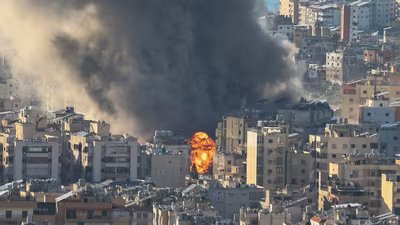
As the Middle East war deepens, global media outlets are sharply scrutinising US President Donald Trump’s decision to expand military operations against Iran following the killing of Supreme Leader Ayatollah Ali Khamenei.
Here’s how major international publications are framing the conflict and its possible consequences.
Also Read | Trump speaks of boots on the ground in Iran, hours after US defence secy Hegseth says ‘it’s not Iraq’
The New York Times
How Trump Decided to Go to War
The publication reports that President Trump’s decision to embrace military action was shaped significantly by Israeli Prime Minister Benjamin Netanyahu’s push to end diplomatic negotiations. It notes that few of Trump’s advisers voiced opposition.
The report describes Trump’s public messaging as inconsistent, saying he alternated between expressing interest in striking a deal with Iran and suggesting he wanted to topple its government. It adds that he made limited efforts to convince the American public that war was necessary and that his administration’s case included what it calls false claims about the imminence of the Iranian threat.
Behind the scenes, however, the paper says the move toward war gathered momentum, bolstered by Netanyahu’s lobbying and Trump’s confidence after the US operation that toppled Venezuelan leader Nicolás Maduro earlier this year.
The Washington Post
Trump pursues Iranian decapitation without a plan for what comes next
The Washington Post highlights what it describes as the United States’ fraught history of toppling autocratic regimes without securing stable democracies in their aftermath.
It reports that Trump placed responsibility on the Iranian public, quoting him as saying: “When we are finished, take over your government. It will be yours to take. This will be probably your only chance for generations.”
The paper says US allies are alarmed by what it characterises as a “bomb first” approach without a clear post-war strategy. Security officials in the Middle East and Europe, it reports, fear spillover effects, disruptions to global trade, and potential asymmetric retaliatory attacks, with no certainty that hardliners would lose their grip on power.
Al Jazeera
As bombing continues, Israel’s war aim in Iran becomes clear: Regime change
Al Jazeera frames Israel’s objective as regime change in Iran, while questioning how invested Israeli leadership is in ensuring a smooth transition.
The outlet notes that Prime Minister Benjamin Netanyahu addressed Iranians in Farsi following Khamenei’s killing, urging them to “come to the streets” and “overthrow the regime of fear.”
It adds that while there may be domestic support within Israel for the war, there is also recognition that the duration of the conflict may not be entirely within Israel’s control.
It also states how the US President has his “own endgame” and it could be that Trump pulls out and leaves Israel holding the bag. What happens then, I don’t know.”
BBC
Trump’s Iran endgame unclear after mixed messaging on war aims
BBC News focuses on what it calls mixed messaging from Trump about the war’s objectives. It notes that in more recent remarks, Trump did not outline what Iran’s future might look like after the war or explain why he believed the country would no longer pose a threat once operations conclude.
The outlet contrasts this with his earlier statement urging Iranians to “take back your government,” widely interpreted as an implicit call for regime change.
Deutsche Welle (DW)
Column: EU faces legal and moral dilemma
In a column, Deutsche Welle reports that while EU officials have been critical of Iran and imposed sanctions over human rights abuses, they are now grappling with whether the US-Israeli strikes align with international law and the rules-based order the EU advocates.
It notes that according to the Red Crescent, at least 555 Iranian civilians were killed in the strikes in addition to Khamenei. During a press briefing, EU spokespeople repeatedly avoided directly answering whether the strikes complied with international law, highlighting what the column describes as a diplomatic dilemma.
Together, the coverage reflects broad international concern over the war’s objectives, legality, and the absence of a clearly articulated endgame.
Russia TV
The Iran war could have unexpected consequences in Ukraine
Russia TV connected the repercussions of the tensions in the Middle East for the Russia-Ukraine war.
This analysis said that although the United States did not achieve an immediate “knockout blow” against Iran, the situation in Tehran is still unstable.
It suggests that Iran’s new leadership could, within a week or two, reconsider its stance and seek negotiations with Washington.
It further says that such an outcome would not be favourable for Russia, especially in terms of its international image.