
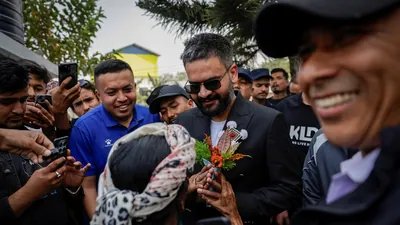
It might take a few days for Nepal to declare a clear winner in its national elections but raper-turned-politician Balen Shah has emerged as the man of the moment. The former Kathmandu mayor is now likely to be the next Prime Minister of Nepal.
The large lead and several wins of his new party founded in 2022 is also telling of the youth’s frustration with Nepal’s status quoist and elitist politics spearheaded by its old guards such as the former PM KP Sharma Oli.
This was also seen in the Gen Z protests, also called by some a “revolution”, which had although started with a social media ban but turned into large scale protests showing disillusionment of the youth with poverty, unemployment and frustrations with the life of its elite.
Follow here for live updates
Shah and his politics, including his mayoral campaign and his rap music became symbols of a new politics for the youth.
If the RSP’s strong performance continues, the results could mark a major victory for Nepal’s youth-driven political movement.
Here are top 5 points of the Nepal elections 2026:
1. Man of the moment – Balen Shah
Rapper-turned-politician Balendra ‘Balen’ Shah’s Rastriya Swatantra Party (RSP) has emerged as a dominant force, winning 29 seats and leading in 88 constituencies, as of 12 pm on Saturday — signalling a decisive shift away from Nepal’s long-standing political status quo.
Shah is also maintaining a lead over CPN-UML chairman and former prime minister KP Sharma Oli in his home constituency of Jhapa-5. Oli had resigned as prime minister following the Gen Z protests in September 2025.
RSP was also leading Nepal’s proportional representation vote with 35,091 votes – about 57.2 per cent of the 61,399 ballots counted till 12 pm.
2. A possible break from the old political guard
The election pits entrenched mainstream parties against a relatively new force that many believe could become the frontrunner. It may decide whether long-dominant leaders remain politically relevant or a younger leadership takes charge.
“This is heading to a landslide victory – this reflects the frustration that has been building up,” political analyst Chandra Dev Bhatta told AFP. “It is actually the people’s revolt against the established political parties,” he added.
Not many had predicted the scale of the political change.
“This is even a bigger upset than we expected — it underscores the level of public disenchantment with the old parties for under-performance, as well as anger over the events of September,” Kunda Dixit, publisher of Nepali Times told AFP news agency.
3. Gen Z protests laid the groundwork
While Shah and his party, along with several other young politicians, were poised to take centre stage in Nepal’s politics, it was the Gen Z movement that ultimately propelled youth politics forward.
What began as demonstrations against the government’s decision to ban 26 social media platforms soon grew into a broader movement against corruption, unemployment and poor governance and ultimately toppled the KP Oli Sharma government.
These elections, the first since the Gen Z protests, are raising the same concerns at the ballot box- with voters now seeking answers through the choice of a new government.
“This election will decide whether my 4-year-old son will live in Nepal or migrate to another country,” Biki Shrestha told The New York Times, a finance manager at an IT company. “We need change.”
“For many years, we have seen the same political parties, and they have not changed anything in Nepal,” Sujan Sipai told NYT, a teacher from Bhaktapur. “That’s why this time the entire country has stood up against corruption and for Balen.”
4. RSP’s young candidates
The RSP is fielding nine Gen Z candidates, several of whom were aides to Shah, a sharp contrast to Nepal’s traditional parties, which have far fewer Gen Z candidates despite stronger political machinery.
Until recently, these parties were led by septuagenarian prime ministers. Earlier this year, the Nepali Congress nearly split when Gagan Kumar Thapa, 49, ousted the party president who was three decades older.
Overall, 65 political parties contested the elections and nearly 160 Gen Z candidates were on the ballot, roughly half as independents.
5. Massive voter travel before polling
Ahead of the vote, about 800,000 people left Kathmandu Valley to travel back to their hometowns to cast ballots, as Nepal’s law requires citizens to vote in their registered constituencies, BBC reported.
With more than 80% of Nepal’s terrain mountainous and about a tenth of its 30 million population living in Kathmandu Valley for work or study, the migration led to packed highways and hours-long traffic jams, the report added.
This also shows increased anticipation about the outcome of the 2026 elections.