
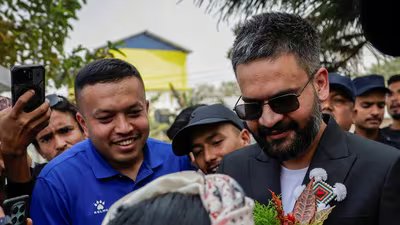
Nepal’s latest election has brought an unusual story to the spotlight: a young rapper-turned-politician challenging the country’s traditional political heavyweights. At the centre of this shift is 35-year-old Balendra Shah, widely known as Balen, whose campaign has captured national attention not only for its momentum but also for its communication strategy: “a speech every eight days”.
Two days after Nepal voted in its first election since the youth-led protests of September that forced the previous elected government to step down, the Rastriya Swatantra Party (RSP) is leading the vote count.
Shah is its candidate for prime minister, and if current trends continue he could ride the wave of public anger and hope unleashed during those protests all the way to the top office.
Follow latest LIVE updates here
While many factors have shaped the campaign, one element stands out: Shah’s strategical approach to public messaging, including a deliberate plan to deliver a major speech only once every eight days.
A tightly managed message
Behind the campaign is an elaborate organisational structure working from the upper floors of a six-storey building in Kathmandu.
Much of the planning is handled by the party’s research department. The unit is overseen by an 11-member board and supported by about 300 party workers, who are divided into national teams that coordinate activities across the country, Reuters reported.
Also read| Rapper to be next Nepal PM? Gen-Z favourite Balen Shah’s RSP heads to win general elections | 5 points
These teams manage multiple aspects of the campaign, planning rallies, monitoring voter reactions on the ground, and producing a constant stream of digital content. But rather than flooding the public with daily speeches, the party adopted a different tactic.
The speech formula
At the centre of Shah’s campaign is a communication model built around patience rather than constant visibility.
In an era where political messaging often moves at high speed, the strategy offers a different approach: fewer speeches, but bigger impact.
By spacing out major speeches every eight days and allowing time for each message to spread, the campaign tried to ensure that its narrative remained clear and consistent.
The idea was simple — give each message enough time to travel across the country, especially on social media.
A team of around 660 people helped amplify these speeches online, ensuring that each address stayed in public discussion for days before the next one arrived.
A party official explained the thinking behind the approach and said, “If you keep giving speeches, people get confused,” a party official said, asking not to be named. “We let opposition parties raise some issues, and then respond once. This way, our message stays clear.”
The carefully spaced speeches were complemented by daily activity on the ground. The party organised roadshows in five to seven districts each day, while Shah also made short appearances in one of Nepal’s seven provinces to interact directly with voters.
A campaign powered by supporters abroad
Running such a centralised campaign required significant funding. According to party officials, a large portion of that money came from Nepalis living overseas, particularly those based in the United States.
At the same time, individual candidates were responsible for financing their own local campaign programmes.
From rap star to national contender
Before entering national politics, Shah had already built a reputation as Kathmandu’s mayor after winning the post in 2022. His popularity as a rap artist with millions of followers on social media played a significant role in that victory.
When he joined the Rastriya Swatantra Party in December ahead of the election, the party quickly positioned him as a central figure in its national campaign.
One of the early moments that boosted his political momentum came during a rally on January 19 in the capital of Nepal’s Madhesh province. Standing alongside party founder Rabi Lamichhane, Shah addressed a crowd of thousands and said, “A Madhesi boy is going to become prime minister.”
The speech quickly spread across social media platforms, highlighting the campaign’s ability to turn individual moments into national talking points.
For party leaders, the message reflected a deeper political sentiment. Regions such as Madhesh and the wider Terai plains are among the most populous in Nepal, yet the country’s leadership has long been dominated by elites from Kathmandu and the surrounding hill regions.
A different style of campaigning
Shah’s personal campaign style also differs from conventional politics. He has largely avoided media interviews, choosing instead to speak directly with voters during impromptu stops.
In the Jhapa-5 constituency, where he is contesting the election, teams of youth volunteers help coordinate his outreach efforts. Alongside campaigning, these volunteers also gather feedback from voters about development issues and governance concerns.
Part of this feedback system is connected to the central campaign team in Kathmandu, allowing the party to track local reactions and shape its messaging accordingly.
Why this election matters
Nepal’s electoral system includes 165 seats decided through direct first-past-the-post contests and another 110 through proportional representation. The final results are expected next week.
If the current trends hold, Shah’s campaign could mark one of the most significant political shifts in the country in years. It would also demonstrate the growing power of youth mobilisation and digital campaigning in South Asian politics.
The election comes months after the 2025 protests that saw thousands of young people take to the streets over corruption, unemployment and restrictions on social media. The demonstrations intensified after clashes with police left 19 people, mostly students, dead.
Despite police orders, protesters continued to rally and demanded the resignation of the government led by then-prime minister KP Sharma Oli. On September 12, 2025, former chief justice Sushila Karki was sworn in as interim prime minister — becoming the first woman to hold the post — after days of unrest that left over 70 people dead and more than 2,000 injured.
(With inputs from Reuters)