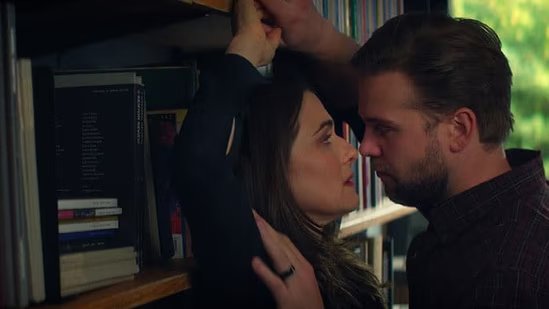
If the classic “Goodbye, Mr. Chips” were to be remade today, the Chipster’s cheerio would be all about his affair with an undergrad, using the wrong pronouns and including Norman Mailer on his required-reading list. The campus drama has become so predictably about concupiscence and cancellation that an academic comedy—say, “Vladimir”—might raise one’s expectations. But as they say around the lit department, abandon all hope.
Rachel Weisz and Leo Woodall
Created by Julia May Jonas and adapted from her novel, the eight-part “Vladimir” is directed in part by one of TV’s more reliable couples, Shari Springer Berman and Robert Pulcini (“Only Murders in the Building”). Their star, Rachel Weisz, is an actress who needs no adjectives from me (see “The Constant Gardener” just for instance). But despite the assemblage of first-rate parts, ignition proves elusive. Ms. Weisz never seems quite comfortable as the so-called M. And only if she were would the story about inappropriate lust between students and faculty—and faculty and faculty—be as amusing as she has to pretend it is.
The series is certainly an unflattering look at academia, but the cheap shots are pretty cheap, considering all the current acrimony surrounding higher education and the cartoonish way it’s so often portrayed. The faculty members are spineless and blinkered; the students are privileged twits; the politics are about appeasement. The educators need an education. Some will think this is a documentary. Documentaries aren’t hilarious either.
M’s problems are the stuff of parody. Her fellow professor husband, John (John Slattery), is a serial philanderer with whom she has a longtime “understanding”—that each would sleep around without repercussions. Unfortunately, their upstate New York college was not party to the deal: Six of John’s former undergraduate bedmates have come forward to accuse him of—well, it’s not clear, actually. All involved were consenting adults. Some of the brief liaisons are at least 10 years old. The alleged power-dynamic issue isn’t well-articulated. But John is in trouble, nonetheless. And so is M: Because she hasn’t come out against John publicly, the English department wants to put her tenured self on administrative leave. The students are upset with M, her colleagues say, while stabbing her in the back. Which would concern her much more if she weren’t besotted by the newest member of the faculty.
The animal magnetism of Vladimir (Leo Woodall)—a writer with a wife, Cynthia (Jessica Henwick); a baby; a new novel; and a new job—certainly eluded this viewer. But it has M doing hormonal cartwheels. There are regular visual manifestations of M’s sexual fantasies involving Vlad and references to the political risks she runs in pursuing another teacher. But pursue she does. One reason Vlad himself doesn’t quite convince as a character is that any author worthy of a university appointment would be at least marginally astute; not so oblivious to M’s very discernible yearnings; and not so slow to pull the proverbial trigger. But, you know, eight episodes.
“Vladimir” begs comparison to two other fairly recent defunct and superior comedies, for different reasons. One show was “The Chair,” which starred Sandra Oh as a harried head of department and involved a professor (Jay Duplass) who gets canceled for giving his class of infants an ironic Nazi salute. The other is “Fleabag”: Like Phoebe Waller-Bridge’s acidic reprobate, Ms. Weisz’s character is unconstrained by a fourth wall, sharing with us, reflecting, observing, making wisecracks but not being particularly funny. Ms. Weisz is shortchanged by the material, which likely wouldn’t be improved by, say, a snappier delivery. Or a less self-absorbed M.
Everyone seems to be trying too hard, with the exception of Mr. Slattery, which is why he’s the best thing here. John knows he’s going to be called on the carpet, to the extent that a public hearing will be held and witnesses summoned. (A lot of this is profoundly depressing.) But he goes with it, accepts his incipient doom—or whatever his lawyer daughter, Sid (Ellen Robertson), can wrangle—and Mr. Slattery gives a wonderfully wry performance. Ms. Weisz has done comedy; she was great in “The Favourite.” But this is a different kind of role. And a different kind of vehicle—one in which the steam is coming mostly from under the hood. One wheel is in a rut. And the passengers will invariably be asking, “Are we there yet?”