
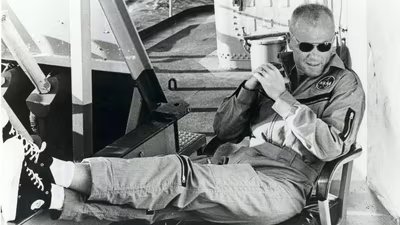
Astronaut John Glenn became the first American to orbit the Earth on February 20, 1962, but he was known also for a succinct and profound quote, with which he elevated the idea of space travel to a metaphysical level.
“To look out at this kind of creation out here and not believe in God is to me impossible,” John Herschel Glenn Jr said after the second and last time he traveled to space in 1998.
On his spaceflights, he said, he prayed every day — a seeming dichotomy as science and the concept of God are seen as adversarial ideas.
Glenn did not see it like that.
He was a devout Presbyterian.
“John Glenn is always used as that paradigmatic example of somebody who had a strong faith before becoming an astronaut, and for him it was reinforced by his experience in space,” Mark Shelhamer, a medical professor who served as the chief scientist for human research at NASA’s Johnson Space Center, told Washington Post in 2016 upon Glenn’s death.
In this seeming irony of being faithful and scientific, Glenn was not an outlier as such.
US astronaut James Irwin, who walked on the moon, dedicated his life to religion and founded the evangelist High Flight Foundation. Buzz Aldrin was an elder at his Presbyterian church, served himself Communion as one of his first acts during man’s first landing on the moon. “In the one-sixth gravity of the moon, the wine slowly curled and gracefully came up the side of the cup,” he later said of the moment.
“You will hear this from astronauts not infrequently — that they have felt the kind of oneness of humanity,” Shelhamer told WaPo.
James Irwin, who was aboard Apollo 15, the fourth human lunar landing, and was only the eighth person to walk on the moon, said of his experience, “As we got farther and farther away it (Earth) diminished in size. Finally it shrank to the size of a marble, the most beautiful marble you can imagine. That beautiful, warm, living object looked so fragile, so delicate, that if you touched it with a finger it would crumble and fall apart. Seeing this has to change a man, has to make a man appreciate the creation of God and the love of God.”
John Glenn was once asked to address this issue frontally. He told nes agency AP, “I don’t see that I’m any less religious by the fact that I can appreciate the fact that science just records that we change with evolution and time, and that’s a fact. It doesn’t mean it’s less wondrous, and it doesn’t mean that there can’t be some power greater than any of us that has been behind and is behind whatever is going on.”
A US Marine Corps aviator who was also a businessman and later a politician, Glenn was only the third American in space and the first to orbit the Earth, circling it three times in 1962.
A member of the Democratic Party later in life, he was a senator from 1974 to 1999 from Ohio. He flew into space again at the age of 77 in 1998.
Before joining the US space agency, Glenn was a fighter pilot, who flew missions in World War 2, and earned six Distinguished Flying Crosses and eighteen Air Medals in his a career.
His extreme experiences, which he said strengthened his faith in God, included one in 1957, when he made the first supersonic transcontinental flight across the United States. He had a camera with him that took the first panoramic photograph of the country.
Glenn was one of the “Mercury Seven”, the military test pilots selected in 1959 by NASA as the nation’s first astronauts. On February 20, 1962, Glenn flew the Friendship 7 mission, becoming the first American to orbit the Earth. He was the third American, and the fifth person, to be in space. He was the last living member of the Mercury Seven, and died at the age of 95 in 2016.