
It’s never been difficult for fans to appreciate what Quentin Tarantino brings to cinema with his films and the stories he tells. This includes whatever form they come in, which is why many of his early screenplays that turned into films are also highly regarded. Still, nothing compares to Tarantino’s most complete works. The films written and directed by him are his masterful contributions to cinema.
With this in mind, Tarantino is not immune to making a flawed movie, even if it feels like he never has. For casual moviegoers, there’s either a love, hate or whatever feeling about Tarantino’s films, and it’s not surprising when considering how distinctly specific his work is. The movie nerd who became a movie-maker, Quentin Tarantino is the cinephile’s director, but even they can see when something isn’t his best, and that was the case with Death Proof in 2007.
Death Proof Is Quentin Tarantino’s Most Flawed Yet Entertaining Movie

To be fair, the 2007 endeavor Grindhouse, which saw the combined experiment of Quentin Tarantino and Robert Rodriguez come to life with two films, was never meant to be anything more than a fun adventure for the two filmmakers. Death Proof and Planet Terror display two directors having fun with an idea that involves honoring a specific era and style of filmmaking that has long since past. Death Proof is not one of Tarantino’s essential career moments, and it was never meant to be. Even though Death Proof has been considered a true project of Tarantino by himself and by fans, it never really was.
What fans can appreciate about the 2007 genre gem is its ability to capture the feel of ’70s grind house movies that gave rise to a filmmaker like Tarantino. Inspiring him in a lot of ways, these films were known for exploiting genre, style, social issues and cinematic conventions, as well as being low-budget independent endeavors. In this regard, Death Proof succeeds in every way, and it’s because of its complete embodiment of this that it remains an entertaining watch from start to finish.
Tarantino fans can look back and appreciate that Death Proof is the only time that Tarantino got to make a car action B-movie, as well as a slasher movie. There have certainly been worse films in both genres. With that being said, Death Proof is still Tarantino’s most flawed directorial work. There’s good and bad to many of the decisions that Tarantino made in the film, and it really depends on whether it works for specific audiences.

While fans wait for Tarantino’s 10th film, the Once Upon a Time in Hollywood sequel is on the horizon, breaking this interesting trend.
A good example is the use of a black and white scene at the midpoint of the movie, which mostly just feels like purposeless fodder for Tarantino to gush over. However, there’s also an element of it that pertains to Stuntman Mike’s arrival and exit in the scene, looming in the shadows, stalking his next victims like a killer in a Hitchcock movie. It’s also used as a transition of change as it speaks to the “then and now” aspect of how Tarantino stylistically designs the story. The sequence pertaining to the first girls is shot entirely in a ’70s grain reminiscent of the low-budget 16mm or 35mm film stock used in old grind house movies.
The black and white scene transitions the story to the “final girls”, who represent a more “modern” group of female characters who can handle their stalker. Once cutting back to color, the grainy filter has been removed, giving weight to how these women will be different from the last ones, as well as commenting on how women were represented in old cinema as compared to new cinema. There’s purpose to everything Tarantino does, and it’s up to the viewer to discover what that purpose is. This doesn’t mean everything he does works.
Fans can’t deny how dialogue-driven most of the movie is, and that’s saying something for a Tarantino movie. Most of the time, the dialogue-driven scenes fit in neatly and add a lot of substance to the plot as well as breaking up the pace. That’s not the case with Death Proof, which drags a lot of these scenes out, leaving little room for action. Overall, a lot of what Death Proof is meant to be is an expression of cinema itself rather than a transcendent narrative that resonates on a deeper thematic level. It’s structurally conventional and poorly paced, but it’s almost worth all of it for its climactic final sequence.
Death Proof Is A Mess Of a Movie That Says A Lot About Cinema

For the most part, fans and casual audiences won’t deny that Death Proof is the least compelling Tarantino endeavor, even if die-hard fans know exactly how to defend their enjoyment of it. Maybe that’s the point, since cinephiles rally behind Tarantino being “their” director. Death Proof is the cinephile’s movie as it remains a very entertaining mess of different cinematic elements, references and homages. In the midst of all these ideas flying around, a rather introspective film comes to life that says a lot about cinema.
Quentin Tarantino has always honored the cinematic medium itself by reflecting its greatest elements and ideas in his own movies while then transcending all of it to make something completely his own. With Death Proof, this practice is even more deliberate, as the entire project is meant to be an experiment that honors a specific kind of filmmaking and a specific era of cinema. While Tarantino tries to make something fresh and new, it falls short of the level of his other movies in this regard. That doesn’t mean it isn’t a blast to watch.
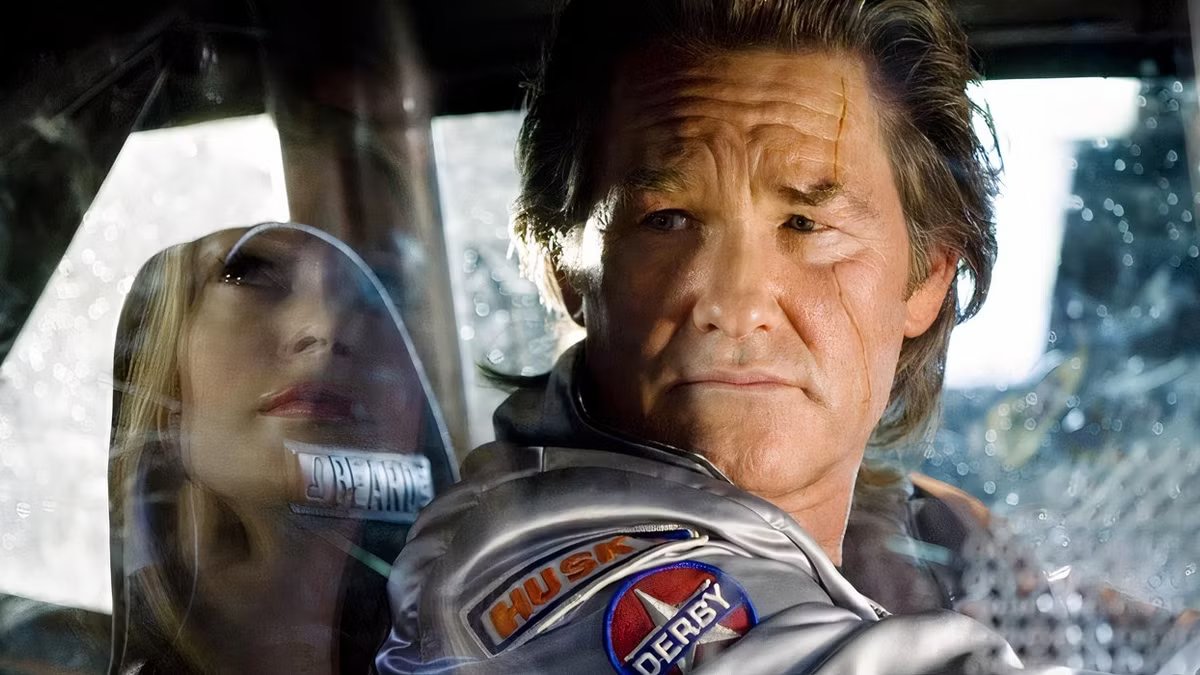
Even with the action lacking for most of the movie, Tarantino builds to a climax that is as entertaining as anything in car action over the last twenty-five years. There’s definitely something to be said about how the car action is designed and executed in the film, and Tarantino is completely pulling from his greatest inspirations. The same goes for the film’s B-horror aspects and slasher influences. Kurt Russell can play a better villain than people give him credit for sometimes, and he’s channeling the greatest slasher villains as Stuntman Mike. It might actually be one of Russell’s most underrated performances.

Filmmaker Quentin Tarantino said that one groundbreaking comic book adaptation has been worthy of the praise, blowing fans out of their socks.
Most of the performances deserve more credit than they’ve been given, but all of it springs from a place of innate passion and creativity from Quentin Tarantino. One of the main thematic elements of the film is how female representation is explored, and an overall commentary on how this has changed over various generations of cinema. 1970s grind house movies obviously come out of a time when women had very specific archetypal roles, especially in slasher movies, which Tarantino is putting on full display in Death Proof. By constantly exploring power dynamics between men and women, there’s a heightened thematic resonance to his characters.
Women seem to be demeaned by the sheer power of Stuntman Mike, while the women in the film constantly talk about how they control and manipulate the men in their lives. This pits specific gender roles against one another, and it leads to tragedy for the first group of girls. The second group of girls is different – Tarantino makes a few of them stuntwomen, which comments on the evolution of female representation in cinema and specifically slashers, but also on the evolution of female roles in the film industry itself. Stuntwomen are as capable as stuntmen, and that’s not something Tarantino is going to gloss over.
Therefore, stuntwomen are the ones who become Stuntman Mike’s demise. The power dynamic shifts greatly, almost as if Stuntman Mike is a character from a different era who just drove his death-proof killing machine into the wrong time at the wrong time. This is also all heightened by the fierce sexualization of characters as well as the sexualization of Stuntman Mike’s terrifying actions. The evolution of how far cinema has come is what Tarantino speaks about beyond making an homage piece to cinema that inspired him. What can be shown or discussed on screen now, as well as how it’s shown or discussed has changed significantly. This is Death Proof’s greater purpose as a film.
Death Proof Is One Of Quentin Tarantino’s Most Personal Films

Despite how it lands with audiences, Tarantino’s most flawed film is still something to appreciate. Regardless of its greater legacy in pop culture, the 2007 experiment is a personal endeavor for Tarantino, who is commenting directly on cinema itself and a type of cinema that he holds dear to him. Furthermore, the era speaks to him, and pop culture in general speaks to him in a certain way that fans see in this movie. At its core, Death Proof is a modern iteration of B-movies in the car action genre and slasher genre. A Southern B-movie made for modern audiences, people can learn a lot about cinema from witnessing a story where Tarantino teaches people all about it.

In the way that it was conceived, written, shot and edited, Kill Bill: The Whole Bloody Affair is the definitive version of Tarantino’s masterpiece.
Tarantino’s passion is on full display and there’s value in that. From his casting of Rose McGowan, who starred in Scream just a decade prior (a film Tarantino openly criticized as something he could’ve made better) to specific musical choices. Quentin Tarantino is honoring car action movies like Dirty Mary Crazy Larry and Vanishing Point, slasher movies like Drive-In Massacre and Death Race 2000 and exploitation movies of all kinds. Tarantino’s embodiment of the cinema he’s trying to depict can’t be overlooked, and even throwing in a “Wilhelm Scream” adds to this. The car action is brilliantly executed, the satirical violence fits better than ever and the camp factor is off the charts. Death Proof is not a perfect movie, but it’s the kind of movie people just don’t see anymore, and that makes it special.

- Release Date
-
May 22, 2007
- Runtime
-
113 minutes
- Producers
-
Bob Weinstein, Elizabeth Avellan, Harvey Weinstein, Robert Rodriguez, Shannon McIntosh
-

Kurt Russell
Stuntman Mike
-

- Entertaining characters throughout the movie.
- Effective commentary on cinema.
- Fun references.
- Great action climax.
- Poorly paced.
- Overly dialogue-driven.
- Lacking enough action.
- Minimal thematic resonance.