
In September 2025, former Nepal Prime Minister KP Sharma Oli stepped down after days of protests – led by youngsters, or Gen Z – a trend also seen in neighbouring countries like Bangladesh and Sri Lanka, where massive protests against the government led to regime change.
Oli, who has served as the Nepal PM four times, had to flee to safety after demonstrators in Kathmandu and other cities protested against an end to corruption, the reversal of the social media ban, and demanded accountability from the government.
Following days of protests, Oli resigned on September 9 and was kept under army protection and then to a secluded life, far from the political spotlight.
Cut to March 2026, when Nepal is holding fresh elections for the first time since the deadly protests, Balendra Shah has emerged as the frontrunner for the top post. However, the challenger to the rapper-politician is no other than Oli.
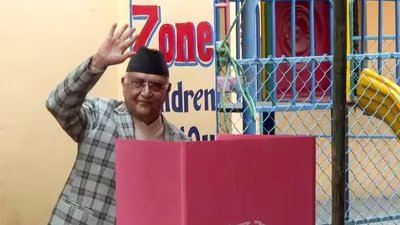
On Thursday, KP Sharma Oli, who is also the Prime Ministerial candidate for the Communist Party of Nepal (Unified Marxist-Leninist) (CPN-UML), cast his vote at a polling station in Bhaktapur.
From a time when he had to flee angry demonstrators, leading to his resignation, what has prompted KP Sharma Oli to try his luck again in Nepalese politics?
HT analyses the whereabouts of the former Nepal prime minister and whether Oli stands a chance in the changed politics:
Where is KP Sharma Oli?
When the protests raged in Nepal in September last year, one of the reasons behind the agitation was the prime minister of that time, KP Oli. Oli was not only the reason behind the protest, but also one of its ‘victims’.
Oli not only resigned, but his house at Balkot in Bhaktapur was also burnt down to ashes on September 9. Oli was at his official residence at that time.
Shortly after his resignation, he was flown to the army barracks in a forest area north of the capital Kathmandu. Days later, he was moved to a rented accommodation in Gundu, Bhaktapur, according to The Kathmandu Post.
However, the CPN-UML leader refused to back down, and the same month, he reappeared at a public event in Bhaktapur where he addressed the youth wing of his party.
Stakes for Oli in Nepal’s politics
When Oli resigned after the Gen-Z protest, many believed that the politics following the September 2025 protest would be a ‘political obituary’ for Oli and his nearly six decades in politics.
When the Gen-Z protestors toppled his administration, it was a turning point in Nepal’s politics – a development few would have anticipated – as Oli was at the peak of his power, leading a strong coalition.
However, the government toppled just days following the protests, which were largely centred around Kathmandu.
Months later, Oli is back in the Nepal battleground, facing a challenge on his home turf by 35-year-old Balendra Shah, who is portraying himself as a symbol of youth-driven political change, a factor that featured prominently in the Gen-Z protest.
After two weeks of campaigning, nearly 19 million people, including 800,000 first-time voters are all set to decide the fate of Nepal’s politics.
March 5 will decide whether the latest election was the epilogue in the former PM’s political journey, or it turns out to be another feather in Oli’s hat.