
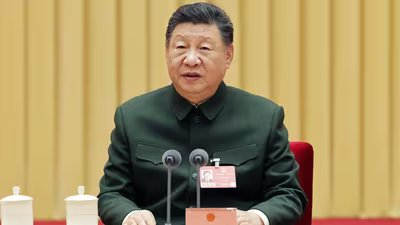
SINGAPORE—Chinese leader Xi Jinping has ousted most of his top generals. Now he must rebuild a high command battered by scandal and resume his push to ready his military to challenge the U.S.
To accomplish this, Xi declared while addressing military delegates at China’s legislature on Saturday, loyalty will be the paramount concern.
“The military must leave no room for people disloyal to the party, nor any place for corrupt elements to hide,” Xi said, in his most extensive comments on military affairs since purging his top general in January.
After presiding over a crackdown on corruption and disloyalty that has ripped through the armed forces at a speed and scale unseen since the Mao Zedong era, Xi is looking to assemble a new team of senior commanders—and his Saturday remarks underscored his demands for absolute loyalty and more stringent processes for selecting senior officers.
The scale of the task was on display this past week during annual meetings of China’s legislature. Some 36 members of the military caucus have been unseated from the National People’s Congress since its term started in 2023, or nearly 13% of the delegation’s 281 original members, according to a Wall Street Journal review of official disclosures. The military caucus accounts for more than one-third of lawmaker dismissals this term, far surpassing any other delegation.
Nine of the dismissals from the military caucus were announced in late February, while an additional three generals were ejected from a political advisory body this past week. More removals are likely, since the remaining military delegates include officers who have recently come under investigation or disappeared from public view.
Even with purges rolling through the People’s Liberation Army, the Chinese military continues to operate at a high tempo—but the uncertainty over senior command appointments is a challenge, including to the morale of a two million-strong force.
Xi has dismissed dozens of senior commanders over the past 2½ years, including five of the six uniformed officers serving under him on the Communist Party’s top military decision-making body.
The crackdown culminated in January with the purge of Xi’s closest military deputy, Gen. Zhang Youxia—the highest-ranking uniformed member of the party’s Central Military Commission, and one of China’s few senior generals with combat experience.
Since mid-2023, more than 75 senior military officers and defense-industry executives have been placed under investigation, removed from public office or abruptly replaced, according to the Journal review. They included top officers in China’s army, air force, navy, rocket force and paramilitary police, as well as major theater commands, including the one focused on Taiwan.
Of the 81 military officers promoted to three-star rank under Xi, at least 25—nearly one-third—have been expelled from the party, removed from public office or faced investigations, according to the Journal review.
The Center for Strategic and International Studies, a Washington-based think tank, recently tallied up about 100 senior officers who have been dismissed or gone missing since 2022, affecting about half the positions in the PLA leadership.
“The depth of the purge suggests that dissatisfaction with the PLA leadership’s performance is a major factor in Xi’s calculus,” said M. Taylor Fravel, director of the Security Studies Program at the Massachusetts Institute of Technology.
In his Saturday remarks, Xi demanded overhauls to the management of military budgets and tighter scrutiny on fund flows—areas seen as rife with corruption. “Spend every penny on where it matters most,” he said.
Filling the vacuum will be a challenge. Xi’s last remaining subordinate on the Central Military Commission is a career political officer with limited operational experience. Many senior posts overseeing combat planning and commanding major formations are being filled on an interim basis by deputies and lower-ranking generals.
“Xi will have his hands full in vetting replacements. The key criteria will be loyalty, professionalism and expertise,” said Joel Wuthnow, a senior research fellow at the National Defense University in Washington.
To restock the CMC, which now has just two active members left from the seven it started with in 2022, Xi must get his picks approved by the party’s Central Committee, which currently comprises more than 350 officials. This time-consuming process requires Xi to convene a party conclave.
Having purged his most powerful military chiefs, Xi has a freer hand to reshape the command structure around his goals. The new lineup would likely reflect his priorities, including military modernization and tightening supervision of an officer corps long riven with patronage networks.
While Xi has removed generals with combat experience, the next generation will likely bring know-how more useful for digital-age warfare.
Xi could use the purges as “an opportunity to promote young turks who are from the technological domains of the PLA,” such as cyberwarfare and aerospace, said Tai Ming Cheung, a professor at UC San Diego who has written books on China’s military.
“Some of the younger generals are quite competent and technically literate,” Wuthnow said. Most have experience commanding aircraft carriers and running integrated operations between air, sea and land-based forces, he said.
There are risks, too. “In the culture of fear that pervades the PLA, these new appointees may not give Xi the frank advice he needs,” Wuthnow said.
Alternatively, Xi could choose to leave the military leadership understaffed until the party’s next twice-a-decade congress in 2027.
Whatever approach Xi takes, he wouldn’t be able to call upon officers with Zhang’s unique stature as a combat veteran and member of China’s red aristocracy. Zhang’s father fought alongside Xi’s father and helped Mao seize power in 1949. The younger Zhang distinguished himself in China’s 1979 war with Vietnam and a border clash in 1984.
“A sycophant with no combat experience has to tell Xi what Xi wants to hear,” wrote Drew Thompson, a former Pentagon official who met Zhang when he visited the U.S. in 2012. “Zhang’s intellect, experience and his relationship with Xi made honesty and objectivity possible, and that makes him an exception among PLA generals.”
Such clout also made Zhang a potential alternate power center to Xi, who has routinely neutered even latent threats to his dominance.
Xi’s motives for ousting Zhang may never be definitively known. Some analysts say the purges appeared to dismantle two lines of political patronage in the military leadership, one led by Zhang and another by two other CMC members.
Some of the earlier targets were seen as Zhang’s associates, having worked with him on arms procurement, strategic missiles and space missions. Subsequent probes ousted a loose grouping of officers, led by Zhang’s perceived rivals, who once served with a PLA formation in the southeastern province of Fujian, a power base for Xi.
For several months, Zhang stood alone as China’s most powerful military officer until his own downfall in January.
Zhang had been in a position to influence major decisions and personnel appointments, through which he could entrench his own networks, said Guoguang Wu, a senior fellow at the Asia Society Policy Institute. “The closer you are to the leader and the more important you are, the bigger the threat you pose to Xi.”
The nature of China’s political system encourages officials to seek career advancement and security through personal ties with other officials, said James Char, an assistant professor at Singapore’s S. Rajaratnam School of International Studies. “Even China’s current strongman leader is incapable of averting malfeasance leading from his own political patronage.”
Write to Chun Han Wong at chunhan.wong@wsj.com