
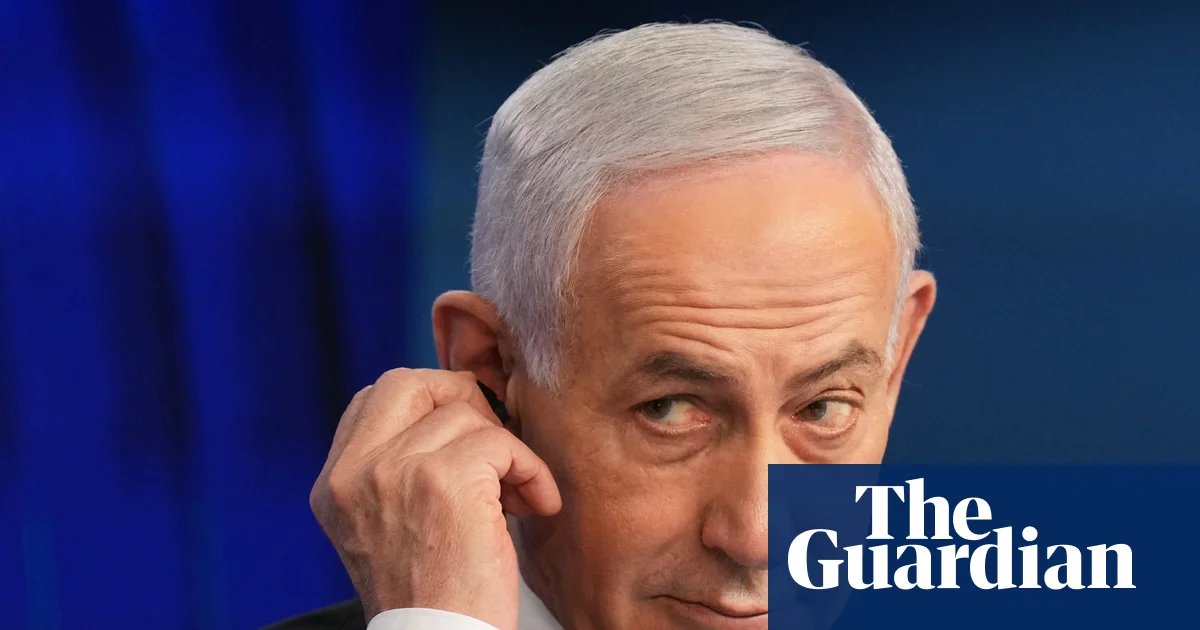
Benjamin Netanyahu is to meet Donald Trump at the US president’s Mar-a-Lago resort in Florida on Monday evening amid growing fears Israel could launch new offensives against regional enemies, potentially plunging the Middle East further into instability.
The Israeli prime minister left Israel on Sunday on his fifth visit to see Trump in the US this year.
High on the agenda will be the ceasefire in Gaza, which in October halted the devastating two-year-long war. Though the terms agreed for an initial phase have been largely completed, with Israel’s forces pulling back to new positions and Hamas releasing all living and all but one of the dead hostages, immense challenges face the implementation of the second phase of the president’s 20-point plan.
There are also fears Israel will launch new offensives against Hezbollah in Lebanon, breaking a ceasefire established more than a year ago, or against Iran, which it accuses of accelerating the manufacture of ballistic missiles in recent months.
Gershon Baskin, the co-head of the peace-building commission at the Alliance for Two States, who has taken part in back-channel negotiations with Hamas, said the timing of Netanyahu’s trip was “very significant” for Gaza.
“Phase 1 is basically over, there’s one remaining Israeli deceased hostage which [Hamas] are having difficulty finding,” he said.
Both sides accuse each other of ceasefire violations. Hamas has failed explicitly to commit to disarmament and has had considerable success in imposing its authority in the parts of Gaza where almost all the population is concentrated. Israel appears reluctant to withdraw from the 53% of Gaza it now controls or to allow free passage of aid into the territory.
“Phase 2 has to begin … and I think the Americans realise that it’s late because Hamas has had too much time to re-establish its presence and this is certainly not a situation that the Americans want to leave in place,” Baskin said.
More than 70,000 Palestinians, mostly civilians, died in Gaza during the war and almost all the territory’s 2.3 million population was displaced. About 400 Palestinians have died in Gaza since the October ceasefire, and huge numbers continue to live in conditions of acute hardship.
In recent weeks, heavy rain and cold temperatures have compounded the suffering in Gaza, where most housing and infrastructure have been badly damaged or razed.
The war was triggered by a surprise attack by Hamas in southern Israel in 2023, in which 1,200, mostly civilians, were killed and 250 others abducted.
Under the next stages of Trump’s plan, an interim authority made up of nonaligned Palestinian technocrats is to govern the Palestinian territory instead of Hamas and an international stabilisation force (ISF) of thousands of troops is to be deployed.
US officials have suggested the composition of the new authority could be announced in January.
On Friday, the US news outlet Axios reported senior Trump officials were growing frustrated “as Netanyahu has taken steps to undermine the fragile ceasefire and stall the peace process”.
Analysts in Israel and overseas agree.
“There are more and more signs that the American administration is getting frustrated with Netanyahu,” said Yossi Mekelberg, a Middle East expert at London-based thinktank Chatham House.
“The question is what it’s going to do about it, because phase 2 is right now going nowhere,” Mekelberg added.
For Netanyahu, a priority will be convincing Trump to allow Israel to act to prevent Iran from repairing the damage inflicted on its nuclear programme in its short war with Israel and the US this summer, or building its ballistic missile capabilities.
The Iranian president, Masoud Pezeshkian, said on Saturday that his country was in a full-scale war with the US, Israel and Europe. He added that the conflict was “more complicated and more difficult” than the Iran-Iraq war, which left more than 1 million casualties on both sides.
Meanwhile, efforts to secure a security agreement between Israel and Syria have failed to make significant progress and will also be on the agenda at Mar-a-Lago, local media in Israel said. Israeli officials have also called for more effective efforts to disarm Hezbollah in accordance with the 2024 ceasefire in Lebanon.
Netanyahu faces an election within 10 months, and the looming polls will influence his agenda, Mekelberg said. “Everything is connected to [his] staying in power,” he said.
Polls show Netanyahu’s current coalition would struggle to form a government if elections were held now, with many voters angry over the failures that led to the Hamas raid of 2023, moves to continue the exemption of most ultra-Orthodox Jewish men from compulsory military service in Israel and a series of scandals among other issues.
A close relationship with Trump would reinforce Netanyahu’s appeal among undecided voters and his base, and this suggests any public disagreement between the two leaders is extremely unlikely, analysts said.
Netanyahu is expected to seek to convince Trump of the need for Israel, which relies on the US for many of its defence needs, to maintain a military technological edge over potential regional enemies. Many Israeli officials were shaken when Trump said this year that he would allow the sale of F-35 fighter planes to Saudi Arabia, which he described as a “great ally”. The state-of-the-art stealth aircraft was key to Israel’s successes against Iran in this summer’s war.