
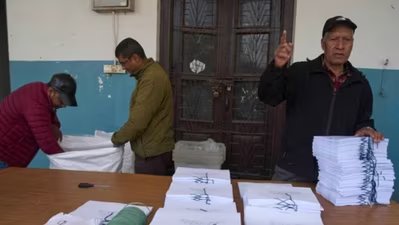
After a year marked by unrest and political instability, voters in Nepal headed to polls on Thursday, March 5, the first for the country since deadly student-led anti-corruption protests, often termed as Gen Z protests, toppled the KP Sharma Oli-led government in September 2025.
Nepal has since been under an interim government led by former chief justice Sushila Karki which promised to hold fresh elections and hand over power within six months. Right on time, the elections are being held to elect 275 members of parliament.
This election will decide the composition of the House of Representatives and determine who forms the next government.
Also read| Nepal Elections 2026: When will the result of the Gen Z-induced polls be declared?
Nepal’s mixed electoral system
Nepal follows a mixed electoral model that blends direct elections with proportional representation. The system is designed to balance local constituency representation with fairer national broader party strength.
First past the post (FPTP)
- Under the First Past the Post system, 165 seats in the 275-member House are decided through direct contests.
- The country is divided into constituencies, and in each one the candidate with the highest number of votes wins the seat, according to a report by The Sunday Guardian.
Proportional representation(PR)
- A further 110 seats are allocated through proportional representation.
- Voters cast a separate ballot for a political party rather than an individual candidate.
Why two voting systems?
The dual system is intended to prevent any single party from dominating Parliament outright.
When will the results of the Nepal elections be declared?
Nepal’s Election Commission has promised to release the results of the 165 directly-elected seats within 24 hours of ballot boxes being collected from across the country, an exercise that typically takes at least a day.
Officiating Chief Election Commissioner Ram Prasad Bhandari told local reporters that tallying the results of the proportional representation vote could take another two to three days. This is the type of voting that will decide the fate of candidates on 110 of the 275 seats.
Some of Nepal’s polling stations are located in difficult, mountainous terrain, making the collection of ballot boxes challenging. For some, the ballot boxes need to be carried down by hand, while at other places they have to be airlifted in and out of polling stations.
The Election Commission took more than two weeks to declare the final results of the last elections in the country, which were held in 2022.
Another reason for the delay is that political parties dispatch representatives to the counting centres. These representatives have sometimes disputed issues such as results and vote validity, further delaying the process.