
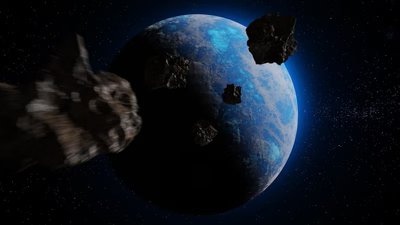
A NASA scientist has issued a chilling warning for earth. The planetary defense expert said that the earth had no way to defend against up to 15,000 undetected near-earth asteroids, all of which had the potential to wipe out an entire city.
Kelly Fast, a planetary defense officer at NASA, said that what kept her ‘up at night’ were the ‘asteroids we don’t know about’, as per the Daily Star.
The expert went on to say that it was not the ‘large ones’ which worried her as much, because they knew ‘where they are’. Similarly, the small ones hit the earth ‘all the time’ and is no cause for concern either. The expert highlighted that it was the rocks that measure about 500 feet that are a cause for concern because they’re small enough that they can skip detection, but large enough to dole out serious damage.
Also Read | NASA considers using nuclear bombs to destroy Moon-bound ‘city killer’ asteroid 2024 YR4
As per The Times of London, the scientist warned that these mid size asteroids, called ‘city-killers’ could cause ‘regional damage’.
What to know about ‘city-killer’ asteroids?
As per Fast, there are about 25,000 such asteroids passing within our planet’s vicinity, and we are only aware of where 40% of them are located.
She added that ‘even with the best telescopes’ these bodies are hard to detect due to their inconvenient sizes, as they accompany the earth around the sun, preventing them from reflecting any amount of sunlight.
Scientists plan to launch a ‘Near-Earth Object Surveyor space telescope’ next year to battle this issue. This makes use of thermal signature to spot dark asteroids and comets, which were earlier hidden from earth.
Fast flatly stated it was her responsibility to ‘find asteroids before they find us’ and potentially develop ways of ‘getting asteroids before they get us’. However, detection is only part of the problem. Currently, humans lack the defenses to stop ‘city-killers’.
“We would not have any way to go and actively deflect one right now,” as per Nancy Chabot, leader of NASA’s Dart (Double Asteroid Redirection Test). This test, in 2022, saw NASA crash a spacecraft into the mini moon of Dimorphos at 14,000mph, thus proving that they could knock asteroids off course. However, Chabot has noted that these conditions would be hard to replicate for a ‘city killer’ as they don’t have deflector crafts ‘sitting around ready to go’.
Chabot added that she didn’t see space agencies investing in such measures as they ‘lack the funding to keep planetary defenses on standby.’
“We could be prepared for this threat. We could be in very good shape. We need to take those steps to do it,” she noted.
This comes amid fears about city-killer asteroid YR4, which has been on our radar since 2024, and now has a 4% chance of striking the earth in 2032.