
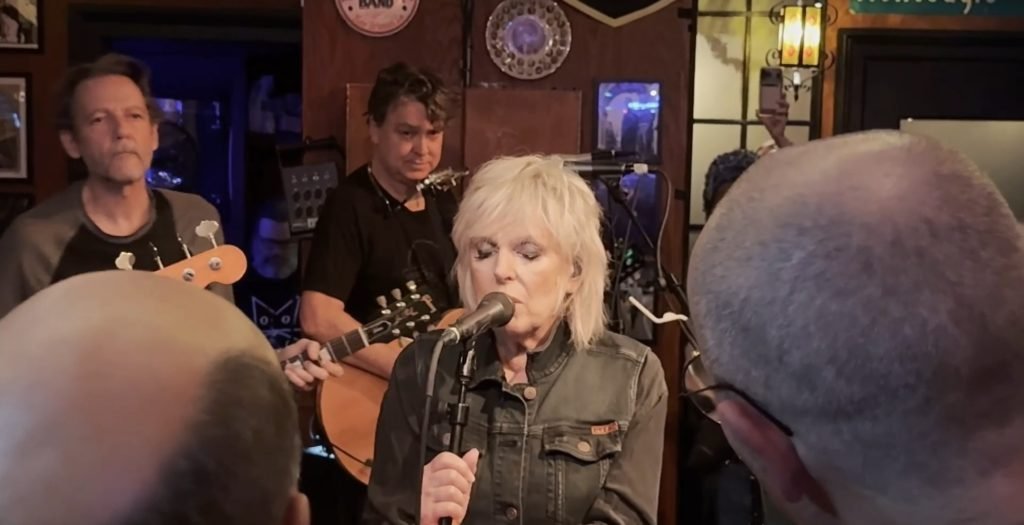
Lucinda Williams has been making music for decades. With her new album, she’s speaking and singing to this moment, calling it a battle cry and finding grit and grace in a world on edge. Senior arts correspondent Jeffrey Brown sat down with Williams for our series, Art in Action, as part of our CANVAS coverage.
Geoff Bennett:
Lucinda Williams has been making music for decades. Now she’s out with a new album and embarking on a 20-city tour across Europe and the U.S. In it, she’s speaking and singing to this moment, calling it a battle cry, finding grit and grace in a world on edge.
Our senior arts correspondent recently sat down with her for our Art in Action series exploring the intersection of art and democracy as part of our Canvas coverage.
Jeffrey Brown:
Five years ago, Lucinda Williams suffered a stroke. She had to learn to walk again and no longer plays her guitar. But here she is writing songs, a new album out, and still performing.
How does she do it?
Lucinda Williams, Musician:
Maybe a little stubbornness. A little stubbornness never hurt anybody.
Jeffrey Brown:
Williams has long been known as a musical storyteller, beloved by passionate fans who followed her for decades and by other leading singer-songwriters for her way with words. And the story she’s telling now is the title of her new album, “World’s Gone Wrong.”
Lucinda Williams:
It’s kind of a commentary on things that have been going on and just how it makes people feel. And it helped me to write about it. That’s why I write songs. Maybe I’m old-fashioned, but I feel like the artist’s role is to speak about what’s going on.
Jeffrey Brown:
Williams story goes back to a peripatetic childhood, most of it in town throughout the South, as her father, the poet Miller Williams, moved the family from place to place for university teaching posts.
Miller Williams, Poet:
They will not forget.
Jeffrey Brown:
He would gain his biggest audience reading a poem written for Bill Clinton’s second inauguration in 1997.
Now 73, Lucinda recalls having her 12-year-old mind blown in 1965, when her father’s friend brought over a new album by Bob Dylan, “Highway 61 Revisited.”
Lucinda Williams:
I started reading about him and listening to other singer-songwriters from that era, like Joan Baez and Judy Collins. They were all writing these songs about social injustice and anti-war. And I loved those songs and they spoke to me.
Jeffrey Brown:
And did you say at some point, I want to do that?
Lucinda Williams:
Yes.
Jeffrey Brown:
Yes?
Lucinda Williams:
That’s what happened.
Jeffrey Brown:
She would go on to success, including 17 Grammy nominations and three wins, with her unusual blend of rock, country, blues and folk, telling stories of hard living and heartbreak in such critically acclaimed albums as 1998’s “Car Wheels on a Gravel Road.”
The song “Passionate Kisses,” which she recorded in 1989, was covered and made famous by Mary Chapin Carpenter three years later. Williams built and kept her faithful following over many years.
Man:
Now here is Lucinda Williams.
Jeffrey Brown:
But all along the way, she battled a music industry that she felt wanted to put her into a box, a marketable genre. She refused.
Lucinda Williams:
I just didn’t think in those terms. They described it like I fell in the cracks between country and rock, because they have to have a market for you.
Jeffrey Brown:
Yes.
Lucinda Williams:
Because it’s a business. That’s why they call it the music business.
Jeffrey Brown:
Hers is a story of perseverance and resilience. And more recently she’s felt caught up in the times, angry at actions by the Trump administration, responding through songs she hopes hearken back to an earlier era of 1960s protest music. One is called, “We’ve Come Too Far to Turn Around.”
Lucinda Williams:
When I was writing that, I was thinking a lot about songs like “We Shall Overcome.” That’s a very powerful feeling to stand with a whole bunch of people, like-minded people, singing songs like that.
I wanted to feel that again. If you watch the news on TV or read the newspaper, there’s something every day that’s upsetting.
Jeffrey Brown:
Well, people have different ways of responding to that. You’re a…
Lucinda Williams:
They’re not responding enough, I don’t think.
Jeffrey Brown:
You don’t think so.
Lucinda Williams:
What I’d like to see would be more marching, more demonstrations and all of that, just speaking out more.
Jeffrey Brown:
On the new album, she collaborates with renowned figures like Norah Jones. The two played together recently on Jones’ podcast.
Mavis Staples joined on a cover of Bob Marley’s “So Much Trouble in the World.” As for Williams’ personal story of resilience, she continues to deal with the aftermath of her stroke, when everything, she says, went haywire. She told us of promising new therapy she’s undergoing that’s helping with what she calls her brain fog.
Lucinda Williams:
That’s probably been the hardest part…
Jeffrey Brown:
Yes.
Lucinda Williams:
… yes, is just that kind of confusion and memory loss and all of that. I just tried really hard to focus and pay attention. And I’m fine when I go on stage and I know what I’m supposed to do and all of that.
Jeffrey Brown:
So that’s a lot to deal with.
Lucinda Williams:
Yes. See, I told you I was stubborn, though.
Jeffrey Brown:
Lucinda Williams continues her tour in Europe and later back in the U.S. playing to old and new fans alike.
For the “PBS News Hour,” I’m Jeffrey Brown in New York.