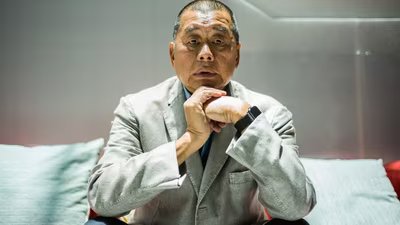
Monday’s sentencing of Jimmy Lai to 20 years in prison is a profound injustice to the publisher, but it also marks a symbolic end of an era. It confirms that Hong Kong, which was promised autonomy for 50 years after 1997, is now firmly under the iron boot of Beijing.
Jimmy Lai in 2020.
The sentencing marks the end of the 26-month trial of the owner of Apple Daily on trumped up charges of sedition and conspiracy to collude with foreign powers. But it also marks the end of the larger dream that Hong Kong could—under Chinese rule—preserve the freedoms that had transformed it from a barren rock into a beacon of hope and opportunity.
This was the question hanging over Hong Kong’s future when Britain and China issued a Joint Declaration in 1984 laying out the terms of Hong Kong’s return to Chinese sovereignty. Would China’s Communist Party uphold the rights and freedoms a free-market society requires? Sad experience said no, and we expressed our doubts at the time.
“The essence of the declaration,” we wrote more than 40 years ago, “is that five million largely free people will soon have their futures determined by a totalitarian government not known for tolerance or stability.” That editorial was headlined “Promises, Promises.”
With Jimmy Lai, our fears have been realized. The 20-year sentence might as well be a death sentence for the 78-year-old newspaper man. He is in ill health and has spent most of the last five years in solitary confinement, the lone window fixed to block sunlight. Along the way, the Hong Kong government denied him his choice of lawyer and stole his newspaper without a court order. Six former Apple Daily executives also received multi-year sentences on Monday.
This isn’t the way Hong Kong operated under Britain. It isn’t the way a world trade and financial center operates. But it is the way of Hong Kong under Chinese rule.
Whatever the Hong Kong government may say, the people who live there know Beijing is the real authority. The Apple Daily readers who queued up for tickets to Monday’s sentencing did so because they regard Mr. Lai as standing up for them. They see in him the virtues that made their city free and prosperous—and the courage it took for him to risk arrest and prison rather than abandon his principles or flee abroad.
Some hoped that Hong Kong’s judiciary might be the one institution to stop Hong Kong from being swallowed up by the Chinese system. It was never to be. In June 2024, British judge Lord Jonathan Sumption resigned from Hong Kong’s Court of Final Appeal. As he wrote in the Financial Times, the rule of law in Hong Kong is “profoundly compromised in any area about which the government feels strongly.”
Mr. Lai was convicted on national-security charges and will die in prison if nothing is done. President Trump, who has raised Mr. Lai’s plight with President Xi Jinping, is scheduled to visit Beijing in April. At this point someone in Beijing should be asking whether it is really in China’s interest to keep generating the bad press and opprobrium that come from keeping an old man incarcerated.
On Friday a bipartisan group of five U.S. Congressmen wrote the Nobel Peace Prize Committee in Oslo nominating Jimmy Lai for the prize. There’s no one more deserving. And Beijing’s message to Taiwan about what life would be like under rule by the Chinese Communist Party couldn’t be clearer.