
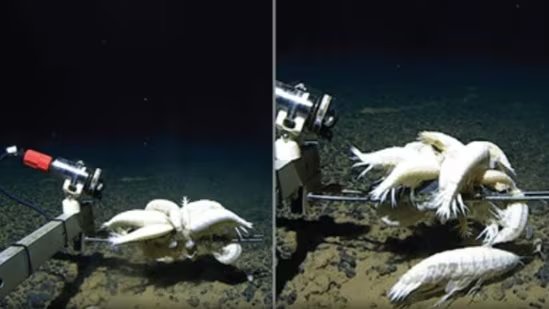
The supergiant amphipod Alicella gigantea, which was earlier regarded as rare, has now been discovered to be prevalent and flourishing in the ocean’s most profound and extreme habitats.
For many years, Alicella gigantea, a giant, shrimp-like crustacean, was perceived as a deep-sea oddity, with infrequent sightings regarded as exceptions. However, a recent study suggests that this species is significantly more widespread than was once thought.
Alicella gigantea: All we know about the research
Researchers have historically regarded the deep-sea Alicella gigantea as a rare inhabitant of the abyss.
However, recent genetic and exploratory studies published in Royal Society Open Science have revealed that this enormous crustacean occupies nearly 59 percent of the ocean floor worldwide, challenging longstanding beliefs about species rarity and providing new insights into deep-sea biodiversity, adaptation, and the resilience of life in Earth’s extreme habitats.
Also Read: HasanAbi tears into Nick Shirley over viral Minnesota daycare scam video, ‘you botched it for clickbait’
Alicella gigantea, often referred to as the “supergiant amphipod,” can grow to lengths of up to 34 centimeters (13.4 inches) and was first identified in 1899.
For many years, sporadic sightings and limitations in sampling led researchers to conclude that the species was either rare or distributed in isolated areas.
However, a comprehensive worldwide study led by Dr. Paige J. Maroni and her colleagues at the University of Western Australia is challenging this conventional wisdom.
Here’s what new study revealed
The researchers gathered 195 records from 75 different locations and conducted thorough genetic analyses.
Their results suggest that A. gigantea is not only present but is also flourishing in the abyssal (3,000–6,000 meters) and hadal (6,000–~11,000 meters) zones of the Pacific, Atlantic, and Indian Oceans.
Despite the animal’s enormous size and wide range of habitats, scientists found little genetic variation among populations worldwide, suggesting the existence of a single species capable of extreme dispersal, facilitated by both evolutionary stability and geological influences such as shifting ocean currents and tectonic activities over millions of years.
“As exploration of the deep-sea increases to depths beyond most conventional sampling, there is an ever-growing body of evidence to show that the world’s largest deep-sea crustacean is far from rare,” stated Dr. Maroni.