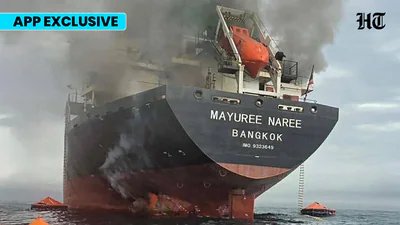
The US–Iran war appears to be intensifying by the day, with both sides adopting new tactics to gain the upper hand. Tehran is reportedly turning to a familiar strategy, deploying sea mines in the Strait of Hormuz, a crucial maritime route used by oil-carrying vessels. By threatening shipping in the narrow passage, Iran appears to be trying to disrupt traffic and raise the cost of further US military action.
A Thai-flagged cargo vessel was attacked near the Strait of Hormuz on Wednesday. (Reuters)
About 20% of globally traded oil passes through the narrow waterway each day. According to reports cited by CNN, nearly 15 million barrels per day of crude and another 4.5 million barrels per day of refined fuels could be affected if shipping is disrupted.
Oil prices have surged globally, rising more than 9% to cross the $100-per-barrel mark, according to a Reuters report. Meanwhile, reports that Iran has begun placing sea mines in the Strait of Hormuz have heightened fears and uncertainty across global markets and economies.
US President Donald Trump said forces have struck 28 Iranian mine-laying vessels, while also warning Iran to remove other vessels or face it could lead to ‘consequences’.
Have sea mines been used before?
Iran had used the same sea mine tactics during the conflict with Iraq in the 1980s, laying them in the Persian Gulf and Strait of Hormuz. In the Gulf War in 1991, Iraq had used as many as 1,300 mines, badly damaging two US Navy ships, including the USS Princeton, which cost about $100 million to bring back on line, according to US researcher Scott Truver, cited by AFP.
Also Read: Ships attacked in Strait of Hormuz, Iran’s oil ‘$200 a barrel’ threat, Mossad base targeted: 10 points on Iran-US war
How many sea mines does Iran have?
AFP reported that Elie Tenenbaum, a researcher at the French Institute for International Relations (IFRI), estimates Iran has around 5,000–6,000 naval mines, including “drifting mines that are extremely difficult to intercept.”
What are the different kinds of sea mines, and how do they cause damage?
Moored mines: These mines are anchored to the seabed with a cable or weight and float beneath the water’s surface. They explode when a passing vessel makes contact with them.
Drifting mines: These are considered the most dangerous type of mines. They drift freely on the water’s surface, carried by currents, making them difficult to detect and neutralise since they do not remain in fixed positions. “It’s the most rudimentary mine, the cheapest one, and the main threat in the Strait of Hormuz,” a former senior navy officer told AFP.
Limpet mines: Attached directly to a ship’s hull using magnets, these mines are typically triggered by a timed fuse.
Bottom mines: Resting on the seabed, these mines are typically triggered by sensors that detect a ship’s acoustic, magnetic, or pressure signature.
When a naval mine detonates underwater, it generates a powerful shock wave. The blast also forms a rapidly expanding gas bubble that can damage a ship’s hull, disrupt its electronic and mechanical systems, and destabilise the vessel. The severity of the damage depends on the size of the ship and the depth at which the mine explodes. When triggered, it can detonate up to 120 kilograms (264 pounds) of explosives.
Also Read:As Iran attacks Gulf shipping, shares fall, oil goes above $100 a barrel
How will Iran place these mines?
According to a report by AFP, Iran could also use speedboats to attach limpet mines to the hulls of ships, which are then set to explode after a timed delay, an ex-navy official said. The Defence Intelligence Agency (DIA) said in a 2019 report that Iran can rapidly deploy such mines in the Persian Gulf and the Strait of Hormuz using high-speed small boats equipped as minelayers. “Iran has equipped many of its Ashoora small boats with mine rails capable of holding at least one mine,” the report said.