
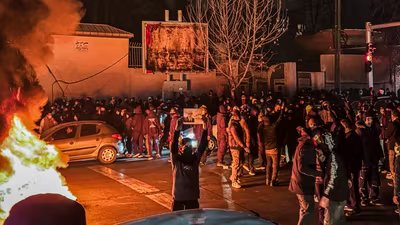
DUBAI—The Iranian businessman was chanting antigovernment slogans along with hundreds of other protesters on the streets of northern Tehran on Jan. 8 when police opened fire. A man a few feet away crumpled to the ground, bleeding profusely.
The 38-year-old entrepreneur said he bent to help the wounded man, but fled as more bullets slammed into the retreating crowd at a packed intersection bordered by a park and a shopping mall.
“When they fired I was full of anger,” he said. “I felt good and scared—good to be doing something.”
That night, authorities shut down the internet. It was the start of a multiday crackdown that human-rights activists say killed at least 3,000 people.
Like many of those who took to the streets, he was demonstrating for several reasons: deep disaffection with Iran’s clerical rulers, a yearning for more political and personal freedom, and anger at the spiraling cost of living driven by a sharp decline in Iran’s currency.
The Wall Street Journal decided not to use the entrepreneur’s name, despite his willingness to be identified, given the risks to his safety as Iranian leaders vow to punish those involved in the protests.
He joined the Tehran protests the day President Trump warned Iran’s leaders that if they started killing people “they will be hit very hard.” Reza Pahlavi, who is the son of Iran’s last shah and lives in the U.S., called for mass demonstrations.
The entrepreneur said he didn’t decide to protest because of those comments, but that he was heartened by the prospect of international support for the protesters and their calls for a change of government.
In an effort to keep security agents from identifying him, he left his cellphone at home and headed for the Punak neighborhood in northern Tehran, where he used to live and knew there would be people on the streets. He joined a crowd of protesters who were calling for freedom, he said.
After police started shooting, he retreated to his own neighborhood near the University of Tehran, where the situation was calmer. The next day he took to the streets again. He said police and pro-regime paramilitary forces were even more violent.
“The sound of gunfire came from everywhere,” he said. “It was like a battlefield.”
The entrepreneur’s life mirrors that of many who grew up under the rule of the ayatollahs, chafing at religious conservatism and suffering in an economy strangled by international sanctions and dominated in many ways by the Islamic Revolutionary Guard Corps.
As prices have soared and the Iranian currency has depreciated to record lows against the dollar, he sold his car in an effort to keep his company afloat.
“I am in difficulty like everyone else,” he said. “I do not have the things I want—a house of my choice, a car of my choice, entertainment and travel and everything else that is related to the quality of a normal life. This is not called living.”
Since dropping out of a Tehran university two decades ago because the course work was focused too much on religion and ideology and not enough on computer science, he has sought to carve out a life for himself as an internet entrepreneur and activist.
That has meant a long-running cat-and-mouse game with an autocratic government intent on stifling online expression and silencing dissent as he built and ran a company offering livestreaming and cybersecurity to Iranians looking to evade state monitoring.
Despite regular brushes with Iran’s security services, he said, he managed to stay in business for 17 years before finally pulling the plug in June, rather than submit to new registration requirements that he said contravened his belief that the internet should be free and open to all.
He has managed to use a Starlink terminal to evade the government’s latest internet blackout. He said he has been forwarding brief texts and audio messages from friends and other Iranians to worried relatives in the outside world.
On Jan. 10, the entrepreneur, who now has an office job, went back to work, passing a police station and mosque that had been torched. The company told employees to go home for their safety. When a call for protests went out again that evening, fewer people ventured out, he said.
The entrepreneur stayed home as well. “It was quiet,” he said of that day. “It was as if we had just realized what had happened to us and how many people had been killed.”
Still, he said, anticipation of some kind of U.S. military intervention mounted in the following days as Trump urged people to take to the streets and vowed to punish Iranian leaders for any bloodshed.
Then, on Jan. 14, Trump stood down after coming to the brink of ordering strikes, when his advisers told him the U.S. didn’t have the forces in the region to significantly damage the regime. Trump said he had been assured there would be no more killing.
On Friday, Trump thanked Iran for canceling 800 hangings that he said had been scheduled for that day, without saying where he got the information. A day later, Tehran’s prosecutor called the claim “nonsense” and said the country would act firmly and swiftly against lawbreakers.
“The fact that he said, ‘Don’t kill people or we will come,’ and after all that killing nothing happened, disappointed people,” he said, referring to Trump. “Our numbers dwindled.”
The U.S. is moving an aircraft carrier and other forces to the region, signaling that an attack against the regime remains possible.
But Iranians reached by the Journal, along with some foreign government officials and analysts, say the current round of protests is all but over after the violence.
The government is signaling its confidence that it has regained control of the streets, with Supreme Leader Ali Khamenei calling Trump a “criminal” and judicial officials saying they would deal firmly with those they said were behind the unrest.
“The feeling of being on this path alone was very painful,” the entrepreneur said.
Write to David S. Cloud at david.cloud@wsj.com