
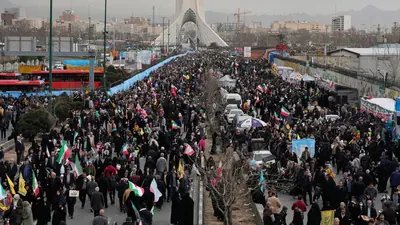
The death toll from the Iranian crackdown over the Islamic Republic’s nationwide protests last month has reached at least 7,002 people killed, with many more still feared dead.
The latest figures are according to the US-based Human Rights Activists News Agency. The HRANA relies on a network of activists in Iran to verify deaths.
Iran’s government offered its only death toll on January 21, saying 3,117 people were killed.
HT could not independently verify the death toll numbers.
The rise in the death toll comes as Iran tries to negotiate with the United States over its nuclear program.
The Iran-US tensions and the Benjamin Netanyahu twist
The rise in the number of dead from the demonstrations adds to the overall tensions facing Iran, both inside the country and abroad, as it tries to negotiate with the United States over its nuclear program. A second round of talks remains up in the air as Israeli Prime Minister Benjamin Netanyahu pressed his case directly with US President Donald Trump, intensifying his demands on Tehran in the negotiations.
“There was nothing definitive reached other than I insisted that negotiations with Iran continue to see whether or not a Deal can be consummated. If it can, I let the Prime Minister know that will be a preference,” Trump wrote afterwards on his Truth Social website.
“Last time Iran decided that they were better off not making a Deal, and they were hit. … That did not work well for them. Hopefully, this time they will be more reasonable and responsible.” Meanwhile, Netanyahu told reporters before boarding a plane to return to Israel that Trump believes that his terms and Iran’s “understanding that they made a mistake the last time when they did not reach an agreement, may lead them to agree to conditions that will enable a good agreement to be reached.”
On the other hand, Netanyahu said he “did not hide” his own “general scepticism” about any deal, and stressed that any agreement must include concessions about Iran’s ballistic missiles program and support for militant proxies, not just the Islamic Republic’s nuclear program. He described talks with the US president as “excellent.”
Meanwhile, Iran at home faces still-simmering anger over its wide-ranging suppression of all dissent in the Islamic Republic. That rage may intensify in the coming days as families of the dead begin marking the traditional 40-day mourning for the loved ones.
Talks continue
Senior Iranian security official Ali Larijani met with Qatari foreign minister Sheikh Mohammed bin Abdulrahman Al Thani on Wednesday. Qatar hosts a major US military installation that Iran attacked in June, after the Donald Trump administration bombed Iranian nuclear sites during the 12-day Iran-Israel war in June. Larijani also met with officials of the Palestinian Hamas militant group, and in Oman with Tehran-backed Houthi rebels from Yemen on Tuesday.
Larijani told Qatar’s Al Jazeera satellite news network that Iran did not receive any specific proposal from Washington in Oman, but acknowledged an “exchange of messages.”
Qatar has been a key negotiator with Iran in the past, with which it shares a massive offshore natural gas field in the Persian Gulf. State-run Qatar News Agency reported that ruling emir Sheikh Tamim bin Hamad Al Thani spoke with Trump about “the current situation in the region and international efforts aimed at de-escalation and strengthening regional security and peace,” without elaborating.
The US has moved the aircraft carrier USS Abraham Lincoln, ships and warplanes to the Middle East to pressure Iran into an agreement and have the firepower necessary to strike the Islamic Republic should Trump choose to do so.
Already, US forces have shot down a drone they said got too close to the Lincoln and came to the aid of a US-flagged ship that Iranian forces tried to stop in the Strait of Hormuz, the narrow mouth of the Persian Gulf.
Trump told the news website Axios that he was considering sending a second carrier to the region.
“We have an armada that is heading there, and another one might be going,” he said.