
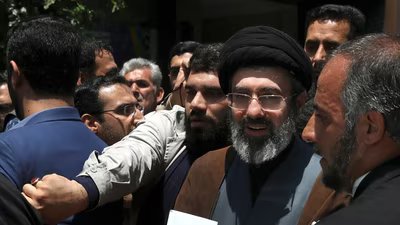
He has spent his adult life deliberately invisible — no elected office, no public speeches, no formal title. Yet, as Iran’s Assembly of Experts deliberates over who will lead the Islamic Republic following the killing of Supreme Leader Ayatollah Ali Khamenei in joint US-Israeli airstrikes on February 28, one name has surfaced more insistently than any other. That’s Mojtaba Hosseini Khamenei, the late leader’s son.
No decision has been formally announced; and Iran’s top clerics are nearing a decision. The Assembly of Experts has narrowed its list of candidates and will announce a decision “as soon as possible,” members told Iranian state media over the past two days.
Who is Mojtaba? Quite figure, leading name
Formally, the decision rests with Iran’s Assembly of Experts, the powerful clerical body tasked with selecting the country’s supreme leader. In practice, the outcome will almost certainly emerge from a much smaller circle: senior clerics, the Islamic Revolutionary Guard Corps, and the security establishment that has long underpinned the Islamic Republic’s power structure.
Several names surfaced. But the leading contender is Mojtaba Khamenei. Unlike many figures in Iran’s hierarchy, he has for years operated quietly behind the scenes from within his father’s office, cultivating influence across the security establishment, particularly within the elite military force IRGC.
Born in 1969 in the holy city of Mashhad, Mojtaba is a product of the Islamic Republic’s security and clerical world. While Mojtaba has never held public office, his father served as Iran’s third president between 1981 and 1989. Religiously speaking, Mojtaba, like his father before he became supreme leader, is only a mid-ranking cleric. He teaches theology at the renowned Qom seminary.
As with his father, and for political purposes, the Assembly of Experts would have to elevate Mojtaba’s status to a grand ‘ayatollah’ too.
Georgetown University professor and Iran expert Mehran Kamrava told CBS News that the prospect of a Mojtaba as the new leader would be an act of “institutional self-preservation”.
“The deep state in the Islamic Republic wants continuity,” Kamrava said, “If Mojtaba indeed is chosen as his father’s successor, it would indicate more than anything else that the Islamic Republic is trying to ensure continuity. The assumption inside Iran is that Mojtaba has a similarly superior position in relation to the commanders of the Revolutionary Guards.”
There are questions, though, as sections in the political and religious establishment categorically reject hereditary or dynastic succession, news agencies have reported. Dynastic rule is considered antithetical to the Iranian Revolution, which deposed the monarchy led by Shah Mohammad Reza Pahlavi in 1979, noted Iran International in a recent report.
Contenders’ list, and the big hint
Potential candidates to succeed Ali Khamenei included, besides son Mojtaba, his aides Asghar Hijazi, Ali Larijani, Sadiq Larijani, Alireza Arafi, Mohammad-Mahdi Mirbagheri, and Mohsen Araki.
Then there’s Hassan Khomeini, the grandson of Islamic Republic founder Ruhollah Khomeini.
Ayatollah Alireza Arafi has drawn particular attention. The 67-year-old cleric is an influential figure in the Islamic Republic’s religious establishment and was handpicked by Khamenei to join the Guardian Council in 2019, and was elected to the Assembly of Experts three years later. He now sits on the three-member interim leadership council guiding the country pending a permanent succession.
Ayatollah Mohammad Mehdi Mirbagheri, popular with hardliners and a member of the Assembly of Experts, was close to the late Ayatollah Mohammad Taghi Mesbah Yazdi, a fellow hardliner who wrote that Iran should not deprive itself of the right to produce “special weapons”. That was a veiled reference to nuclear arms. Mirbagheri is currently head of the Islamic Cultural Center in Qom, the main center for Islamic teaching in Iran.
It was Mirbagheri who said a consensus was all but reached; but gave no names. Iran’s Mehr news agency on Sunday quoted him as saying “some obstacles” still needed to be resolved regarding the process.
Ayatollah Mohsen Heidari Alekasir, another member of the Assembly of Experts, said in a video released by Nournews on Sunday that a candidate had been picked based on Khamenei’s advice that the top leader should “be hated by the enemy”.
Then he dropped the hint that Mojtaba may in fact be chosen. “Even the Great Satan [the US] has mentioned his name,” Alekasir said, apparently referring to US President Donald Trump’s statement that Mojtaba Hosseini Khamenei was an “unacceptable” choice for the US.
Some analysts have also pointed to Hassan Khomeini, grandson of Islamic Republic founder Ayatollah Ruhollah Khomeini. Among clerics and reformist circles he commands respect, though his relatively moderate reputation could make him a difficult choice for Iran’s hardline establishment, CBS reported.
Similarly, Ayatollah Sadeq Larijani, a former judiciary chief and member of one of Iran’s most powerful political families, has long been viewed as a plausible successor because of his clerical credentials and deep ties to the country’s political establishment.
How analysts see it
Amin Saikal, professor emeritus at the University of Western Australia, has been quoted as saying that, while some names appear as frontrunners, the Assembly of Experts could opt for another member, or even someone from outside it. “There is going to be a great deal of horse-trading,” he said. “Whoever emerges might be a compromise.”
There were unconfirmed reports by Israeli media that Mojtaba was injured; these came soon after buzz gained traction that he would be chosen as the next leader.
The succession is unfolding against an unprecedented backdrop. The country is in an active state of war, with Iranian cities recovering from strikes and the country’s nuclear infrastructure severely damaged in an earlier attack by Benjamin Netanyahu’s Israel regime and Trump-led US.
Sanam Vakil, director of the Middle East and North Africa program at Chatham House, had said earlier that the Assembly of Experts may not convene in full until the US and Israel wind down their operations. “They cannot risk further death and damage to the institution,” she told CNN. But members have since said an in-person meeting may not be needed at all.
However, Vakil also cautioned that ideological fissures within Iran may will not be resolved with just an appointment of a single figure.
“Moments of succession tend to strengthen conservative and security-driven factions, at least initially,” she was quoted as saying.
She added, “Any internal debate about the country’s direction is likely happening quietly and within narrow elite circles rather than in public view. If reform politicians have ambitions, this is their now-or-never moment.”