
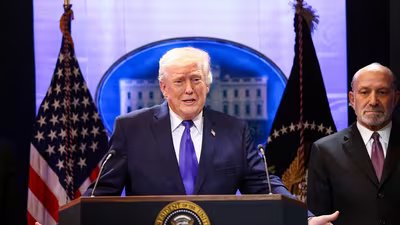
The United States Supreme Court’s decision to strike down President Donald Trump’s global tariffs, and his imposition of a 15% global tariff in response to the verdict, have concerned the world and its trade order. India and China seem to be among the biggest winners, while the United Kingdom appears to be the biggest loser from Trump’s latest order.
The US Supreme Court handed Trump a major setback when it cancelled several tariffs he had imposed during the global trade war. Just hours after the decision, Trump announced a fresh 10% duty on imports into the US from every country starting Tuesday, later increasing it to 15% on Saturday.
ALSO READ | India, US postpone interim trade deal talks; March timeline likely to get hit amid Trump tariffs row
Here’s where some of the big countries in the world stand:
India, China among winners
China, India and Brazil are among the countries now facing reduced tariff levels on exports to the US after the top court ruled that Trump’s use of the International Emergency Economic Powers Act to impose duties was unlawful.
India
Tariffs on Indian goods had climbed to 50% before dropping to 25% in early February, followed by another cut to 18% promised by the US after Prime Minister Narendra Modi and Trump finalised a trade deal.
Right after Friday’s ruling, they fell to 10%, then rose to 15% on Saturday, the highest allowed under Section 122.
For India, the present 15% rate still improves on the 18% set in the bilateral framework revealed this month and is far lower than the 26% Liberation Day level.
China
China said it is closely watching the Trump administration’s move to continue its tariff system through other trade measures in what was its first official response since the Supreme Court decision.
On Monday, Beijing also urged the United States to cancel unilateral tariffs announced by Trump since “there are no winners in a trade war and protectionism leads nowhere”.
For countries such as China, which also had a 10% fentanyl tariff removed by the courts, exports now face less harsh rates.
Apart from Beijing, Mexico also had fentanyl-linked levies, so it benefits as those charges no longer apply.
ALSO READ | Most Americans are unhappy with Donald Trump’s policies, 60% dislike tariff tirade: Poll
UK among biggest losers
The UK could end up among the worst hit after the Supreme Court decision cancelling Trump’s global tariffs.
Britain had been benefiting from a lower reciprocal tariff of 10% than many other countries, which gave it an edge, but Trump’s pledge to raise it to 15% for all nations means firms may now face steeper duties.
The UK is set to face the largest increase, followed by Italy and Singapore, according to Global Trade Alert, while Brazil, China and India are likely to gain the most.
UK officials are now urgently trying to convince the US administration to exclude it from the higher rate. The British Chambers of Commerce says this could increase costs on UK exports to the US by up to £3 billion ($4 billion) and affect 40,000 British companies.
“We are having conversations at the highest levels to make sure that what we regard as being in our national interest is heard loud and clear with our American counterparts,” cabinet minister Bridget Phillipson told Sky News on Sunday.
EU says US must honour trade deal
The European Commission said on Sunday that Washington must stick to the terms of the trade deal agreed last year with the EU, after Trump announced fresh global tariff increases a day after the Supreme Court ruling.
“A deal is a deal,” a commission statement said.
“As the United States’ largest trading partner, the EU expects the US to honour its commitments set out in the Joint Statement — just as the EU stands by its commitments,” it added.
The EU and the United States last year reached an agreement that set US tariffs at a maximum of 15 per cent on most European goods.
Could EU freeze trade deal with US?
The European Parliament’s trade chief will propose pausing the ratification process of the European Union’s trade agreement with the US until they receive full details from Trump’s administration about its trade policy.
Bernd Lange, chairman of the parliament’s trade committee, said he will propose halting legislative work on approving the deal on Monday “until we have a comprehensive legal assessment and clear commitments from the US.”
With inputs from agencies