
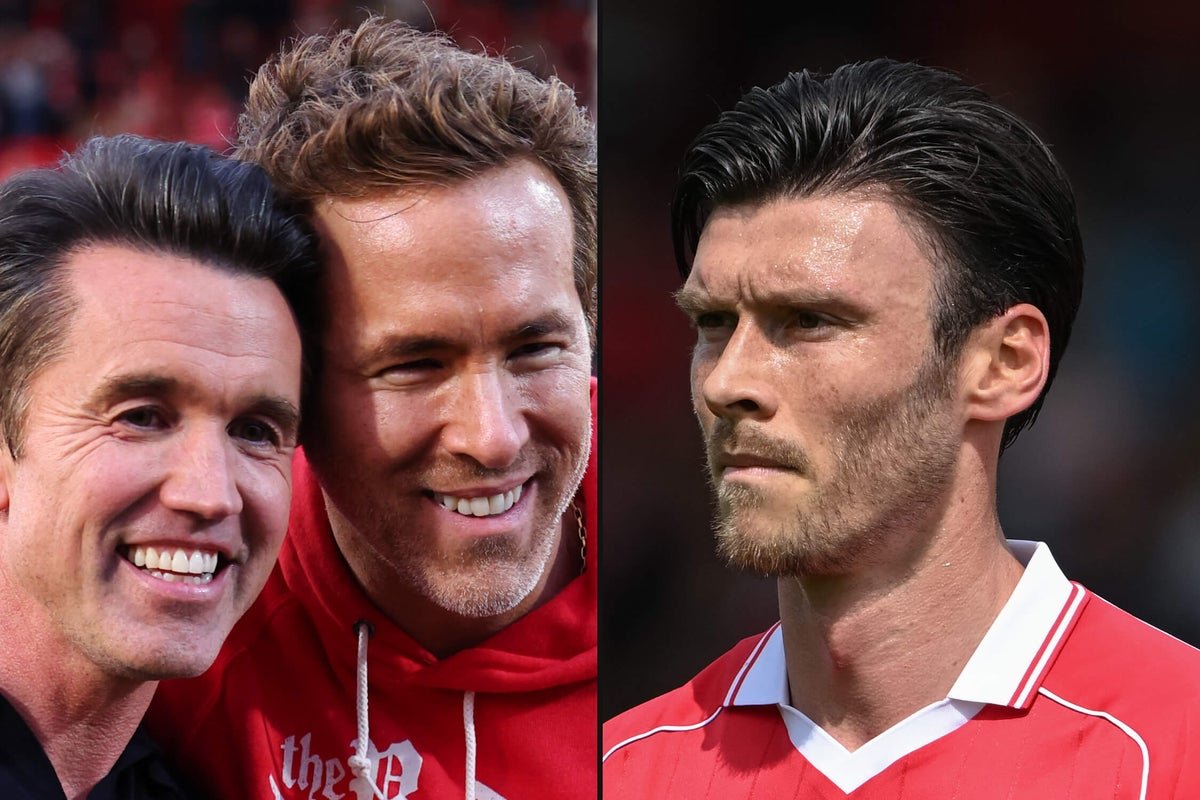
It’s become as much a feature of a new signing’s welcome to Wrexham as the induction songs traditionally performed in front of their team-mates and staff.
With the ink still drying on the contract, Phil Parkinson will turn to the new arrival and warn them to expect a ‘phone call from either a New York or Los Angeles dial code’, as co-owners Ryan Reynolds and Rob Mac want to offer their own greetings.
“Rob and Ryan are real successful in their own right,” the Wrexham manager tells The Athletic. “But they both want to talk to the new lads as a chairman and owner about Wrexham Football Club. As people, they also want to talk about what the club is all about.
“I think it’s fantastic they do that. Even though both of them are on the other side of the Atlantic, they keep in touch with the lads.”
Recruitment has been key to Wrexham’s remarkable rise under their Hollywood owners. Seventy-three signings have been made on Parkinson’s watch, Liam McAlinden and Shaun Brisley arriving on the same day in July 2021 to get the ball rolling, both joining as free agents following their release by Morecambe and Port Vale respectively.
Along the way there have been far more hits than misses, with Paul Mullin and Elliot Lee among his early pivotal additions on free transfers. This impressive success rate continued last summer, the busiest window of Parkinson’s reign as 13 new faces arrived as part of a £33million rebuild designed to make Wrexham competitive in the Championship.
Three of those were deadline-day signings, the clubs involved as Issa Kabore (Manchester City), Ben Sheaf (Coventry City) and Dom Hyam (Blackburn Rovers) moved to the SToK Cae Ras testament to just how far Wrexham have come under Reynolds and Mac (formerly McElhenney).
Famously, neither actor is involved in the day-to-day running of Wrexham. A combination of demanding work schedules and an appreciation from the very start that football is best left to those fully versed in this unique industry explains what is a relatively hands-off approach compared to some overseas owners.
But the pair remain across every facet of the club’s affairs, including transfers. Budgets, for example, are now agreed by the pair in conjunction with chief executive Michael Williamson, who also keeps them up to speed with how negotiations are progressing.

Reynolds and Mac stay across all the details of Wrexham’s transfers (Oli Scarff/Getty Images)
And, while today a global profile earned through those three consecutive promotions and an Emmy-award-winning documentary means any first contact between the owners and a new signing invariably comes after the deal is done, this wasn’t always the case.
“In the early National League days, we had to really sell the vision of the club,” adds Parkinson. “Occasionally, Rob and Ryan would be brought in to have a chat. They did that with Mulls (Mullin) at the start. Same with Elliot Lee (a year later).
“Don’t forget, there had been no documentary at this stage. No promotion (to the EFL) and it was quite a hard sell. We were a National League club and we had to work really, really hard to bring Elliot Lee, Mulls and others to the club.
“Football has had a lot of clubs who talk big and tell you a great story only for nothing to come to fruition. So, players, agents, their families wanted to speak to us to know we were serious.”
Clearly, such a USP as a phone call from Deadpool can only help Wrexham land big targets alongside a spending power made possible by income streams more commonly associated with lower Premier League clubs.
But, there’s a lot more to their recruitment operation than either of these advantages, including a transfer committee boasting decades of experience, skilled negotiations and a due diligence process that includes the manager insisting on meeting prospective signings face to face — so, as a former chairman who once employed Parkinson puts it, “Phil can see the whites of their eyes”.
Transfers may be restricted to two windows per year in the modern game but the recruitment process never really stops. Not for Parkinson, at least.
“You never take your eye off the ball,” he says. “There’s no real cut-off and no start-point to each window. It’s just constantly evolving.”
The upcoming window is a prime example, with the past few months having seen the coaching staff continually discuss everything from injuries to issues over a player’s form and even how those out on loan are faring, all with one eye firmly set on January.
Eventually, as each window nears, the manager sits down with assistant Steve Parkin, first-team coach Dave Jones, goalkeeping coach Aidan Davison and chief scout Chris Johnson to thrash out a plan.

Parkinson took over at Wrexham in 2021 (Gareth Copley/Getty Images)
Once the desired make-up of the squad is agreed, a list of targets is drawn up. Under Parkinson, Wrexham prefer to have several options per position, albeit with one clear favourite. This applies to both free agents and players who will cost a fee.
“You must have backup plans in place,” says Parkinson. “That’s because recruitment is never as straightforward a business as fans think. People often ask, ‘Why are the last few days of a window so hectic?’.
“Well, it’s because negotiations can take time. There’s all sorts of potential hold-ups, including how other teams want to get players in before they will do a deal. Plus, sometimes a club just do not want to sell.”
Transfers have come a long way since the pre-Hollywood takeover days when Wrexham were run on a skeleton staff. Geraint Parry, who stepped down recently after 21 years as club secretary, remembers well the day one signing arrived in his office and he hadn’t a clue who he was.
“These two guys walked through the door unannounced,” he says with a smile. “Turns out one of them was signing for us but the manager hadn’t been able to let me know. He was on his way up to the office at the time.
“Both of them looked like footballers, so I took a chance and asked, ‘One of you is signing, are you?’. Turns out it was Dominic Vose who was signing but I still had to ask, ‘Sorry about this, but who are you?’. It was only then that the manager appeared.”
Such awkward situations are unlikely to occur today, not least because Wrexham’s army of office staff befits that of a Championship club.
Since the 2021 takeover, there’s also been very clear demarcation lines when it comes to transfers. Budgets are today drawn up by chief executive Williamson, who submits these to the board, which includes Reynolds and Mac, plus minority shareholder Kaleen Allyn.
Once agreed, these figures are transmitted to the manager. He, in turn, starts to finalise his list of targets, with priority initially given to free agents if it’s the summer. Feelers are then put out by the coaching staff.
When it comes to actual negotiations, however, these are conducted by others, invariably former EFL chief executive Shaun Harvey, now a director after initially getting involved pre-takeover as an advisor to the board, or Williamson.
Harvey and Williamson are joined on the club’s five-man transfer committee by Parkinson, former FA technical director Les Reed and Humphrey Ker, the man who in effect set the current owners on the road to buying Wrexham.

Les Reed, Shaun Harvey (left, second left) and Michael Williamson (right) all sit on Wrexham’s transfer committee (Steven Paston/Getty Images)
“The transfer committee meets on an ‘as and when required’ basis,” Harvey explains to The Athletic. “In the last week of a window, this usually means every day. But, at other times, it’ll be less frequent.
“Phil will start things off at the first meeting by outlining his plans and thinking. This will then spark a discussion. Phil always has the final say. That’s how it has always worked here. But by having a transfer committee, we can test different theories.
“Personally, I don’t get involved in what qualities a signing can bring. I just look at whether a deal is achievable. But what the setup does is ensure no one here makes decisions in isolation. Or free of enquiry or question.”
Once a firm list of targets has been drawn up, Harvey gets to work. Contact is made with the club, usually via a director of football or chief executive. Few respond ‘yes’ straight away, but the merest hint of encouragement and the next port of call will be the agent to gauge both the player’s interest in a potential move to Wrexham and the likely wages.
Last summer, Wrexham had countless deals ongoing at the same time, making for an incredibly hectic and stressful few weeks with negotiations even continuing on the other side of the world during the Down Under tour. Often, this meant long calls back to the UK in the early hours.
As talks progress, the manager’s well-oiled due diligence process steps up a gear. References have usually been sought by this stage, Parkinson wanting to know early on whether a prospective signing’s character will dovetail with an already strong dressing room.
“It can involve speaking to players who have played with them or maybe one of their managers,” he explains. “Making a few calls to help build up a profile. This starts quite early, meaning we’ve usually built up a very strong picture of a player by the time it comes for Shaun to start negotiations.
“At some stage as we’re getting closer, Kev (Mulholland, head of performance) is also brought in. He’ll start to dig into a player’s medical history, identifying potential problems.
“Meeting the player is something that’s very important to me. Though, of course, the timing has to be right. It’s easier if a player is out of contract. In the summer, I’ve met players very early, expressed an interest and yet the deal has then taken quite a bit of time to progress.
“If the player is under contract, you have to be careful. Equally, it’s very important to meet and have a good chat. Find out about each other.”

Josh Windass arrived at Wrexham on a free transfer this summer (Pieter van der Woude/Getty Images)
As negotiations continue, co-owners Reynolds and Mac are kept up to speed by Williamson. The pair also like to check in with the manager from time to time, this open dialogue between owners, chief executive and manager allowing the club to move quickly once the green light has been given by the selling club.
“When we were in New Zealand,” adds Parkinson, “I had a chat with Rob and Ryan about Kieffer Moore. Just explaining why we wanted him, what he’d bring and what the sticking points were. It wasn’t a hard sell.”
Not every deal can be concluded successfully. This is, after all, a competitive business with the best talents invariably having a host of suitors. But Wrexham boast an enviable strike rate and Parkinson believes an ability to be both flexible and persistent, as and when the circumstances dictate, helps.
“I do believe we’ve been really good over the years at getting our man by persevering,” he says. “A good example is Sam Smith (signed from Reading last January). We tried to get Sam initially but couldn’t.
“This meant we were talking to other players but we kept coming back to the same point. That Sam was the player who could make the difference. So, we decided to have one final go and this time it worked.
“Equally, there can come a time in a potential transfer when you realise you need to move on. Experience tells you that you’ve taken things as far as you can and that if you don’t move on elsewhere, then there’s a danger you end up with no one of the calibre you need.”
Harvey concurs. “We go into every window here with a clear understanding of what we are trying to do,” he says. “But the success of that thinking is dictated by the response of others.
“Deals that you think are going all right can suddenly go wrong and not happen. Every transfer is hard until you get it over the line.”