
Nepal is set to vote for a new government on March 5, six months after a large-scale anti-corruption protest led by Gen-Z toppled the KP Sharma Oli government. The 2025 protests in the Himalayan nation were never meant to start a revolution, but over the course of five days, Nepalese youth found themselves marching the streets to call out rampant corruption in the government.
Widespread unemployment and the state of the economy, further exacerbated by the ban on 26 social media sites, only enraged ‘Generation Z’ as thousands marched the streets demanding answers from the government. However, these protests turned into a revolution after a clash with the police killed 19 people, mainly students.
Nepal’s youth would continue to defy police orders and protest, calling for the government, led by Prime Minister KP Sharma Oli to resign.
On September 12, 2025, Nepal saw history in the making when former chief justice Sushila Karki was sworn in as interim prime minister, becoming the first woman to hold the top post.
However, this historical moment in Nepal was marked after days of large-scale violence, which led to the deaths of at least 74 people and injured over 2,000.
Here’s a look at how a protest against a social media ban turned into a revolution that overthrew the Nepalese government.
From social media ban to toppling the government: How the Nepal protests unfolded
Chaos ensued in Nepal after the government moved to ban social media sites, citing that the tech companies had failed to meet the deadline to register under the new guidelines. A total of 26 websites were banned, including YouTube, Facebook, Instagram and X.
The ban angered Nepal’s youth, who immediately took to the streets to highlight its impact. However, the protests later snowballed into an anti-corruption movement.
With TikTok exempted from the Nepalese ban, videos were shared online under the trends #NepoKid, #NepoBabies, #PoliticiansNepoBabyNepal. These videos highlighted the sharp contrasts in the lives led by ordinary youth and the children of politicians in the country.
While it was widely reported that the social media ban triggered the mass movement, the protest grew after an 11-year-old girl was hit by a provincial minister’s car on the outskirts of Kathmandu. Videos of the accident show the driver fleeing the scene, leaving the child on the floor.
The Prime Minister’s reaction to this accident, which he deemed “normal”, is what sparked the wildfire.
As students, activists, and youth marched through the streets of Kathmandu and gathered outside the parliament, they clashed with police and security officials. The BBC has reported that these clashes resulted from police orders, which called on officers to “deploy necessary force”.
A total of 19 people were killed in these clashes, including a teenager in school uniform.
After this clash, a curfew was imposed in various parts of the country. Due to violence in the capital, the Oli government revoked the social media ban, but the protests continued.
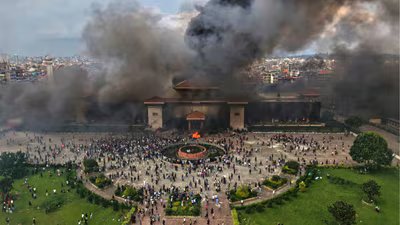
The killing of 19 youths sparked a revolution in Nepal as vengeful mobs moved to torch buildings, the parliament and houses of politicians.
Also Read | Nepal’s youth protests: A warning for South Asian democracies
In Kathmandu, offices of the Communist Party of Nepal (Unified Marxist–Leninist, or UML), the Nepali Congress, and the Maoists were torched. The Prime Minister’s Office, a 122-year-old palace, went up in flames, as did the Ministries of Home, Finance, and Health, the Parliament, the Supreme Court and other lower courts, and the anti-corruption commission.
Tax, municipal and customs offices were set on fire, and a prison break erupted as violence took over the streets of Nepal.
Sher Bahadur Deuba, five-time prime minister of Nepal, and his wife Arzu Rana Deuba, who was the foreign minister, were beaten up inside their home by an angry mob, which was later burnt down.
The house of former PM Jhala Nath Khanal was also set on fire, while his wife was still trapped inside the house
Read | Five-time Nepal PM Deuba, wife thrashed; Khanal’s wife ‘set on fire’: Ugly face of ‘Gen Z’ protests
Protestors also pelted stones at the residence of Deputy Prime Minister and Finance Minister Bishnu Paudel. The minister was also attacked as mobs chased after him.
As Nepal witnessed widespread violence across the country, Prime Minister KP Sharma Oli faced immense pressure to step down as he faced mass resignations from his cabinet.
On September 9, 2025, the prime minister announced he would be stepping down from his post. As people marked this win, the protest was far from over.
Also Read | Nepal PM KP Oli resigns after violent anti-corruption protests sparked by social media ban
With the Army taking charge the next day and curfews in place, violence and clashes continued to break out across the country. On September 12, 2025, former chief justice Sushila Karki was selected as the Prime Minister of Nepal and the interim government was now tasked with holding fresh elections as soon as possible.
As Nepal heads to the polls after a mass movement overthrew the government, three candidates – a former rapper turned Kathmandu mayor, the young leader of Nepal’s oldest political party, and a communist veteran politician – have emerged as the top contenders for the top post.
Balendra Shah, widely known as Balen, is seen as the front-runner; Gagan Thapa, the newly installed leader of the Nepali Congress, is another contender in the PM race, and joining the new faces is KP Sharma Oli, the controversial but strong communist leader, who was forced to step down during the Gen Z protests.
Nearly 19 million people will take part in the ballot, which includes 800,000 first-time voters. Voting will begin at 7am local time on March 5 and conclude at 5pm local time.