
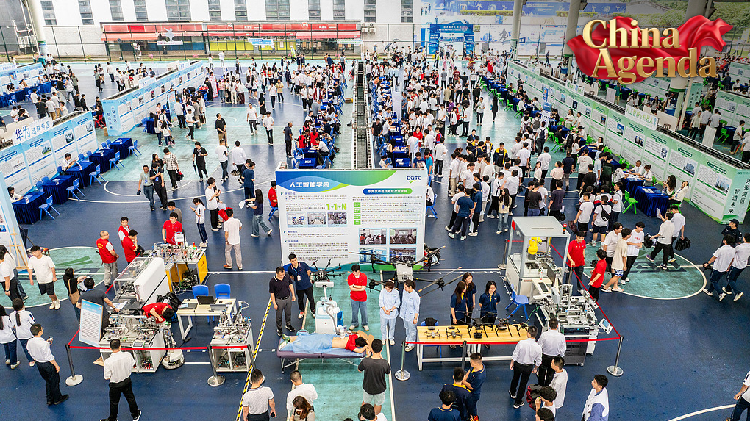
<img src=' alt='A career fair dedicated to artificial intelligence(AI) and the robotics industry in Dongguan, south China's Guangdong Province, May 7, 2025. /VCG'
Inside a hydrogen energy storage station in Lu’an, east China’s Anhui Province, Xia Peng carefully monitors a row of control screens, checking system data to ensure everything runs smoothly.
His job – energy storage station operations manager – barely existed just a few years ago.
The facility converts surplus electricity into hydrogen and then back into power during peak demand. Each year it saves about 1,091 tonnes of standard coal and cuts roughly 1,889 tonnes of carbon emissions.
As China accelerates its transition toward greener and more advanced industries, entirely new occupations like Xia’s are emerging. These new jobs offer a glimpse into a broader shift taking place in the world’s second-largest economy.
For decades, China’s rapid growth was powered by a large labor force – often described as the country’s “demographic dividend.” Some observers focus on the country’s aging population and question whether China’s growth momentum can be sustained.
However, such concerns overlook a deeper structural shift underway.
Chinese lawmakers on Thursday approved the outline of the 15th Five-Year Plan for national economic and social development at the closing meeting of the fourth session of the 14th National People’s Congress. The blueprint sets out how China plans to unleash the “talent dividend” to support its next stage of high-quality development.
New industries, new jobs
A key feature of the new five-year plan is the highlight of the rapid expansion of emerging industries and the new jobs that come with them.
The outline calls for actively fostering new occupations and expanding employment opportunities in sectors such as the digital economy, the green economy and the “silver economy,” which focuses on services for an aging population.
Among these, the digital economy remains one of the fastest-growing areas. China is home to more than 6,000 AI enterprises, while the country ranks first globally in generative AI patent applications, accounting for about 60% of the world’s total in 2025.
As AI technologies infiltrated into industries ranging from manufacturing and finance to healthcare and urban governance, entirely new roles are emerging. Generative AI system testers and algorithm trainers, for example, are becoming increasingly common as China moves deeper into what policymakers call the “AI-plus” era.
“AI, the low-altitude economy, quantum technology and bio-manufacturing will directly create a large number of new occupations,” said Mo Rong, director of the Chinese Academy of Labour and Social Security and a member of the 14th National Committee of the Chinese People’s Political Consultative Conference.
“These new jobs provide fresh opportunities for workers and inject vitality into the labor market,” he said.
China’s push toward greener growth is also generating demand for specialized talent. New professions such as carbon sink evaluators and energy storage operators are emerging as the country advances its carbon reduction goals.
At the same time, the development of the “silver economy” is creating additional employment opportunities. As China continues to upgrade its healthcare and eldercare services, demand is rising for elderly care specialists and rehabilitation professionals.
The outline also underscores the crucial role of highly skilled workers, master artisans and engineers in supporting China’s industrial upgrading. It pledges to roll out dedicated programs to support manufacturing talent and promote continuous professional development for technical specialists.
Whether in the precision calibration of high-end equipment or the innovative inheritance of traditional craftsmanship, master artisans remain a key pillar of China’s industrial strength. The emergence of new occupations – from steel structure assemblers and drone maintenance technicians to ferrite magnet manufacturers – is creating growing demand for skilled workers with both technical expertise and innovative capabilities.
To strengthen this talent pool, China aims to cultivate around 2,000 national-level master artisans, 10,000 provincial-level master artisans and 50,000 city-level master artisans by 2035, professionals who combine deep knowledge with advanced technical and creative skills.
Meanwhile, China’s push for rural revitalization is also reshaping talent demand. As the country advances agricultural modernization, it will need more “new farmers,” including agricultural managers and rural collective economy managers who can help develop local industries, activate rural resources and bring agricultural products to broader markets across the country.
Building a stronger talent ecosystem
Alongside new job creation, China is also working to reform its broader talent development system.
The outline of the 15th Five-Year Plan emphasizes coordinated progress in building a strong education system, advancing scientific and technological innovation, and strengthening the country’s overall talent base.
The outline proposes improving collaboration among education, research and talent development platforms, while encouraging top research universities to create world-class academic environments.
To better support researchers and innovators, China is also exploring long-term funding mechanisms for scientific projects and improving policies related to staffing systems, salaries, professional title evaluations and career advancement.
At the same time, policymakers are working to make it easier for talent to move across sectors and regions. Measures include improving policies that allow researchers to start businesses or take part-time roles in industries.
Efforts are also underway to gradually remove institutional barriers involving household registration, social security, professional titles and personnel archives, according to the outline.
Opening wider to global talent
China is also signaling a more open approach to attracting international talent.
The new five-year plan calls for improving support mechanisms for overseas experts and exploring a high-skilled immigration system designed to attract global researchers, engineers and entrepreneurs.
In August 2025, the State Council announced the creation of a new “K visa” specifically for young foreign scientific and technological talent.
The visa, which took effect in October 2025, offers longer validity periods and more flexible entry arrangements. Importantly, applicants are not required to secure a domestic employer or invitation letter at the time of application, lowering barriers for global innovators who want to come to China for exchanges, research or entrepreneurship.