
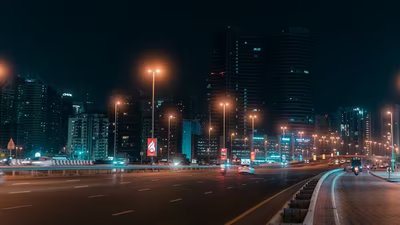
Lee hsien loong, Singapore’s Senior Minister, recently gave some advice to foreigners in the city-state: “Please keep the bling down.” Mr Lee counselled migrants not to go popping expensive champagne or driving their Ferraris loudly at night. Such excess may grate on locals. Happily, the social mores are different in Dubai, says Li Guo, a transplant to the Gulf city and owner of an Italian sportscar.
Mr Li is not alone. More and more wealthy Chinese migrants are moving, with their cash, to Dubai. A stagnant economy at home and America’s use of financial sanctions is pushing some to diversify their holdings. Many private investors are looking beyond Singapore, long favoured by China’s rich-listers, in search of another sunny, safe and low-tax jurisdiction. Chinese firms eager to escape miserly consumers at home also seek rich, growing markets beyond America and Europe. For both groups, Dubai holds much promise.
According to China’s own estimates, 370,000 of its citizens live in the uae. More than 15,000 of its firms operate there. Both figures have roughly doubled since 2019. Chinese investors are part of a larger migration of private wealth to the uae, according to Henley & Partners, an advisory firm that tracks the minted and mobile. It reckons that the uae saw a net inflow of nearly 10,000 dollar-millionaires in 2025. Singapore, on the other hand, saw its annual net intake halve to around 1,600. More than 1,250 private-investment vehicles now operate in Dubai’s offshore financial centre, up from 800 at the end of 2024. Though Emirati authorities do not provide details of the nationalities of family offices, wealth advisers say Chinese capital explains a disproportionately large share of recent growth.
China’s expats in Dubai can live much as they would at home. The city offers not just a scattering of Chinese restaurants but entire supply chains tailored to their tastes: shoppers browse familiar brands at wemart, the main Chinese supermarket there, while leafy greens are grown in desert greenhouses. Since 2020, parents have had the option of enrolling their children in the Chinese School Dubai, a state-run institution that teaches China’s curriculum at affordable fees. There is even a Chinese hospital. The Chinese community is mostly self-contained, explains one arrival from China.
The investment wave includes more than just familial wealth. Chinese businesses are planting the flag. The Dubai Multi Commodities Centre, one of the city’s free-trade zones, counts more than 1,000 Chinese firms in its ranks, says Feryal Ahmadi, its deputy ceo. That is just 4% of the zone’s total enterprises. But their overall number has grown each year, by as much as a quarter, for the past three years. Firms in Dubai’s free zones or otherwise operating in the city range from all of China’s big state banks and the state petroleum company to whizzy tech startups, such as WeRide, a self-driving car company.
Hong Kong and Singapore remain the largest hubs for Chinese cash, helped by shared languages and those cities’ access to sophisticated capital markets, says Cameron Harvey of Landmark Family Office, a Hong Kong-based advisory firm which is expanding to Dubai. The Gulf city’s appeal is growing for three main reasons: its neutrality, its openness and the opportunities it presents Chinese newcomers to make money.
Dubai’s main advantage is its pragmatic approach to foreign affairs. The city’s expat population has grown in response to geopolitical events. In 2022 Western sanctions pushed rich Russians out of the world’s financial capitals. Many had their assets abroad frozen. Dubai welcomed those who had been shown the door elsewhere, including in Singapore. Some were dismayed when Switzerland, for example, excluded those who were under sanctions from its banks, says a property investor from Hangzhou who has pitched up in Dubai. For globetrotting Chinese the lesson is clear: nowhere is entirely safe from Western sanctions, but Dubai is a safer place than most.
The uae’s ecumenical approach to global politics is reflected at home. It takes wealthy foreigners of all sorts. Whereas Switzerland and Singapore can make it difficult for outsiders to obtain residency, in Dubai it’s more straightforward. For an investment of 2m dirhams ($545,000)—in, say, a waterfront apartment—newcomers can qualify for a long-term visa. Dubai issued 158,000 such residency permits in 2023 (the last year for which data are available), double the tally in 2022. It is possible that figure has only grown in the years since.
Getting money out of China can require street smarts, given its strict capital controls. But getting cash into Dubai is easier than in many other places. Singapore’s authorities, for example, have been combing over the books of foreign investors after a series of scandals related to family offices in recent years. They have also been reining in the crypto sector, which is often used to move illicit funds across borders. The mood is calmer in Dubai. And many crypto firms are heading there, says Lewin Li, an entrepreneur in the city.
Socially, Dubai’s permissiveness appeals to China’s rich. “In China, even if you are super rich, you cannot drive a Lamborghini,” says Li Guo. In keeping with the Communist Party’s expectations, businessmen like him these days keep it “low key” at home, he says. “But in Dubai, you can drive anything. No one will touch you.” For those who want to fly the flag, Hongqi, which produces limousines for the Communist Party’s bigwigs, has a showroom near the downtown area. Richard Zhang, a luxury-watch dealer near Dubai’s Grand Souk, says people from all over the world favour the entrepot as a place to enjoy their wealth without bother.
Dubai also offers chances to make more money. Chinese investors have piled into Dubai’s property market, one of the hottest in the world. Residential property prices in Dubai posted growth of about 12% in 2025 (albeit slower than the 16.5% increase in 2024) . That contrasts with China’s largely illiquid, depressed property sector. Alice Liu imports Chinese solar panels to Dubai, then exports them to the region. But sensing the upswing in interest from Chinese buyers, Ms Liu just qualified as an agent marketing properties to investors from China. Her clients “are more interested in rental yields than hot tubs”, she says.
Chinese start-ups see gold in the desert. Like China, Dubai’s regulators welcome experiments in new technologies, such as artificial intelligence and autonomous robots. But Dubai also has an abundance of patient capital and rich customers. As The Economist and Eric Dong, WeRide’s capital-markets boss, glide through Dubai in one of the firm’s self-driving taxis one February morning, he says his business is far more profitable in Dubai than it would be in China. At home users pay about 30 cents per kilometre for a taxi; in Dubai riders fork over roughly three times as much. All three of China’s big av firms are driving in Dubai.
Will the city maintain its welcome for Chinese migrants and investors? The arrival of bad actors is one complication. After China began cracking down on scam centres run by its nationals in South-East Asia in recent years, for example, some cashed-up cyber criminals have shifted to Dubai. They brought along hundreds of indentured workers, many of whom lived in a run-down Chinese community on Dubai’s outskirts before a crackdown. Several expats report being questioned by authorities when leaving China about their business in Dubai, an apparent attempt to stop human trafficking.
Two other risks exist. First, Chinese authorities may grow tired of seeing their richest citizens moving money overseas, and flaunting it. If so, more clampdowns on capital moving abroad and restrictions on trips for Chinese citizens could follow. The bigger worry would be conflict between America and China, which could perhaps see entities in Dubai, such as banks, targeted through secondary sanctions for their Chinese dealings. But until such a time the city’s expats will continue to indulge.