AS A STRATEGY for managing allies, the message “You’re on your own, suckers, but do as America tells you”, has a number of flaws. More rational members of the Trump administration know this. That helps explain why the secretary of state, Marco Rubio, and the Pentagon’s undersecretary for policy, Elbridge Colby, headed to Europe this month to assure allies that America is not leaving them entirely alone, as some of them fear.
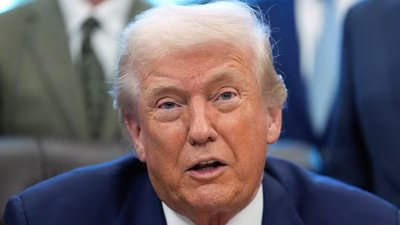
President Donald Trump speaks to reporters in the Oval Office of the White House. (AP)
Mr Rubio addressed the Munich Security Conference, an annual gathering for political leaders, generals and spy chiefs. He earned a standing ovation for nodding to historic bonds between America and Europe. Mr Rubio’s speech was well-marinated in MAGA values. He urged Europe to protect its Christian heritage and avoid “civilisational erasure” by curbing mass migration. He dismissed those concerned about climate change as beholden to a “cult”. But because Mr Rubio recalled his Spanish and Italian ancestry and thanked Europeans for sending troops to fight alongside America in many wars, his tone offered relief, after the scornful criticisms directed towards Europe by America’s vice-president, J.D. Vance, at the Munich conference a year ago.
For his part, Mr Colby urged European allies to worry less about transatlantic differences over values and to focus more on interests and the work of building armed forces capable of deterring Russia. Mr Colby credited Mr Trump with giving allies a salutary shock that would make NATO stronger. He outlined a businesslike bargain. America will continue to extend its nuclear umbrella over NATO partners, if Europeans take responsibility for the conventional defence of their continent. In return for staying around, America will continue to take the lead on such grave questions as the use and spread of nuclear weapons. Nodding to growing debate in some European countries about acquiring nuclear arms, Mr Colby stated that America’s government opposes so-called “friendly proliferation” by allies.
This columnist was in Munich and heard the private responses of national leaders and officials from Europe and beyond. They did not buy Trumpworld’s messages of reassurance. Trust is a big problem. Something broke inside the transatlantic alliance when Mr Trump declared in January that he needs to own the vast, Danish-governed island of Greenland as payback for America’s longtime defence of Europe. Huddled in Munich coffee lounges and meeting rooms, politicians and diplomats offered metaphors for that attempted territory-grab. Some compared Mr Trump to a mafia boss. Others described the West as resembling an extended family thrown into crisis by lecherous demands from an old, powerful patriarch. Mr Trump has backed down for now, cowed by direct warnings of economic reprisals from a handful of European leaders, by private appeals from Republicans in Congress, and by jitters in financial markets. But high-ranking figures in Munich worry, understandably, that his Greenland obsession will return.
The Trump administration’s muddled logic is another concern. America is pushing allies to take responsibility for conventional defence and the deterrence of Russia, including by investing in long-range weapons and the kit needed to project power far from home. In Munich Mr Colby talked of restoring a culture of burden-sharing that operated during the cold war, when many European allies spent hefty sums on defence. Mr Colby called the years after the fall of the Soviet bloc an aberration, when Europeans drastically shrank their armies, navies and air forces and American governments foolishly let them. This is selectively remembered history. With the exception of British and especially French nuclear weapons, which were in theory under the sole command of France’s president, cold-war America jealously guarded its control of weapons that could hit Soviet territory, in case it was dragged into conflicts started by hot-headed allies. Indeed, Mr Colby is known to worry privately about precisely this risk.
Delegates in Munich included Vipin Narang of the Massachusetts Institute of Technology, a former head of nuclear, space and missile-defence strategy in the Biden-era Pentagon. To Professor Narang, it is hardly America First to push Europeans to buy potent conventional weapons that could be fired at Moscow against America’s wishes. He called it a false distinction to say that America will handle nuclear strategy while allies do conventional defence. Once missiles start flying, America would be dragged in. “There is not a war between NATO and Russia that does not touch on US vital national interests,” said the professor. Should an ally attack Russia, America may find it has written “escalation cheques” that it has to honour.
Half-abandoning an alliance is a terrible plan
If America risks losing control of European escalation against Russia, the opposite problem is caused by Mr Trump’s embrace of hard-right political parties that want to appease Russia’s president, Vladimir Putin. After leaving Munich, Mr Rubio travelled to Slovakia and Hungary. Both countries are run by Trump-admiring, Putin-friendly conservative nationalists. In Hungary Mr Rubio endorsed the prime minister, Viktor Orban, who faces a tough re-election fight, despite years of efforts to crush the democratic opposition and independent news media. Mr Rubio said Mr Orban’s success was “essential” to America’s national interests. That fits oddly with Mr Trump’s demands for Europe to buy less Russian energy, and with his administration’s calls for Europeans to do more to deter Russia. Mr Orban is a Putin apologist who secured a waiver from Mr Trump for Hungary to keep buying Russian oil.
Anxious NATO officials say it would take ten years to build armies that can fight with less or no American help. With America still indispensable, allies fear being left alone, for now. But with trust crumbling, they are resolved to be suckers no more.