
Bangladesh is just a week away from its most critical elections, the first since the August 2024 student uprising and the dramatic fall of Sheikh Hasina’s government. The country is preparing to vote for its 300-seat assembly to select its next government and leader.
The vote count is also scheduled for Thursday, February 12, the same day as polling.
Ahead of the general elections, Bangladesh’s political landscape changed further when former prime minister and Bangladesh Nationalist Party (BNP) chief Khaleda Zia died on December 30, 2025. Her death prompted the return of her son, Tarique Rahman, who came to Dhaka after 18 years of self-imposed exile in London.
BNP is in the fray in the 2026 elections along with other key parties, including Bangladesh Jamaat-e-Islami (JMI), the National Citizen Party (NCP), the Jatiya Party (Ershad)-led National Democratic Front (NDF), the Nizam-e-Islam Party, among others.
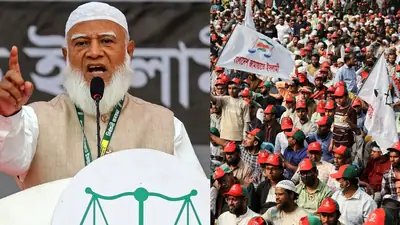
Among these, Bangladesh Jamaat-e-Islami is a key political player in the country and in the upcoming general elections.
What is JMI?
Jamaat-e-Islami was founded in 1941 by Islamic philosopher and Hyderabad-born scholar Abdul A’ala Maududi in India. He created JeI as an Islamic organisation, which later transformed into a socio-political outfit.
Today, Jamaat-e-Islami is the largest Islamic political party in Bangladesh. From its founding in the Indian subcontinent, the Jamaat evolved from a trans-regional Islamic organisation into a key political force in Bangladesh.
During the 1971 Liberation War, Jamaat-e-Islami played a controversial role. Seeking to preserve the idea of a united Muslim community, the Jamaat supported Pakistan’s army in its fight against Bangladesh’s freedom fighters, according to ORF Online.
ALSO READ | BNP’s Tarique Rahman, Jamaat leaders among key candidates as 1,700 contest Bangladesh polls
The nationalist movement led by Sheikh Mujibur Rahman, Sheikh Hasina’s father, did not give up, however. Bangladesh eventually achieved independence on December 16, 1971. Many Jamaat-e-Islami leaders who supported the Pakistani Army and survived the war fled to Pakistan.
Shortly after independence, Sheikh Mujibur Rahman became Bangladesh’s first prime minister in January 1972. He banned Jamaat-e-Islami the same year as part of his push to curb extremist religious parties.
Rahman and most of his immediate family were assassinated in a military coup in August 1975. What followed was a series of military takeovers. Amid this turbulence, Major General Ziaur Rahman became President of Bangladesh in 1977. He restored Jamaat-e-Islami through the Fifth Amendment to the Constitution, which removed provisions related to secularism and socialism and paved the way for religion-based political parties.
Over the next few decades, the Jamaat emerged as a key political force, backed by Ziaur Rahman and later by his wife, Khaleda Zia of the BNP.
Khaleda Zia became prime minister for the first time in 1991, and it was during her tenure that a prominent JeI leader, Ghulam Azad, regained his citizenship.
ALSO READ | Worry for India? US seeks ‘friendship’ with Bangladesh’s once-banned Jamaat-e-Islami, says report
In 2001, Jamaat-e-Islami formally joined the BNP-led coalition. However, seven years later, when the Sheikh Hasina-led Awami League returned to power, the Jamaat’s influence declined. Sheikh Hasina set up the International Crimes Tribunal in 2009 and amended the 1973 Act.
Despite protests against the Tribunal’s proceedings, several Jamaat leaders, including Abdul Quader Molla, Ali Ahsan Mohammad Mojaheed, Motiur Rahman Nizami, and Mir Quasem Ali, were tried and executed.
The party’s political strength weakened significantly, marginalising it for about 15 years.
In 2024, the student uprising and the ouster of Sheikh Hasina were followed by the revocation of the ban on Jamaat-e-Islami. The interim government led by Nobel laureate Muhammad Yunus lifted all restrictions on the party in August 2024, allowing it to contest the 2026 elections.
Since the ban was revoked, the party, currently led by Shafiqur Rahman, has reorganised itself and emerged as a key contender in the 2026 general election.
Jamaat-e-Islami is contesting against the BNP as part of an 11-party alliance led by the National Citizen Party, NCP, and JeI leaders.
The NCP is led by student leaders Nahid Islam, Sarjis Alam and Hasnat Abdullah.
Jamaat-e-Islami’s leadership includes chief Shafiqur Rahman, deputy chief Syed Abdullah Mohammed Taher, and secretary-general Mir Golam Porwar.
ALSO READ | Bangladesh’s student-led National Citizen Party split over alliance with Jamaat ahead of national polls
Other parties in the 11-party alliance include Bangladesh Khelafat Majlis, Khelafat Majlis, Bangladesh Khelafat Andolan, Bangladesh Nezam-e-Islam Party, Bangladesh Development Party, Jatiya Ganatantrik Party, NDP, Liberal Democratic Party, LDP, AB Party, and Bangladesh Labour Party.
Why is JMI a key player?
Jamaat-e-Islami remains one of the most influential political entities in Bangladesh, known for its disciplined organisation and committed support base despite years of crackdowns.
The fall of the Sheikh Hasina-led Awami League government prompted Jamaat to quickly align with the BNP.
“Over the last 55 years, Bangladesh has mainly been ruled by two parties, the Awami League and the BNP. People have long experience with both, and many feel frustrated. They want a new political force to govern,” Jamaat deputy chief Syed Abdullah Mohammed Taher told Al Jazeera.
According to a recent survey conducted jointly by Projection BD, the International Institute of Law and Diplomacy, IILD, the Jagoron Foundation, and Narrative, a close contest is projected between the BNP and Jamaat-e-Islami in the forthcoming national elections.
The survey, cited by Prothom Alo English, found that 34.7% of voters intend to vote for the BNP, while 33.6% favour Jamaat. The NCP reportedly has the backing of 7.1% of voters, and Islami Andolan Bangladesh has 3.1%.
Taher also told Al Jazeera that the party has around 20 million supporters, roughly 250,000 of whom are registered members known as “rukon”, including women.
HT EDITORIALS | Dhaka’s dance with anarchy
The party has not only gained popularity among voters but has also sought to ease fears about an Islamist-led government.
“When we come to power, we will accept and implement agreed reforms. Where new laws are needed, for example, to ensure good governance and eliminate corruption, we will examine them at that time,” Taher said.
He added that constitutional reforms, rather than ideological enforcement, would form the basis of governance.
In January, Jamaat chief Shafiqur Rahman also said his party is open to joining a unity government.
Rahman said Jamaat-e-Islami is trying to broaden its base beyond conservative constituencies and that anti-corruption should be a shared agenda for any unity government, according to Reuters.
Amid concerns over violence against Hindus in Bangladesh, the Jamaat has also sought to widen its appeal beyond its Muslim base. For the first time in its history, the party has fielded a Hindu candidate for the Khulna-1 constituency.
Krishna Nandi, president of the Dumuria Upazila Hindu Committee of Jamaat-e-Islami, is contesting from the Khulna seat, The Daily Star reported.
According to a geopolitical analyst cited by Al Jazeera, many Bangladeshi voters today are more religious than before.
“A sizeable part of Bangladeshi society is moving in a more Islamist direction, but that is not the same as being ready to hand the state to a conservative Islamist leadership,” said Asif Bin Ali, a geopolitical analyst and doctoral fellow at Georgia State University in the US.
Recent polling suggests that the BNP holds a narrow lead over Jamaat. Regardless, Jamaat appears on track to surpass its previous best performance in 1991, when it secured 18 seats with about 12% of the vote, according to the International Crisis Group, as cited by ANI.
An International Crisis Group report also said Jamaat-e-Islami chief Shafiqur Rahman has emerged as one of Bangladesh’s strongest political performers and described the party’s social media campaign as “unrivalled”.
Jamaat-e-Islami’s manifesto
In its election manifesto, Jamaat-e-Islami has pledged to maintain “constructive and cooperative” relations with neighbouring countries, including India.
“Constructive relations with neighbouring and nearby countries, peaceful, friendly, and cooperative, will be established with India, Bhutan, Nepal, Myanmar, Sri Lanka, the Maldives, and Thailand based on mutual respect and fairness,” the manifesto, released on February 4, said, according to ANI.
It also stated that the party would work to enhance Bangladesh’s global standing and the strength of its passport.
“The strengthening of relations with countries of the Muslim world shall be a key foreign policy priority,” the manifesto added.
The party also said it would actively engage with the United Nations and other international organisations and reaffirmed its commitment to participating in regional groupings such as SAARC and ASEAN.