Last year Donald Trump claimed he had “obliterated” Iran’s nuclear programme. The claim was hard to sustain when Iran had managed to hang on to a good portion of its of 400kg of highly enriched uranium (heu), enough for about ten bombs if enriched a little further. “People are going to have to go and get it,” decreed Marco Rubio, America’s secretary of state, last week. That would require an unprecedented military operation deep inside Iran. Is it possible?
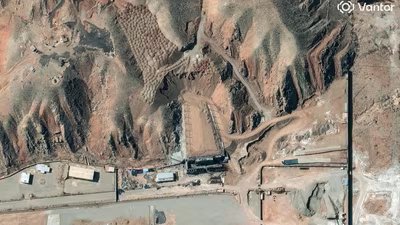
This satellite image released on March 11, 2026 courtesy of Vantor shows a view of Taleghan 2 facility at the Parchin military complex, some 30 kms (20 miles) southeast of Tehran, Iran, on March 6, 2026. President Donald Trump said on March 11 that the United States must “finish the job” in Iran — hours after suggesting the war could be over soon because Washington had run out of targets. (Photo by Satellite image �2026 Vantor / AFP) / RESTRICTED TO EDITORIAL USE – MANDATORY CREDIT “AFP PHOTO / Satellite image �2026 Vantor” – NO MARKETING NO ADVERTISING CAMPAIGNS – DISTRIBUTED AS A SERVICE TO CLIENTS – THE WATERMARK MAY NOT BE REMOVED/CROPPED – (AFP)
The first problem is working out where the heu is. On March 9th Rafael Grossi, head of the International Atomic Energy Agency, a un watchdog, said that, it was “mainly” at Isfahan, in central Iran, presumably in tunnels whose entrances were sealed off with dirt in February. Some also remains at enrichment plants at Natanz and Fordow, the latter deeply buried in a mountain that was bombed last June. Even if American and Israeli aims were confined to Isfahan, retrieving the uranium would be a huge undertaking. The mh-47g Chinook helicopters used by America’s 160th Special Operations Aviation Regiment, the unit which recently captured Venezuela’s Nicolás Maduro, might reach Isfahan, at least 500km inland, from ships in the Persian Gulf. But they would need refuelling to return. And they would need a quasi-army to surround them.
On March 7th Mr Trump said that any ground force would be dispatched only if Iran were “so decimated that they wouldn’t be able to fight on the ground level”. To achieve that, America would pound Iranian bases in the vicinity of the target. It would then need to send airborne forces to seize a nearby airfield—Badr airbase is 10km from Isfahan’s nuclear sites—or, more practically, create a makeshift airstrip. Nuclear-handling equipment, diggers to move dirt and rubble from tunnel entrances, and other heavy machinery could then be parachuted in on pallets.
Some missions are a choice
At a minimum, a battalion of troops (1,000-odd) would need to hold a perimeter around the nuclear complex. They would need constant air cover to spot and attack any approaching Iranian forces: real-time satellite coverage, loitering drones, reconnaissance planes and strike aircraft. That would require a huge supply of refuelling tankers to allow enough air power to stay airborne—potentially for days.
Israel’s special-forces and combat-engineering corps currently have more relevant and recent experience than American forces in this sort of operation, having worked extensively in the vast networks of tunnels built by Hamas and Hizbullah. Using them would also allow Mr Trump to claim that he had not put American boots on the ground. However, this would stretch Israel’s long-range airlift. If Israeli troops were used, they would need to borrow America’s vast fleet of cargo planes.
America’s Joint Special Operations Command (jsoc) also has relevant expertise, having spent years preparing to secure or seize Pakistani nuclear weapons in a crisis. Squadrons from America’s Delta Force and Seal Team Six practised entering deep underground shelters at a site near Las Vegas, aided by the us Army’s specialist Nuclear Disablement Teams. One of the biggest challenges, says a former jsoc operative, is moving, communicating and surviving underground. If Mr Trump is serious about invading Isfahan, let alone Natanz and other sites, teams will need to have been rehearsing for months.
The next challenge would be handling the heu. It is probably stored in gaseous form in multiple containers to prevent an accidental chain reaction. Daniel Salisbury of the International Institute for Strategic Studies, a think-tank, estimates the full stockpile would require around 19 scuba-type tanks. Cheryl Rofer, a former nuclear researcher at Los Alamos, observes that each cylinder is surrounded by piping to keep them apart. “The special ops team MUST understand,” she notes, “that the piping structures must not be removed.”
One option would be to blow it up in situ. The resulting uf6 (heu in gaseous form) “would go all over the place, get deposited on walls, rocks, rubble, etc, and be quite difficult to recover,” says Matthew Bunn of Harvard University. It would also release toxic hydrogen fluoride. A second would be to “downblend” the material, he suggests, but the equipment for doing that would need to be trucked in and it would still leave nuclear material. The third would be to extract the heu and whisk it away. But if moisture enters the cylinders during transport, warns François Diaz-Maurin, an editor at the Bulletin of Atomic Scientists, it could interact with the uranium gas to produce toxic uranyl fluoride and hydrofluoric acid gas, potentially causing an explosion.
A Hollywood-style operation would appeal to Mr Trump, who has spoken of the humiliation Americans of his age still feel from the seizure of American hostages in Tehran in 1979. It would give him a set-piece denouement to the war, letting him claim victory even if the Iranian regime remained in place. But Mr Trump will also recall how a botched effort to rescue the hostages from America’s embassy, Operation Eagle Claw, doomed Jimmy Carter’s presidency. Performing each of these steps at Natanz and Fordow, too, would amount to one of the largest raids in military history.
“There’s no doubt that the US can do it,” says a former Western military chief. “They’re probably the only military in the world that could. But you either do it incredibly small and insert in a very covert way, or you go in at scale—you essentially turn that part of Iran into the United States of America for a while.”
Sign up to the Middle East Dispatch, a weekly newsletter that keeps you in the loop on a fascinating, complex and consequential part of the world.