
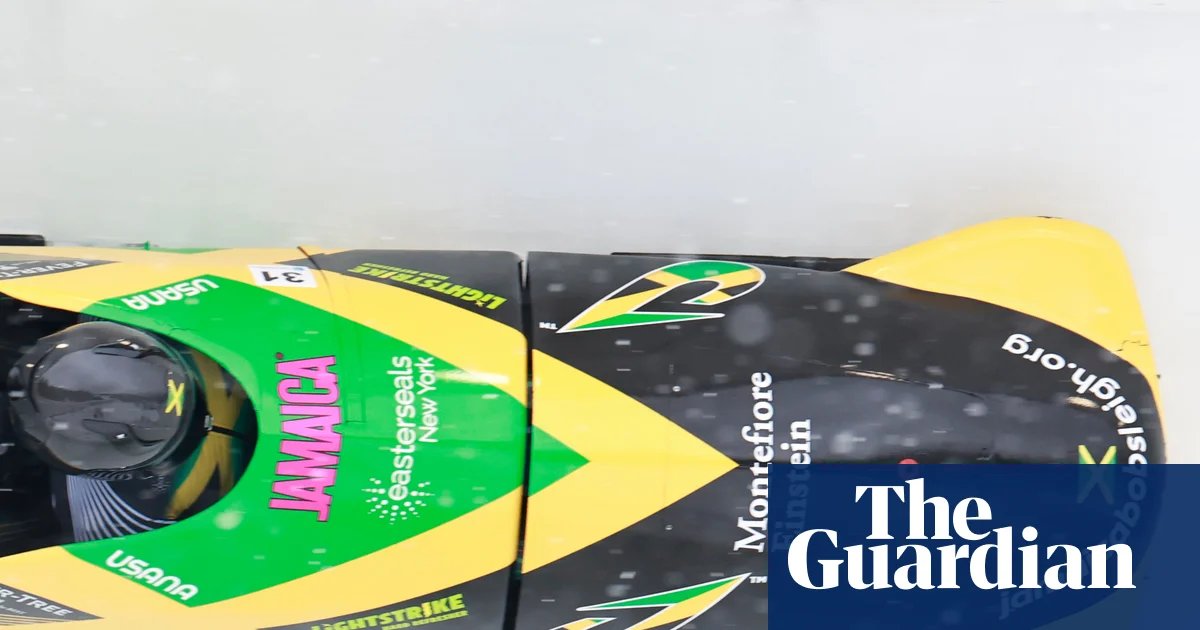
It did not make so much as a ripple outside its minor sporting niche, but something particularly unusual occurred in the bobsleigh world earlier this year. Upon turning up in the New York outpost of Lake Placid for their final Winter Olympics warm-up competition, Jamaica’s four-man bobsleigh team were informed they were not allowed to take part. A hat-trick of gold medals over the preceding few weeks had seen them rise too high in the world rankings to take their customary place on the second-tier North American Cup circuit. They had simply become too good.
In the overwhelming majority of countries, the Winter Olympics is an assortment of sporting oddities held in an alternative climate that might pique attention every four years. Rarely does it break through to the mainstream, which is what makes Jamaican bobsleigh such a curious exception.
“There is no meeting that I cannot get, and no conversation that somebody is [not] at least willing to have with me,” says Jamaica Bobsleigh Federation president Chris Stokes. “Not because they know me, and not because they know bobsleigh. But because they know Cool Runnings.”
When Stokes arrived in the Canadian city of Calgary in February 1988, his sole intention was to watch his brother Dudley drive Jamaica’s four-man bobsleigh on their country’s Winter Olympic debut. Unexpectedly drafted into Dudley’s sled after injury struck one of the other team members, Stokes found a love for the sport that remains strong almost four decades later.
He would also go on to become immortalised on the big screen, albeit with a hefty dose of artistic licence. It is 33 years since the release of the Disney film based on Jamaica’s extraordinary 1988 bobsleigh exploits, but awareness of Cool Runnings – and particular soundbites: “Feel the rhythm! Feel the rhyme! Get on up, it’s bobsled time!” – still greatly eclipses that of the sport it briefly took to Hollywood.
“Is it a documentary? No. Is it historical? No. But it’s entertaining, inspirational and it has stood the test of time,” says Stokes. “People draw strength from it. It has changed people’s lives, opened doors, and it is certainly a massive asset we have that we continue to leverage. The only circumstance I see surpassing it is making the Olympic podium.”
Even entertaining such a possibility is, admits Stokes, “insane”. Yet that is his precise aim – one that appears closer than ever before. Having competed at four Winter Games and served in various national federation roles over the years, Stokes took up the presidency in 2017 on the basis that it would no longer suffice to be “an inspirational face of bobsleigh, but not really competitive on the ice. We want to win.”
Travel limitations of the Covid pandemic dashed any hopes of improvement for the 2022 Winter Olympics, after which Stokes introduced a 10-year strategy with a view to Jamaica winning a bobsleigh medal at the 2034 Games. Central to it was the introduction of the “Back to the Well” programme, focusing on harnessing the athletic talent pool within Jamaica. “Because I believe we have the best athletes in the world,” explains Stokes.
Subsequent converts include the former Jamaica 100m champion Tyquendo Tracey and reigning national 200m champion Ashanti Moore, while Shane Pitter has gone from a fisherman to what Stokes describes as “the most talented young pilot I’ve ever seen” in the space of three years.
Pitter will drive the two-man and four-man sleds at the Milano Cortina Games, while the former Team GB bobsleigh athlete Mica Moore will represent Jamaica in the monobob. Aiding Pitter is Team GB’s 2014 Olympic bronze medallist, Joel Fearon, who came on board as a performance coach at the start of this winter and has ended up pushing in both sleds.
“I didn’t plan to come out of retirement, but there’s still a bit of life left in me,” said the 37-year-old, who stepped back from bobsleigh after his sister, Natasha Morais, was murdered in 2023. “Both my parents are Jamaican, so I’m pushing and coaching the guys at the same time. It’s been busy. I’ve had my hands full. But the athletes are so talented and hungry, which makes the job much easier.”
The season has already yielded eight gold medals across all Jamaica sleds in the North American Cup, which sits beneath the top-level World Cup. That tally is more than ever, but acceptance of Jamaica’s success has not been universal. “We want people to show us a bit more respect,” says Fearon.
“Some other teams, staff and officials have been treating us like we’re a bit stupid and don’t know what’s going on, not realising that I’m already an Olympic medallist. Almost as if we didn’t belong. It was hurtful, and made the team angry. I had to be on my best behaviour to not get myself in any trouble, because on the GB team it’s something I would never experience.
“Some people might not think so, but we’re going to make ourselves fit and make ourselves belong,” adds Fearon, who has a 100m personal best of 9.96 seconds, set in 2016. “We’re looking to show people that we’re here to stay. It’s not just a gimmick.”
Achieving their lofty ambitions by 2034 is no easy task. Still in his infancy as a pilot, Pitter has never been down most European tracks, including the one in Cortina, leaving Fearon to suggest a top-12 finish might be a realistic aim this time around.
Jamaica possesses no proper bobsleigh training facilities, with the team based in New York for much of the winter when not competing. Funding is a permanent concern. The federation receives no money from the Jamaica Olympic Association, with the overwhelming majority of income generated from private sponsorship and public fundraising.
Jamaica’s four-man sled for Cortina is a South Korea cast‑off that won silver at the 2018 Games, while the two-man sled used to belong to Team USA. Such financial impediments will almost certainly need to be overcome to challenge the likes of the indomitable Germans in the long term. But Stokes is adamant hurdles can be overcome.
“One of the things you learn growing up in Jamaica is having money is an illusion,” he says. “I remember seeing Usain Bolt train on a grass track at the University of the West Indies and then break the world record. After that, the money rolled in, but he was already good.
“It’s always an error to think that if you have more money things will get better. It is far more important to be resourceful than to have resources. We’re trying to do something great, and you can’t do that with a normal mindset or attitude. You have to be extraordinary in every regard.”