
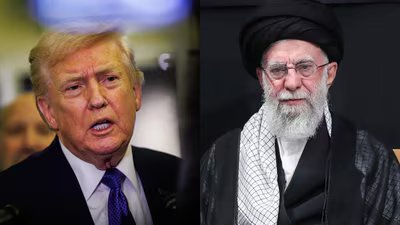
Iran is prepared to consider “compromises” to revive a nuclear deal with the United States, but only if Washington is willing to talk about lifting sanctions, deputy foreign minister Majid Takht-Ravanchi told the BBC in an interview in Tehran.
His remarks come as both sides trade blame over stalled negotiations. US officials have repeatedly said that Tehran is slowing down progress in the long-running talks.
However, speaking to the BBC, Takht-Ravanchi made it clear that Iran expects a concrete signal from Washington. The ball was “in America’s court to prove that they want to do a deal,” he said, adding, “If they are sincere, I’m sure we will be on the road to an agreement.”
Sanctions relief emerges as key concern
Takht-Ravanchi said Iran is open to addressing concerns over its nuclear programme, including its stockpile of highly enriched uranium, but stressed that sanctions relief must be part of the conversation.
Also Read | Trump, Netanyahu agreed US should ‘go full force’ on Iran over oil exports to China: Report
“We are ready to discuss this and other issues related to our programme if they are ready to talk about sanctions,” he told the BBC. The Iranian minister, however, did not clarify whether Iran is seeking the lifting of all sanctions or only some.
He pointed to Tehran’s offer to dilute its 60% enriched uranium as a sign of flexibility. Uranium enriched to that level is close to weapons-grade, fuelling suspicions in the West that Iran may be edging towards developing a nuclear weapon – an allegation the Islamic Republic has consistently denied.
When asked whether Iran would agree to ship out its more than 400 kilograms of highly enriched uranium, as it did under the 2015 nuclear deal, Takht-Ravanchi said “it was too early to say what will happen in the course of negotiations,” the BBC report added.
US says deal ‘very hard to do’
On the American side, US Secretary of State Marco Rubio said on Saturday local time that President Donald Trump preferred reaching an agreement but acknowledged that it was “very hard to do” a deal with Iran, reported Reuters.
Meanwhile, Trump has maintained that failure to secure an agreement to curb Iran’s nuclear programme could lead to military action. After the first round of talks earlier this month, he cautioned that not reaching a deal with his administration would be “very traumatic”.
The US and Iran held indirect talks in the Gulf state of Oman in early February, discussions that Trump described as positive.
According to a report by Associated Press. a second round of negotiations is scheduled for next week, to be hosted by Oman in Geneva, the Swiss Foreign Ministry has said.
Deal in limbo
The renewed diplomatic push follows a turbulent period in the region. Similar talks last year collapsed in June after Israel launched a 12-day war on Iran, during which the US bombed Iranian nuclear sites.
Trump has continued to threaten the use of force if Iran does not agree to constraints on its nuclear programme.
On Friday, Trump said the USS Gerald R Ford – the world’s largest aircraft carrier – was being redeployed from the Caribbean to the Middle East to join other US military assets in the region. He also remarked that a change in power in Iran “would be the best thing that could happen”.
Iran, in turn, has warned it would respond with an attack of its own. Gulf Arab nations have cautioned that any military escalation could trigger a wider regional conflict.
Israel pushes for more
Meanwhile, Israeli Prime Minister Benjamin Netanyahu, who met Trump in Washington this week, has urged that any future agreement should go beyond nuclear limits. He has pressed for measures to curb Iran’s ballistic missile programme and halt its support for proxy groups such as Hamas and Hezbollah.
(With agency inputs)