GENERALS RARELY put themselves directly in the line of enemy fire but on March 6th Major-General Tomer Bar, the commander of the Israeli Air Force, flew an F-15 fighter jet on a strike mission in Iran. Not all his colleagues were enthusiastic about such a senior commander flying deep over hostile territory. “It’s a bit of a stunt,” said one air-force officer. “But I can understand him. We’ve been preparing for so many years for this war.”
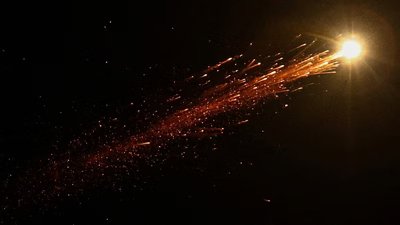
An Iranian missile flies toward Israel, amid the U.S.-Israel conflict with Iran, as seen from Jerusalem, March 11, 2026. REUTERS/Jamal Awad TPX IMAGES OF THE DAY (REUTERS)
These are heady days for Israeli pilots and generals. For over two decades they have been planning and training for long-range strikes on Iran’s nuclear programme. But until very recently they had never imagined doing so in a joint air armada with the world’s superpower. Nor had they imagined hitting targets, including civilian infrastructure, that go far beyond nuclear ones. Now officers from the two countries are constantly sitting together in planning sessions, dividing up targets within Iran. Dozens of American aerial tankers are topping up the fuel of Israeli fighters en route to their missions. Between them, the two air forces have destroyed most of Iran’s air-defence network, achieving dominance over its skies.
Binyamin Netanyahu also seems to be flying high. Having spent many years thundering about the Iranian threat, the Israeli prime minister has found in Donald Trump an American president willing to go all the way with him. That, at least, was the first impression. But with the war into its second week, Israeli planners are increasingly aware of where the two countries’ strategies may start to diverge.
Following the opening strikes of the war on February 28th in which Ayatollah Ali Khamenei, Iran’s supreme leader, was killed, the Americans and Israelis embarked on a 100-hour plan of attack, working their way down a list of targets. Those running the operation were aware that Mr Trump has a propensity for swift declarations of victory and wanted to maximise the damage they could do to the Iranian regime during the first four days.
Some are surprised at how long the war has gone on. The president’s resolve is unclear; his statements are frequently contradictory. On March 9th he said in an interview “I think the war is very complete, pretty much.” Hours later, he changed his tune by saying “we’ve already won in many ways, but we haven’t won enough.” His statements seemed designed to reassure financial markets rattled by soaring oil and gas prices. If so, his words had the desired effect: energy and financial markets had calmed by March 10th.
Since Mr Trump has never made clear what he hoped to achieve through this war, it is not surprising that he is vague about when it might end. At the start of the war, Messrs Trump and Netanyahu were united in their stated aim of destroying Iran’s nuclear and ballistic missile programmes. Now, though, Israel and America’s end goals may be diverging.
Mr Netanyahu is blunt about wishing for regime change. He claims that Israel wants to “create the conditions for the brave Iranian people to take their destiny into their own hands”. Mr Trump, by contrast, has always seemed more enthusiastic about a Venezuela-style victory in which he effects change within the Iranian regime by seeing a more co-operative insider take over. He has demanded Iran’s “unconditional surrender” and said in an interview he must be “involved in the appointment” of Iran’s new supreme leader, “like with Delcy [Rodriguez] in Venezuela.”
Israeli officials increasingly believe that Mr Trump is much less eager than they are, or than they thought he was, to see full regime change. Instead, they reckon he is focused primarily on controlling the flow of oil from Iran. China buys the bulk of the Islamic Republic’s output, at a hefty discount, because it is willing to ignore America’s sanctions on Iranian exports. Mr Trump is due to meet Xi Jinping at the end of March. He would have considerable leverage over China’s leader if he had established control of Iran’s energy supply. Israeli officials became more convinced that this is Mr Trump’s main motive after his officials expressed anger over the scale of a massive Israeli strike on fuel tanks in Tehran on March 7th. It was the first sign of discord between the two countries.
Regime change is extremely unlikely to happen while the war is raging. Iranians have shown extraordinary bravery in recent months in mass protests despite bloody repression by Iran’s security forces. However, they are unwilling to take to the streets while bombs are falling. Iran-watchers in Israel believe that it may be months or more before any new demonstrations against the regime. Israel and America have been bombing the headquarters of the Basij, a paramilitary force, across the country but its power structures, and those of the Islamic Revolutionary Guard Corps, remain largely intact. Prolonging the war, the Israeli experts argue, will only delay any uprising against the regime, while continuing to expose Israel to Iranian missile attacks and the danger of a worsening second front with Iran’s proxy, Hizbullah, in Lebanon.
As always the Israeli prime minister has his eyes on politics and his own position. Stopping the fighting at this point would be a liability for Mr Netanyahu. Regime change, if it ever happens, may not come soon enough for him. He is facing a difficult fight for re-election later this year and is loth to end the war on an inconclusive note. On June 24th last year, at the end of Israel’s previous war with Iran, Mr Netanyahu claimed to have “removed two existential threats” from Israel, that of Iran’s nuclear and missile programmes. Eight months later, Iranian missiles are falling on Israel again. Messrs Trump and Netanyahu will claim victory however the war ends, but their voters may take some convincing.