
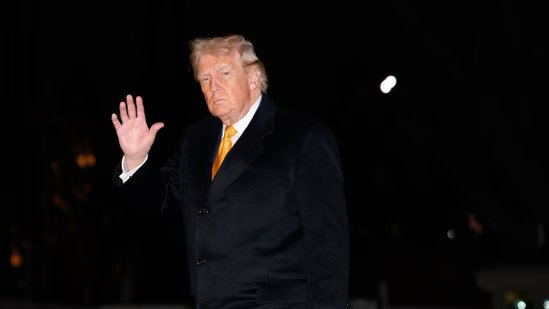
LAST YEAR the Trump administration’s justifications for its tariffs shifted almost as much as the levies themselves. President Donald Trump and his team have variously defended their border taxes as a stop-gap negotiating tool, a weapon aimed at China and a scheme to permanently reshape global trade and finance. But even as many of the arguments shifted, one remained central: the notion that tariffs will inspire a revival in American manufacturing. As he announced his first volley of global levies, Mr Trump promised that: “Jobs and factories will come roaring back into our country.”

American industry has certainly been in decline. Overall production has flatlined for the best part of 20 years, even as services have ballooned—a fact that has suffused American culture, inspiring Oscar-winning films and era-defining writing, and angering people across the political spectrum. By the time Mr Trump took office in January, America had been in a two-year manufacturing recession, according to purchasing managers’ surveys. This, the president vowed, would change. The logic was simple: “If you want your tariff rate to be zero”, said Mr Trump, “build your product right here in America.”
Nearly a year on, however, the Trumpian manufacturing renaissance is conspicuous by its absence. The two-year manufacturing contraction is now hitting its third, and factories have continued to shed jobs; employment fell by 0.6% in the year to November (see chart 1). And it is not just that Mr Trump’s moves are failing to revive American manufacturing. Under the hood, there are signs that they are actively hurting it.
Part of the problem is high interest rates. American industry first fell into recession in early 2023, soon after the Federal Reserve sharply raised rates to combat inflation. Manufacturing, with lots of expensive and often debt-financed equipment, is especially sensitive to such policy. In this regard, Mr Trump does not carry the lion’s share of the blame. He is keen to see looser monetary policy; America’s continuing high rates mostly reflect robust economic growth and, more recently, vast non-rate-sensitive AI spending. All the same, his policies have not helped. High deficits and threats to the independence of the Fed have both made American debt less desirable for investors, and thus lifted borrowing costs.
Moreover, his tariffs have injected uncertainty into the economy. For a manufacturing sector that sends nearly a quarter of its output abroad, this is a significant problem. Many inputs for American-made goods also come from abroad—think of industrial chemicals used in adhesives, coatings and plastics for cars or active pharmaceutical ingredients for medicines. Indeed, surveys suggest that export orders and import volumes for manufacturing have registered a strong contraction since Mr Trump announced high tariffs on “Liberation Day” in April, one that goes beyond the wider weakness in manufacturing (see chart 2). Factory bosses report confusion and difficulty making long-term plans.
Another way to see these costs is to look at the one sort of manufacturing that has been on a tear: computer equipment, especially semiconductors (see chart 3). Demand for chips has grown tremendously owing to the data-centre boom inspired by investment in artificial intelligence. Notably, however, computer parts have also received exemptions from Mr Trump’s tariffs, notes Joseph Politano, author of Apricitas Economics, a newsletter. Semiconductors have been explicitly carved out from Mr Trump’s “reciprocal” tariffs on specific countries. More recently, the president has also watered down the export-control regime designed to deny China chips used to train the most sophisticated AI models. This rare free-trade turn seems to have provided a spur to the industry.
Manufacturers will be hoping for a respite from tariff chaos in the year ahead. They may well be disappointed. Betting markets expect the Supreme Court to rule soon against a large chunk of Mr Trump’s tariffs, which would spark another costly and chaotic reshuffling of the levies. Later in the year the United States-Mexico-Canada Agreement, a free-trade deal, is up for review. It has shielded plenty of manufacturers who rely on cross-border supply chains from the worst of the tariffs. Mr Trump is unlikely to blow the deal up entirely, but the renegotiation process could get messy. Factory-owners could be forgiven, then, for wishing that Washington was rather less enthusiastic about helping them.