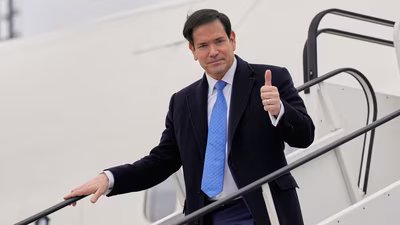
Marco rubio, America’s secretary of state, delivered blunt messages in his Valentine’s Day speech to the European leaders and officials gathered at the annual Munich Security Conference. Migration had put the survival of European civilisation at risk. The “so-called global order” would be subordinated to national interests. “We in America,” he declared, “have no interest in being polite and orderly caretakers of the West’s managed decline.” And yet when Mr Rubio finished, he was greeted with applause and relief—a reward for employing more emollient and moderate language than J.D. Vance, America’s vice-president, had when he lambasted Europe’s record on free speech and political freedom from the same stage a year ago.
Marco rubio, America’s secretary of state, delivered blunt messages in his Valentine’s Day speech to the European leaders and officials (AFP)
Mr Rubio took pains to emphasise America’s ties to Europe, from the age of exploration to the modern day. “We have bled and died side by side on battlefields from Kapyong to Kandahar,” he noted, an inadvertent rebuke to Donald Trump’s recent disparagement of allied sacrifices in the war in Afghanistan. In contrast to others in the Trump administration, Mr Rubio suggested that parts of the existing world order might be salvaged. “We do not need to abandon the system of international co-operation we authored, and we don’t need to dismantle the global institutions of the old order that together we built,” he argued. Instead, he said, these could be “reformed” and “rebuilt”. America sought a “reinvigorated alliance”, he argued, rather than abandonment of Europe. Russia was not winning the war in Ukraine, he added in a later interview, contradicting the line of Mr Vance and other Ukraine-sceptical voices in the administration.
For all this, America will struggle to undo the harm that it has done to the alliance in recent months, particularly through Mr Trump’s efforts to acquire Greenland using economic and military threats. “Irreparable damage has been done,” says Andy Kim, a Democratic senator. “What is the value of an American handshake right now?” Mr Rubio’s message was “more sophisticated” than Mr Vance’s verbal assault, argues Nathalie Tocci, a former foreign-policy adviser to the European Commission, “but [the] bottom line is the same: a civilisational imperial vision where might makes right.” Constanze Stelzenmüller of the Brookings Institution, a think-tank in Washington, notes that Mr Rubio’s stated desire for allies who are not “shackled by guilt and shame” echoed the rhetoric of the Alternative for Germany, a populist-right party which calls for Germany to get over its wartime guilt, and which the Trump administration has sought to boost.
In speeches and discussions among European leaders, there was division over how hard to push back against Mr Trump. Some spoke in dramatic terms. “The United States’ claim to leadership has been challenged and possibly lost,” said Friedrich Merz, Germany’s chancellor. “The international order based on rights and rules is currently being destroyed.” Emmanuel Macron, France’s president, called for Europe to become a “geopolitical power” and promised “to rearticulate nuclear deterrence” on the continent. Sir Keir Starmer, Britain’s prime minister, insisted that America remained “an indispensable power” in Europe and suggested it was dangerous to talk of a “rupture”, though he devoted much of his speech to the need for stronger ties between Britain and the EU. Behind closed doors the disagreements are starker. Some leaders are still keen to emphasise the positives of the transatlantic relationship. Others are sure something fundamental has changed, and worry that any Europeans who are calmed by reassuring words from Mr Rubio are making a big mistake.
Mr Rubio’s speech was not the only reassuring message in recent days. Elbridge Colby, the Pentagon’s policy chief and third-ranking official, was sent to Brussels to attend a meeting of nato defence ministers. That in itself was a snub—America has long sent its defence secretary. But in a well-received speech, Mr Colby said America would continue to extend its nuclear umbrella over Europe and praised nato’s planning process as increasingly “demanding, more operationally grounded, and more focused on real war-fighting requirements”.
Days earlier nato also reshuffled its command structure, implementing reforms that had been set in motion years ago, prior to Mr Trump’s second term. America handed over two joint command centres to Britain and Italy, and a third to be shared by Germany and Poland. But it also took over the alliance’s maritime command, a larger and more important headquarters, essentially binding American military forces closer to Europe. Few allies expect any dramatic reduction in America’s troop footprint. Most countries in Europe accept that the answer is a more European nato, says the official, rather than entirely new defence structures elsewhere.
Meanwhile, several contentious issues still loom over the transatlantic relationship. One is Ukraine peace talks, which will continue with discussions in Geneva next week between Russia and Ukraine. “Zelensky is going to have to get moving—otherwise he’s going to miss a great opportunity,” Mr Trump said on February 13th, contradicting Mr Rubio’s message that America did not yet know whether Russia is serious about ending the war. A second issue is technical talks under way in a working group between America and Denmark over Greenland, which are said to be proceeding well. The third is an ongoing battle between America and the EU over regulation of social media and other digital services. Each of these could yet re-open the wounds that Mr Rubio sought to put a plaster on this week.
The mission of both Mr Rubio and Mr Colby at Munich was clear: to explain that once-complacent Europeans have had a salutary shock which will make the transatlantic alliance stronger. Assembled European leaders are not buying it. Like a family still reeling from a betrayal in its midst, allies felt hostility from Mr Trump that has durably changed how Europe feels about its reliance on America. What was closeness now feels like dangerous dependency. In private, there is talk of hoping for the best but planning for the worst. Even after Mr Trump leaves office, there is no confidence that a future American government will be relied upon.