
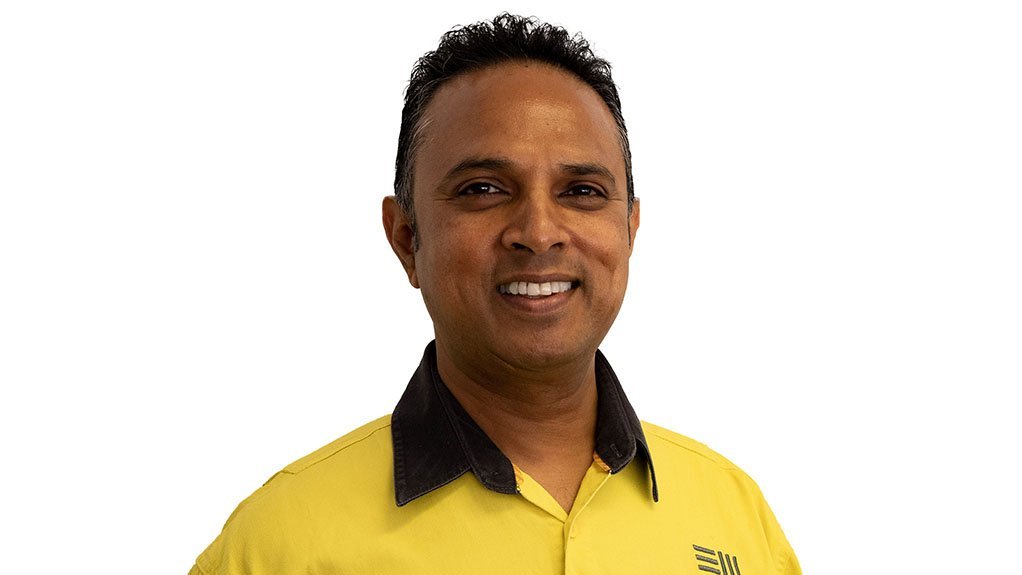
Aluminium is going to be very important going forward, supporting a low-carbon future for the planet, which is why it is so advantageous for South Africa to have an upstream smelter in a country which sustains downstream beneficiation and jobs, argued diversified miner South32 COO Noel Pillay during the Aluminium Federation of South Africa’s International conference, on February 25.
He pointed out that aluminium is often called the ‘green’ metal of the future, noting that it is lightweight and strong, durable and infinitely recyclable.
He said it provides innovative solutions and competitive advantages for businesses and consumers, adding that it also remains one of the world’s most critical industrial metals, foundational to transport, construction, packaging, consumer goods and, increasingly, to the global energy transition.
“We are fortunate in having a supportive and engaging government and an electricity utility that understands our business and is working with us to help the transition to a lower carbon future,” he said.
Pillay pointed out that South Africa’s Department of Trade, Industry and Competition (dtic) declared the aluminium industry to be a strategic industry which enabled South32’s Hillside Aluminium subsidiary to qualify for a special electricity tariff from Eskom in 2021 when South32’s power contract was extended to 2031.
He said the company also had strong support from the Department of Energy and Electricity (DEE) in putting in place policy that recognises that aluminium smelters require internationally competitive tariffs to remain sustainable.
“I was impressed with the knowledge and experience of the government teams that we engaged with, their understanding of our business and recognition of our industry’s contribution to the economy.
“At South32, we view sustainability as supporting the needs of the present without compromising the ability of future generations to meet their own needs,” he explained, noting that the company aims to halve operational emissions by financial year 2035 and achieve net-zero operational emissions by 2050.
Hillside accounts for just under 60% of South32’s total operational emissions worldwide, mostly from the use of coal-fired electricity supplied by State-owned Eskom.
“That is why getting this right is so important for South32,” said Pillay.
Pillay described decarbonising aluminium smelters as a challenging job owing technological constraints in the process, and the electricity source forms a large part of the overall operational emissions profile.
“We have a very good and supportive relationship with our electricity supplier Eskom. We should recognise the impressive turnaround which Eskom has achieved, led by its CEO Dan Marokane.
“Mr Marokane is also at the forefront of driving Eskom’s change to a lower-carbon utility. His plans neatly align with ours. We are working with Eskom on how it can support Hillside’s low-carbon ambition.”
This includes working to identify mechanisms that will bring affordable, renewable energy onto the grid — energy that can support Hillside as well as other customers.
To meet Hillside’s security-of-supply needs, Pillay said the company will continue to rely on affordable firming power from the grid.
Together with Eskom, he says the company will keep shaping a sustainable and reliable solution, ready for implementation when the current contract concludes in 2031.
Pillay noted that South32 and Hillside has enabled, and continues to expand, downstream beneficiation in South Africa.
“When we closed the Bayside smelter, in Richards Bay, we facilitated a black economic empowerment (BEE) transaction over the Bayside casthouse. We transfer liquid metal across the road from Hillside.
“This has been a game changer.”
Pillay noted that, today, the company is delivering 110 000 t/y to Hulamin and Bingelela Alloys, and helping to grow those businesses and keep them sustainable.
He said the plan is to increase this to 240 00 t/y.
“We designed a competitive tariff which recognises the cost savings on our side. Not having to remelt the aluminium saves on electricity costs so it has been a win-win for all of us.”
Pillay noted that Hillside has also provided substantial support to Bingelela Alloys – a majority black women-owned rim alloy producer supplying global automotive manufacturers.
In 2022, he explained that the company supported its expansion with R60-million through its Enterprise Development Program and re-enforced its support of the domestic industry by a further R110-million in 2025 for the procurement of two new furnaces and relocation of the rim casting line within the casthouse.
Currently, Pillay said the company is working on options to enable a local business to manufacture aluminium rod at the Bayside facility, with the aim to provide total funding of R200-million as support for this project.
He described this as an essential product to help the country in addressing the electrical grid growth in line with Eskom’s plan for a 14 000 km grid expansion, a project with significant national value.
He said this will enable Eskom to procure the aluminium rod nationally and not have to import it from China or elsewhere.
In addition, Pillay said the company is working with local partners to develop a dross plant and a billet alloy plant, which the company is seeking to support financially.
He said these projects are in line with the dtic’s priorities and will benefit the economy and provide jobs.
He added that further jobs are supported through Hillside partnering with about 1 000 South African suppliers.
Over ten years, Pillay noted, the company has spent R23-billion on local procurement – excluding electricity – including R8.9-billion with black-owned suppliers and direct support to small, medium-sized and microenterprises (SMMEs) through loans and grants.
“Our social investment programmes have reached 5.1-million people over the past five years. And we’ve invested R415-million in social programmes over a decade, focusing on education, economic participation and health.
“It is important for all in the aluminium value chain to continue shaping the future of our industry, strengthening collaboration, advancing sustainability, creating new jobs and unlocking new opportunities for South Africa.”