
One of the most common places to find one of his inventions, low-power circuits, is an office setting in which the lights turn on automatically when someone enters a room.
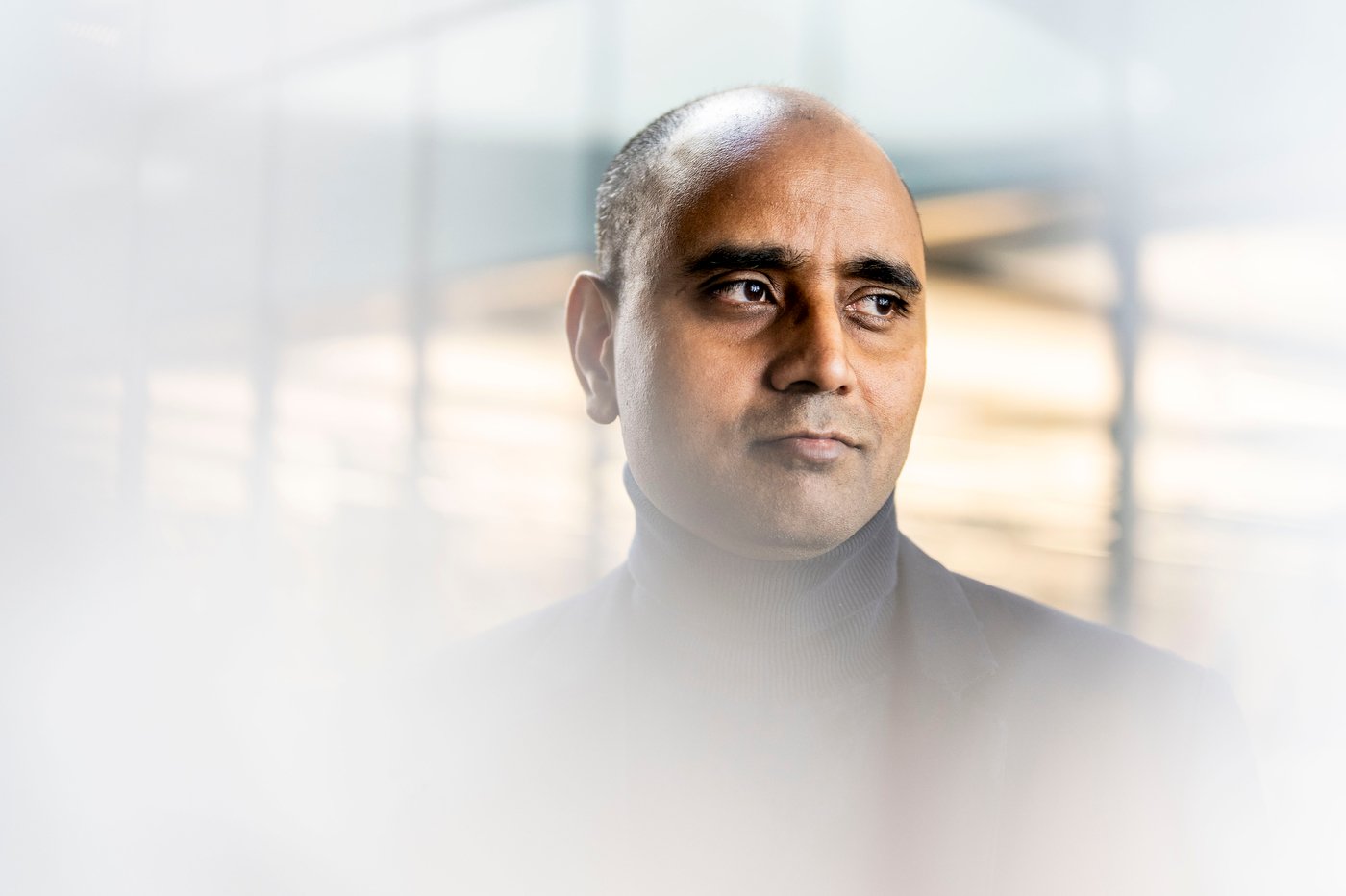
Northeastern University professor Aatmesh Shrivastava, a tenured faculty member of Northeastern’s College of Engineering, has spent his career focused on designing more energy-efficient, low-power circuits to operate sensory interfaces, which are interactive systems that rely on touch, sound or other sensory input as part of the feedback loop. In Shrivastava’s case, it’s movement.
“These sensors know when someone is in the office and the lights turn on. They require sensing modality that sense changes in movement patterns, or in sound,” he said.
An associate professor of electrical and computer engineering, Shrivastava, is one of 230 people to be elected this year as a senior member of the National Academy of Inventors (NAI), an academic member association that recognizes researchers whose work has made an impact on the welfare of society.
There are currently over 4,600 individual NAI members across more than 260 institutions worldwide. The senior member recognition program was launched by the NAI in 2018 and allows member institutions like Northeastern to nominate and recognize innovators on their campuses.
Joining the NAI wasn’t necessarily on Shrivastava’s radar, but when the opportunity landed on his desk, he felt he was more than qualified – so he went for it.
“This ranks quite high among my accomplishments,” Shrivastava said, “I believe there are only around 50 or so members in my specific field.”
Northeastern’s Nian Sun, distinguished professor of electrical and computer engineering, helped nominate Shrivastava to the NAI.
With his 22 granted patents, commercial success and dedication to mentoring the next generation of inventors, Shrivastava is a candidate who embodies the NIA’s mission, Sun said.


“It’s very well deserved, I told him it would be a hands-down easy process – and basically a formality, and that’s how it turned out,” he added.
Still early in his career, and having been at Northeastern for about nine years, Shrivastava decided to pursue the senior member application first, setting his sights on becoming a Fellow, which is the highest professional distinction awarded exclusively to academic inventors, further down the road once he’s worked within Northeastern’s NAI chapter a bit more.
“This year’s senior member class is a truly impressive cohort, said Paul R. Sanberg, president of NAI. “These innovators came from a variety of fields and disciplines, translating their technologies into tangible impact.”
While the circuits in the office setting are smaller scale, it’s larger-scale hubs of those interfaces Shrivastava has now set his sights on. These hubs consist of many sensory interfaces and are referred to as the Internet-of-Things (IoTs). Examples include many of the “smart” devices that are connected to the Internet and are increasingly ubiquitous in our homes, such as automated thermostats or cameras. And depending on the number of functions, they can’t always operate on low amounts of power.
By continuing to develop circuits and chips that are ultra-low-power, or even self-powering, Shrivastava is making it more achievable to reduce the power consumption of those systems.
While the NAI’s mission is to encourage and support research that advances and impacts society, Shrivastava said his work – on a base level – can also apply to just about anyone’s daily life.
“This is one of the most translatable fields in electrical engineering,” he said.
At the same time, Shrivastava is considering more in-depth applications of the research and whether these low-power circuits can one day be used for “more mainstream” applications of artificial intelligence.
At Northeastern, Shrivastava leads a large group of students all working toward this goal. Known as the Energy Efficient Circuits and Systems Group (EECSG), the team started with just two students but has since grown. They work on many pieces of the circuit puzzle, including analog computing software and how to better communicate between system interfaces.
With the company Shrivastava founded in 2024, Think Analog, he also continues to explore how his technology can address the environmental concerns of energy use and be expanded for applications in health care and beyond.
Shrivastava will be formally inducted into the NAI 2026 class of senior members at the organization’s 15th Annual Conference to be held on June 3 at the Loews Hollywood Hotel in Los Angeles.
“I want to thank all the people I’ve worked with, the department [of engineering] in general – and my students – they make it possible for this volume of work to come together,” Shrivastava said.