
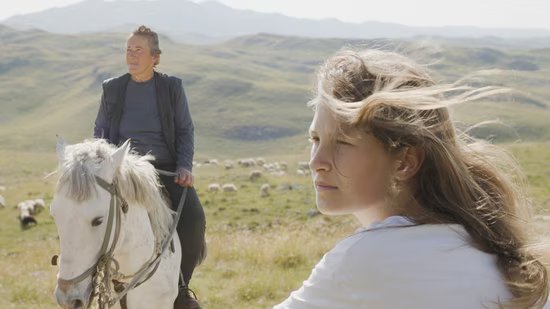
To Hold a Mountain review
Directors: Biljana Tutorov and Petar Glomazić
Star rating: ★★★★
The Sundance Film Festival always surprises with its glorious documentary programming, and this year was no different. I mostly look forward to the non-fiction features to illuminate, shock, and humble me in some manner, and this year, one of those entries was ‘To Hold a Mountain’. (Also read: A female taxi driver forges her way ahead in the Nigerian capital in Lady | Sundance Film Festival review)

The premise
This is a story about a family fighting to protect a mountain in the remote highlands of Montenegro from forces much larger than themselves. It has been said that NATO plans to build a military training ground on the plateau. Helicopters zoom out even when the camera films the middle-aged Gara and her adolescent daughter, Nada. That cannot happen, and Gara is the voice of resistance for the small community nestled in the highlands.
In an early scene, Gara climbs onto a horse at a protest site and declares that this is the land of their ancestors, where they have been raised, and they must fight for their children and for their animals. To Hold a Mountain starts by establishing these factors, and once that is done, it does not divert to the other side. The camera stays right there, with the mother and daughter as they return home and continue living life on the mountain.
What works
Eva Kraljević’s frames are utterly mesmerising, even when they gently follow them inside the rooms as they tend to cattle or wrap themselves up in the blanket at night. It is a warm, delicate little thing- a mother’s love for her child. Nada watches her mother on television, issuing a call for saving what she calls her. The camera lets it be, without feeling the need to ask a question or elicit a response from her. With utmost dignity and respect, the film also unearths the violent family past and reveals that Nada is not really her daughter, but her niece.
To Hold a Mountain is guided with such an unhurried pace and poignancy that it surprised me at times. Was I looking for something more to happen? If yes, then why? What was I expecting? Gara and her community’s resistance lies in their daily livelihood, their day-to-day language of shared ideals. Protest is not 24/7; Gara and Nada also have to survive. How they live their lives is also a form of protest. It is tiresome work, what Gara does through the day at the farm and then at home, and it is high time the viewer sits up and takes note of what lived-in, authentic forms of resistance look like.
Filmmakers Biljana Tutorov and Petar Glomazić are issuing a compassionate call for preservation here, a necessary reminder of how co-dependent human livelihoods are. The documentary is as gentle as it is affecting, as subtle as it is urgent. It subverts and pieces together ideas of what cinéma vérité filmmaking can achieve. The world is packed with forces of apathy and violence, but at home with Gara and Nada, there is safety and care. A mother’s love can move mountains. It is the most beautiful, life-affirming realisation.
Santanu Das is covering the Sundance Film Festival as part of the accredited press.