
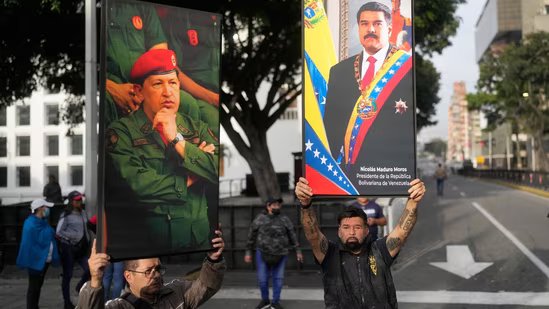
Venezuela’s President Nicolas Maduro is in US custody after President Donald Trump announced that the United States has successfully “captured” him and his wife, Cilia Flores, in dramatically swift military raids in Caracas on Saturday, January 3.
Follow | Updates on US action in Venezuela
US military’s elite Delta Force reportedly took the sitting president from the heart of the capital city and flew him out of the country. This direct US action is the first of its kind in Latin America since the Cold War era.
So far, the global community, barring Russia, has not particularly rallied behind the Communist leader who’s been president of the South American nation since 2013 when he succeeded Hugo Chavez upon his death.
What now happens to Maduro?
For years, the US government has viewed Maduro not as a leader but as a high-level criminal. US authorities have accused him of leading a drug-trafficking group known as the “Cartel of the Suns”. The name comes from the sun-shaped stars that high-ranking Venezuelan military officers wear on their uniforms.
Prosecutors argue that Maduro used his power to flood the US with cocaine as a way to “undermine the health” of the American people.
Also read | Drugs, migrants, regime change? Reasons for Trump’s military action in Venezuela, President Maduro’s ‘capture’
The pressure reached a breaking point recently when the US doubled the bounty for Maduro’s capture to a historic $50 million, following up on a 2020 indictment. Attorney General Pam Bondi said nearly seven tonnes of cocaine was linked directly to Maduro.
Because the US has not recognized Maduro as the legitimate president since 2019, they saw this military mission on Saturday as a “counternarcotics operation” rather than war.
Redux: 1989 capture of Manuel Noriega
To understand Maduro’s likely path, a clue may emerge from 1989-90.
President George HW Bush had sent 20,000 troops into Panama during ‘Operation Just Cause’ to remove military ruler Manuel Noriega at the end of 1989.

The similarities with the Venezuela action of Saturday are numerous, as per a BBC analysis — both Noriega and Maduro claimed victories in elections that many called “rigged”, both were accused of drug trafficking, and both were targeted personally by the US military.
However, the capture of Noriega was much slower than the extraction of Maduro. Noriega hid inside the Vatican’s diplomatic mission for 11 days as US troops surrounded the building. To force him out, the military used psychological warfare by blasting loud rock music at the building day and night.
They played famous songs like ‘Welcome to the Jungle’ by Guns N’ Roses and ‘Paranoid’ by Black Sabbath, NPR reported.
Eventually, the pressure became too much, and Noriega surrendered on January 3, 1990.
What kind of legal battle awaits Maduro in US?
If Maduro follows the Panama parallel, his next stop is a federal courtroom in America.
Panama’s Manuel Noriega was flown to Miami, where he was convicted of drug trafficking, racketeering, and money laundering.
Maduro faces similar legal trouble due to a federal indictment from 2020 in the Southern District of New York. This 28-page legal document charges him with narco-terrorism and conspiracy to import cocaine.
The charges against Maduro are extremely serious and carry heavy penalties. The narco-terrorism count alone has a minimum prison sentence of 20 years and a maximum of life in prison.
He is also accused of working with a violent terrorist group called the ‘FARC’ to move drugs through Venezuela. US Secretary of State Marco Rubio has already confirmed that Maduro is expected to stand trial on these criminal charges.
Will Maduro return, and what next for Venezuela?
Based on the fate of Manuel Noriega, the chances of Maduro returning home are slim at best. After his conviction in the US, Noriega spent the rest of his life in detention. He moved from a US prison to a jail in France, and eventually ended up under house arrest back in Panama. He died in 2017 at the age of 83.
While Maduro is in custody, his home country is in a state of chaos. The Venezuelan government has declared a state of national emergency, and is demanding “proof of life” for their leader.
Defence Minister Vladimir Padrino Lopez has called for a “united front of resistance” against what he calls “imperialist aggression”. He has ordered all armed forces to be deployed across the country to protect the socialist government.
The US has said it plans no further military action in Venezuela.
Who will succeed Maduro?
In Washington, some hope this will allow opposition leaders like Maria Corina Machado or Edmundo Gonzalez to take over. However, the military has long been loyal to Maduro, and there are fears of a civil war.
Among remaining prominent leaders in Venezuela, the first person in line to replace Maduro as per the Venezuelan Constitution would be Delcy Rodriguez, who has served as vice president since 2018. She would be required to call new elections, the New York Times has reported.
Considered Maduro’s right hand, Interior Minister Diosdado Cabello could also make a credible claim to power. A retired lieutenant close to former President Hugo Chavez, Cabello is seen as one of the biggest political winners after Trump’s pressure campaign. He remained stedfast against Trump even as his more moderate rivals favoured an economic and diplomatic truce, NYT reported.